


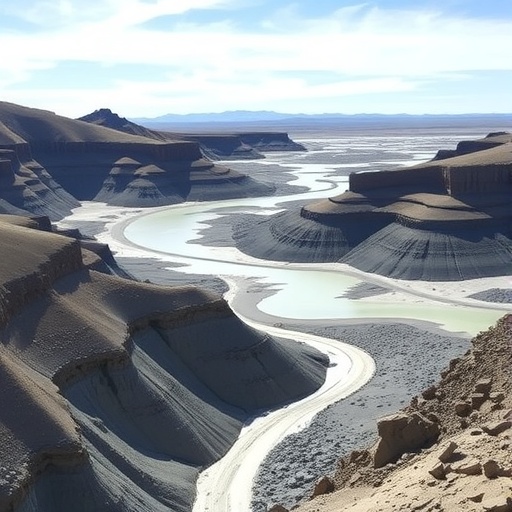
Lithium is often described as the metal powering the clean-energy revolution, but obtaining it from the ground remains one of the most difficult and expensive steps in the battery supply chain. As electric vehicles, grid-scale batteries and renewable-energy systems expand, researchers are looking beyond the industry’s traditional sources: underground brines and hard-rock ores. A new study suggests that clay could become a more competitive source of lithium if the costs of processing it can be significantly reduced.
Published in Communications Earth & Environment, the study by J. Wesselkaemper, T. P. Hendrickson, S. J. Smith and colleagues examines how improvements in processing economics could change the outlook for lithium extraction from clay. Its central message is not that clay is already cheaper than conventional resources, but that the cost gap may be narrowed through optimization. That finding could give the battery industry access to a far broader geological resource base at a moment when concerns about supply, permitting and geopolitical concentration are intensifying.
Lithium-bearing clays are sedimentary materials in which lithium is incorporated into, or attached to, the structure of fine-grained minerals. Unlike the concentrated spodumene ores mined from hard-rock deposits, clay deposits generally contain lithium at lower concentrations and lock it into minerals that do not readily release the element. Unlike brines, where lithium is dissolved in water and can be brought to the surface for chemical separation, clay requires a sequence of physical and chemical treatments before lithium can be recovered.
That difference has historically made clay appear less attractive. Processing may require crushing and grinding the material, heating it to alter its mineral structure, mixing it with chemical reagents, leaching lithium into a solution and then separating impurities. The lithium-bearing solution must subsequently be purified and converted into a usable compound such as lithium carbonate or lithium hydroxide. Every stage consumes energy, water, equipment capacity and chemicals, while also generating residual solids and potentially contaminated process streams. If those costs are too high, a large geological resource may still be commercially irrelevant.
The study focuses on a crucial but sometimes overlooked distinction in resource economics: the size of a deposit does not determine whether it can support a viable mine. What matters is the cost of transforming the material into a saleable product, alongside recovery rates, infrastructure needs, environmental controls and the market value of lithium. By analyzing how processing costs influence competitiveness, the researchers highlight opportunities to improve the entire extraction chain rather than relying on a single technological breakthrough.
One important target is the amount of energy required to prepare clay for leaching. Heating can make lithium easier to extract by changing the arrangement of atoms within clay minerals, but thermal treatment can also become one of the most expensive and carbon-intensive parts of the operation. More efficient reactors, better heat recovery, optimized temperatures and improved control of particle size could reduce the energy needed per unit of lithium recovered. These changes would matter especially in regions where electricity or fuel costs are high, or where mining companies must limit greenhouse-gas emissions.
Chemical use is another major factor. In a leaching process, reagents dissolve lithium from the clay, but they may also dissolve unwanted elements such as iron, aluminum, magnesium or calcium. Removing those impurities can require additional chemicals and separation steps. A process designed to maximize lithium recovery without dissolving excessive amounts of other minerals could reduce both operating costs and waste. The researchers’ analysis points toward this kind of systems-level optimization, in which mineralogy, chemistry, equipment design and energy demand are evaluated together.
Clay resources could also offer strategic advantages that are not captured by a simple comparison of extraction costs. Deposits may be located closer to roads, railways, power networks or existing industrial facilities than some remote hard-rock mines or brine operations. Processing could potentially be integrated with regional chemical manufacturing, creating shorter supply chains for battery materials. At the same time, clay extraction is not automatically low-impact. Large-scale excavation can disturb landscapes, while chemical processing can generate waste and require substantial water. A commercially successful process would therefore need to demonstrate not only lower costs, but also reliable management of water, residues and emissions.
The comparison with brines and hard-rock ores is particularly important because each source has a different cost and environmental profile. Brine operations can use evaporation ponds or direct lithium extraction technologies, depending on the chemistry of the resource, but they may be affected by water scarcity, long production times and complex underground hydrology. Hard-rock mining can produce high-grade ore but requires intensive crushing, concentration and often high-temperature conversion. Clay sits between these categories: it may be abundant and widely distributed, yet technically challenging to process. The study indicates that targeted cost reductions could make that middle ground commercially meaningful.
The implications extend beyond one mining method or one battery market. If clay-derived lithium becomes competitive, manufacturers and governments could gain another option for diversifying supplies and reducing dependence on a limited number of producing regions. However, the research does not suggest that every clay deposit will become economic. Deposit-specific mineralogy, lithium concentration, water availability, energy prices, reagent supply and regulatory standards will determine whether a particular project succeeds. The most promising developments are likely to come from processes tailored to the chemistry of individual deposits rather than from a universal extraction recipe.
The broader lesson is that the future of lithium may depend as much on engineering efficiency as on geological discovery. The world already knows where many lithium-bearing materials are located; the challenge is converting them into battery-grade chemicals at a cost and environmental footprint that society can accept. By showing how processing optimization could improve the competitiveness of clay relative to brines and hard-rock ores, Wesselkaemper and colleagues add a potentially important pathway to the rapidly evolving lithium landscape. As demand for electrification accelerates, even resources once considered too difficult to process may become central to the race for the metal behind the battery boom.
Cite Scienmag News
Faith Mcneil. (August 5, 2026). Lower processing costs could make clay lithium competitive with brines, hard rock. Scienmag. https://scienmag.com/lower-processing-costs-could-make-clay-lithium-competitive-with-brines-hard-rock/
Faith Mcneil. "Lower processing costs could make clay lithium competitive with brines, hard rock." Scienmag, 5 August 2026, https://scienmag.com/lower-processing-costs-could-make-clay-lithium-competitive-with-brines-hard-rock/. Accessed 5 September 2026.
Faith Mcneil. "Lower processing costs could make clay lithium competitive with brines, hard rock." Scienmag. August 5, 2026. https://scienmag.com/lower-processing-costs-could-make-clay-lithium-competitive-with-brines-hard-rock/


