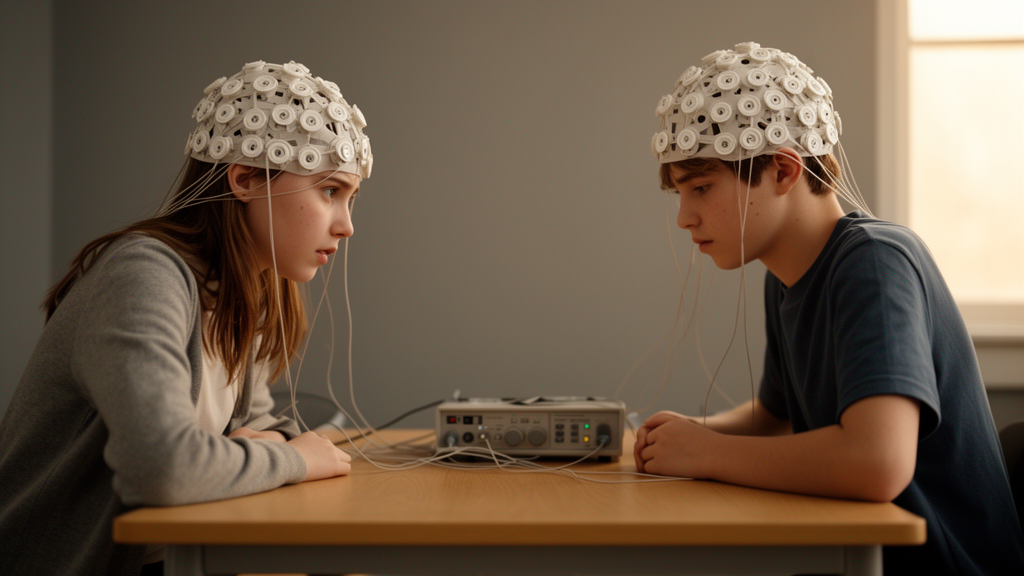
Adolescents with low academic achievement show significantly lower cognitive empathy than peers with adequate performance, according to a comparative study of 40 students aged 14 to 17. The study combined questionnaire measures, a facial emotion recognition test and electroencephalographic recordings to examine how socioemotional processing relates to academic achievement.
The participants were divided into two groups: one with low academic achievement enrolled in a school support programme, and a control group with adequate academic performance. Empathy was assessed with the Basic Empathy Scale, and facial expression recognition was tested directly.
By contrast, the overall between-group difference in facial emotion recognition accuracy was not statistically significant. The researchers caution that the EEG findings should not be read as evidence of a behavioural facial emotion recognition deficit, since the behavioural accuracy measure did not differ significantly between the groups.
The electroencephalographic component used source-level estimates of oscillatory brain activity during facial-expression processing. These exploratory analyses identified between-group differences in task-related activity patterns, offering a complementary electrophysiological perspective on how the two groups process emotional faces. However, the authors stress that these estimates should not be interpreted as specific neural markers of empathy.
The study’s framing rests on prior observations that students with low academic achievement tend to display more maladaptive behaviours in interactions with peers and teachers, and that empathy plays a mediating role in these interactions while also being linked to academic performance. Facial emotion recognition is one component of socioemotional processing that may contribute to empathic responding.
The multimethod design offers complementary perspectives on socioemotional functioning in low-achieving adolescents, but the authors emphasise that the exploratory EEG findings require cautious interpretation and replication in larger, independent samples before any firm conclusions can be drawn about the neural basis of empathy differences in this population.
Subject of Research: Cognitive empathy and EEG activity in low-achieving adolescents
Article Title: Reduced cognitive empathy and differences in EEG activity in low-achieving adolescents
Article References: Hernández-González, S., Gómez-Climent, M. Á., Clemente-Soriano, A., Alba Robles, J. L., Caurín-Alonso, C., & Solbes, J. (2026). Reduced cognitive empathy and differences in EEG activity in low-achieving adolescents. PLOS One, 21(10), e0361520. https://doi.org/10.1371/journal.pone.0361520
Image Credits: AI Generated
DOI: 10.1371/journal.pone.0361520
Keywords: cognitive empathy, adolescents, academic achievement, EEG, facial emotion recognition, socioemotional processing, PLOS One, school support programme, electroencephalography, comparative study, Reduced, cognitive
Cite Scienmag News
Cassandra Pierce. (October 28, 2026). Low-achieving adolescents show reduced cognitive empathy in EEG study. Scienmag. https://scienmag.com/low-achieving-adolescents-show-reduced-cognitive-empathy-in-eeg-study/
Cassandra Pierce. "Low-achieving adolescents show reduced cognitive empathy in EEG study." Scienmag, 28 October 2026, https://scienmag.com/low-achieving-adolescents-show-reduced-cognitive-empathy-in-eeg-study/. Accessed 30 October 2026.
Cassandra Pierce. "Low-achieving adolescents show reduced cognitive empathy in EEG study." Scienmag. October 28, 2026. https://scienmag.com/low-achieving-adolescents-show-reduced-cognitive-empathy-in-eeg-study/