


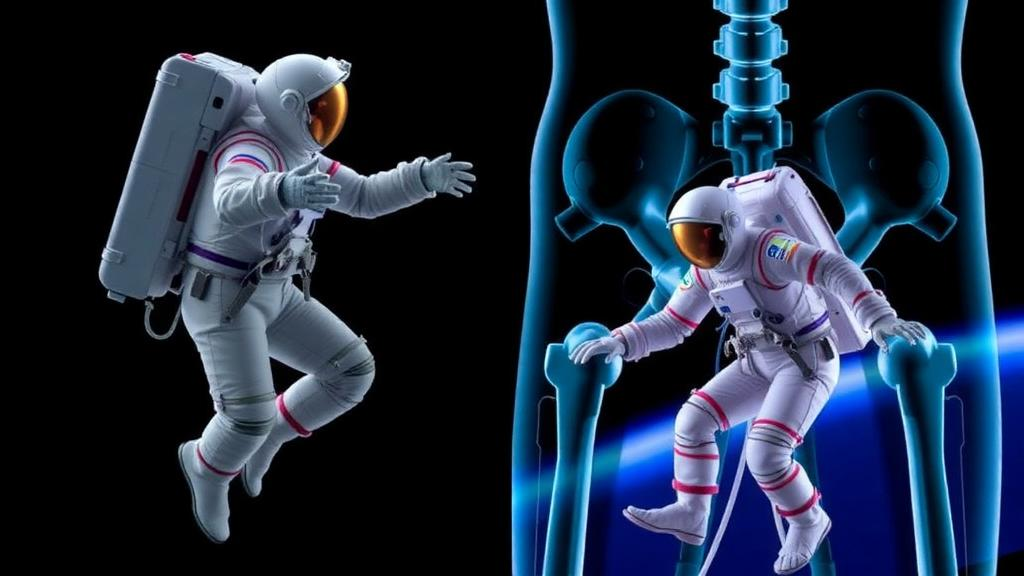
Astronauts who spend more than 90 days in space face a measurably higher rate of hip fractures after returning to Earth than astronauts who fly shorter missions or than people who never leave the planet at all, according to a new peer-reviewed study published in Mayo Clinic Proceedings. The research, led by investigators at NASA’s Johnson Space Center, offers some of the clearest clinical evidence yet that the bone loss triggered by prolonged exposure to microgravity is not merely a temporary inconvenience that resolves once gravity’s pull returns. Instead, it appears to leave a lasting skeletal signature that can translate into real, age-shifted fracture risk years after a mission ends. With NASA preparing for a new era of extended human presence beyond low Earth orbit, the findings arrive at a moment when the question of how to protect astronauts’ bones has shifted from an academic curiosity to an operational priority.
The timing of the study is significant. NASA is currently planning multiple missions with durations exceeding six months in space, spanning commercial activity in low Earth orbit, the Artemis IV mission that will carry the first crewed flight to the lunar south pole in 2028, and the development of sustainable surface capabilities on the moon in preparation for eventual human journeys to Mars. Each of these endeavors will demand more human participation and more cumulative time spent in extraterrestrial environments, and each will draw on crews selected precisely because of their exceptional physical fitness and optimal health. The paradox highlighted by the new research is that the very individuals best equipped to endure the rigors of spaceflight may nonetheless carry forward hidden skeletal vulnerabilities that standard post-flight assessments do not fully capture.
The underlying physiology is well established, even if its long-term consequences have been harder to quantify. Muscle and bone loss in the microgravity environment of space is a common physiologic phenomenon among astronauts, and it is understood as an adaptive response to disuse. In the absence of gravitational loading, the skeleton receives far less mechanical stimulation than it does on Earth, and the body responds by reducing bone formation while resorption continues, gradually eroding bone mass and altering the internal architecture of load-bearing structures such as the hip. What makes this process insidious, as lead investigator Jean D. Sibonga, PhD, of NASA’s Johnson Space Center has noted, is that humans do not feel the effects of bone loss. An astronaut can return from space, feel stable, and even believe themselves fully recovered, then resume physically demanding activities despite underlying skeletal changes caused by prolonged disuse.
That disconnect between how astronauts feel and what their bones can actually withstand is central to why the new findings matter. A better understanding of bone health after spaceflight, the researchers argue, could help astronauts, patients, and clinicians assess long-term health concerns, determine appropriate care, and reduce the risk of injury. The hip is a particularly consequential site in this regard. Hip fractures are among the most serious fragility fractures in any population, associated with substantial morbidity, long recovery periods, and elevated mortality risk, especially when they occur at ages earlier than typical. A fracture rate that rises after long-duration flight, and that emerges at younger ages than would be expected in the general terrestrial population, therefore represents a warning signal that extends well beyond the immediate post-mission period.
One of the persistent obstacles in spaceflight medicine has been the sheer difficulty of gathering statistically robust data. Matthew T. Drake, MD, PhD, of the Endocrinology and Metabolic Bone Disease Service at the Hospital for Special Surgery in New York, and co-author of an accompanying editorial in the same journal, observed that while data to date on bone loss associated with spaceflight are consistent, a major limitation is accuracy, because astronaut cohort sample sizes are small and spaceflights are rare. With only a few hundred people having ever flown in space, and only a subset of those undertaking missions longer than 90 days, conventional epidemiological comparisons often lack the statistical power to detect meaningful differences in fracture outcomes. Small cohorts and rare events make it easy for real effects to hide within the noise.
To overcome this statistical limitation, the investigators took a different analytical approach. They surveyed a cohort of US-based astronauts for all fractures reported during annual clinical exams, assembling a longitudinal record of skeletal outcomes across careers that spanned missions of varying lengths. They then analyzed these data using Bayesian probabilistic modeling, a framework that allows researchers to draw more stable inferences from small samples by incorporating prior knowledge and quantifying uncertainty explicitly. The results were striking in their specificity. While the study did not find a higher incidence rate for fractures in general, the incidence rate for hip fractures in astronauts was increased after a long-duration spaceflight of more than 90 days. The effect was not a diffuse elevation of injury risk across the skeleton, but a concentrated signal at one of the body’s most mechanically critical sites.
Two features of that signal stand out. First, the increased hip fracture rate occurred at a younger age than would be expected in a non-astronaut terrestrial population, meaning astronauts were experiencing these injuries earlier in life than standard fracture epidemiology would predict. Second, the rate was greater than the rate observed before a long-duration mission, or with no spaceflight exposure at all, which points to the spaceflight itself, rather than age or occupational hazards alone, as the differentiating factor. Moshe Gertzulin, MD, also of the Endocrinology and Metabolic Bone Disease Service at the Hospital for Special Surgery and co-author of the accompanying editorial, summarized the implication: taken together, the finding of hip fracture occurrence at an age earlier than expected after long-duration spaceflight is clinical evidence that spaceflight-induced bone loss can lead to real long-term fracture consequences, which should be addressed accordingly.
The study’s authors argue that these conclusions carry direct implications for how space agencies monitor skeletal health. Dr. Sibonga emphasized the need to expand NASA’s current bone surveillance program beyond dual-energy X-ray absorptiometry, or DXA, measurements of bone mineral density, the long-standing standard for assessing skeletal status. DXA provides a two-dimensional summary of density but offers limited insight into the three-dimensional structure of bone, which is increasingly recognized as a critical determinant of fracture resistance. NASA has recently begun ordering quantitative computed tomography scans before and after spaceflight, a modality that can provide more detailed information about different areas of the bone and about whether astronauts have truly fully recovered. Without that finer-grained insight, astronauts could risk placing too much strain on bones that have not yet regained their preflight condition, precisely the scenario in which a fragility fracture is most likely to occur.
Beyond surveillance, the investigators advocate for prophylactic countermeasures designed to preserve the baseline, pre-flight skeletal health of the astronaut, rather than attempting to reverse damage after the fact. A fuller characterization of spaceflight-induced changes to bone mass, density, structure, and microarchitecture will determine which interventions, whether pharmaceutical agents, exercise regimens, or dietary adjustments, are most beneficial for long-term skeletal health. Current in-flight countermeasures centered on resistive exercise have slowed but not fully prevented bone deterioration on long missions, and the new fracture data suggest that residual deficits matter over timescales of years, not weeks. Identifying the right combination of countermeasures before crews embark on months-long lunar surface stays and multi-year Mars transits could mean the difference between a mission that ends with healthy crews and one that seeds decades of orthopedic problems.
The broader significance of the study extends beyond the astronaut corps. The disuse-related bone loss that astronauts experience is, in essence, an accelerated model of the immobilization and unloading that affects patients on Earth, from those confined to bed rest to individuals with spinal cord injuries or age-related osteoporosis. Insights gained from studying spaceflight-induced skeletal changes, and from the advanced imaging and modeling techniques being deployed to study them, may inform how clinicians on Earth assess and manage fragility in their own patients. For now, the message from Mayo Clinic Proceedings is unambiguous: the skeleton keeps a record of every day spent in microgravity, and for missions longer than 90 days, that record includes a heightened risk of hip fracture that surfaces earlier in life than anyone would want. As humanity prepares to spend longer stretches of time on the moon and beyond, safeguarding the bones that carry astronauts home has become a scientific challenge worthy of the ambition of the missions themselves.
Subject of Research: Long-duration spaceflight-induced bone loss and hip fracture risk in astronauts
Article Title: Study links 90+-day spaceflights to higher rates of hip fractures in astronauts
Article References: Study links 90+-day spaceflights to higher rates of hip fractures in astronauts. (n.d.). Original publication
Image Credits: AI Generated
DOI: Not provided
Keywords: astronauts, hip fracture, bone loss, microgravity, spaceflight, NASA, Mayo Clinic Proceedings, bone mineral density, quantitative computed tomography, osteoporosis, Artemis, space medicine
Cite Scienmag News
Ophelia Keating. (October 1, 2026). Long Spaceflights Tied to Higher Hip Fracture Risk in Astronauts. Scienmag. https://scienmag.com/long-spaceflights-tied-to-higher-hip-fracture-risk-in-astronauts/
Ophelia Keating. "Long Spaceflights Tied to Higher Hip Fracture Risk in Astronauts." Scienmag, 1 October 2026, https://scienmag.com/long-spaceflights-tied-to-higher-hip-fracture-risk-in-astronauts/. Accessed 4 October 2026.
Ophelia Keating. "Long Spaceflights Tied to Higher Hip Fracture Risk in Astronauts." Scienmag. October 1, 2026. https://scienmag.com/long-spaceflights-tied-to-higher-hip-fracture-risk-in-astronauts/


