

Monday, October 26, 2026
Science
No Result
View All Result
  • Login
  • HOME
  • SCIENCE NEWS
  • CONTACT US
  • HOME
  • SCIENCE NEWS
  • CONTACT US
No Result
View All Result
Scienmag
No Result
View All Result
Home Science News Biology

Little Foot fossils reveal a major shift toward terrestrial movement

October 26, 2026
in Biology
Drew Townsend
By Drew Townsend Scienmag Editorial Profile - Cell Biology
Reading Time: 2 mins read
0
Little Foot fossils reveal a major shift toward terrestrial movement

Little Foot fossils reveal a major shift toward terrestrial movement

65
SHARES
587
VIEWS
Share on FacebookShare on Twitter
ADVERTISEMENT

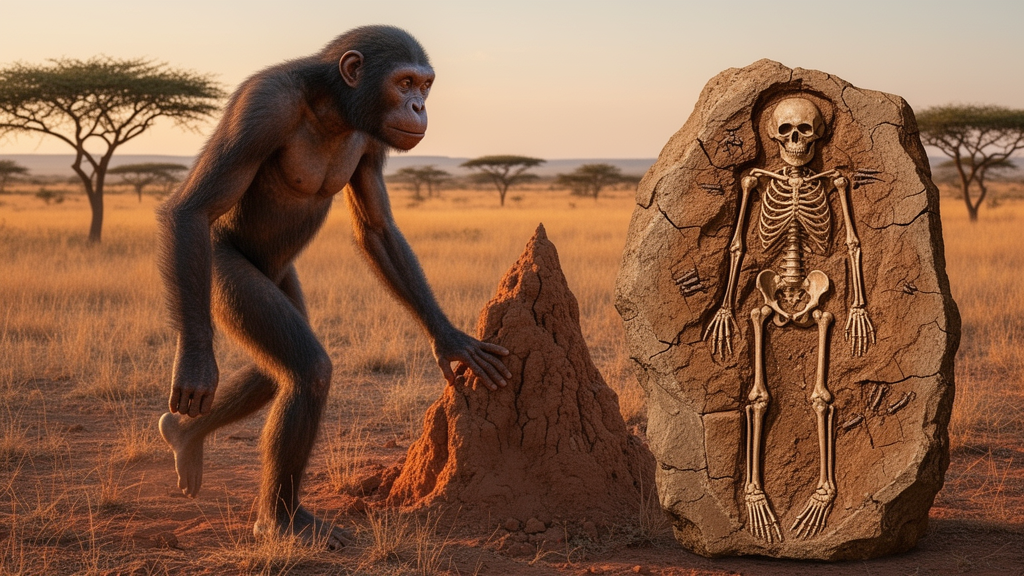
A comparison of limb bones from the approximately 3.67-million-year-old Little Foot skeleton and other fossil hominins indicates that Australopithecus combined substantial tree climbing with regular upright walking, while early Homo had shifted toward life on the ground by about 1.8 million years ago. The peer-reviewed study, published in Science Advances, assessed relative bone strength in the arms and legs of fossil ancestors alongside modern humans and living apes, finding evidence of a pronounced change in how the human lineage used its limbs.

Researchers from the University of the Witwatersrand’s Evolutionary Studies Institute and Sterkfontein Caves research programme, with international collaborators, added measurements from Little Foot, formally designated StW 573, and compared them with fossils from Dmanisi in Georgia dating to about 1.8 million years ago. The analysis considered the strength of arm and thigh bones as well as patterns within the lower limbs. Little Foot and other Australopithecus specimens retained relatively strong arms compared with their thighs, a pattern resembling African apes more closely than modern humans. Because climbing and other weight-bearing activities in trees place substantial demands on the upper limbs, the researchers interpreted this distribution of bone strength as evidence that Australopithecus regularly relied on trees.

Little Foot’s lower limbs, however, displayed a more modern human-like relationship between the strength of the thigh and lower-leg bones. This combination—ape-like relative arm strength paired with a human-like lower-limb pattern—suggests a distinctive form of locomotion. The authors concluded that these ancestors did not move simply like modern chimpanzees or modern humans. Instead, they appear to have combined frequent movement in trees with habitual bipedalism on the ground, a behavioral mixture for which no living species provides a direct analogue. The result also shows that bipedal walking did not necessarily entail abandoning climbing.

In contrast, the Dmanisi fossils and other specimens attributed to early Homo and Homo erectus exhibited limb-strength patterns much closer to those of modern humans. The researchers interpret these findings as evidence that, by roughly 1.8 million years ago, members of the human lineage were more strongly committed to terrestrial bipedalism and used trees much less. They propose that this transition may represent a threshold separating the adaptive patterns of Australopithecus from those of Homo. The timing overlapped with a broad period of increasing brain size in the human lineage, but the study does not establish that changes in locomotion, ranging behavior or brain size directly caused one another. The cause of the shift remains uncertain, with possible links to changes in ranging, food gathering and other selective pressures favoring stronger lower limbs and greater dependence on the ground. The bone-strength evidence supports the proposed behavioral difference, but it does not by itself reveal the full range of activities undertaken by these ancestors.

Subject of Research: Fossil evidence for changes in hominin tree climbing and terrestrial bipedalism between about 3 million and 1.8 million years ago

Article Title: Little Foot study points to major shift in how human ancestors moved

Article References: Little Foot study points to major shift in how human ancestors moved. Original publication (Bibliographic details unavailable.)

Image Credits: AI Generated

DOI: Not provided

Keywords: Little Foot, Australopithecus, early Homo, Homo erectus, hominin locomotion, bipedalism, tree climbing, fossil bone strength, Dmanisi fossils, human evolution, Little, Foot

Cite Scienmag News

Drew Townsend. (October 26, 2026). Little Foot fossils reveal a major shift toward terrestrial movement. Scienmag. https://scienmag.com/little-foot-fossils-reveal-a-major-shift-toward-terrestrial-movement/

Drew Townsend. "Little Foot fossils reveal a major shift toward terrestrial movement." Scienmag, 26 October 2026, https://scienmag.com/little-foot-fossils-reveal-a-major-shift-toward-terrestrial-movement/. Accessed 26 October 2026.

Drew Townsend. "Little Foot fossils reveal a major shift toward terrestrial movement." Scienmag. October 26, 2026. https://scienmag.com/little-foot-fossils-reveal-a-major-shift-toward-terrestrial-movement/


Tags: AustralopithecusAustralopithecus limb bonesAustralopithecus vs modern humansbipedalismbone strength comparison in fossilsDmanisi fossilsearly HomoEarly human evolutionevolution of limb use in homininsfootfossil analysis of Little Footfossil bone strengthhominin locomotionHomo erectushuman evolutionimpact of locomotion on skeletal developmentLittleLittle Footterrestrial movement in homininstransition from arboreal to terrestrial lifestyletree climbingtree climbing adaptationsupright walking in early humans
Share26Tweet16
Previous Post

CRISPR nanodroplet assay identifies NTM species in human samples within four hours

Next Post

UK surgical physician associates report confidence amid anxiety and online harassment

Related Posts

CRISPR nanodroplet assay identifies NTM species in human samples within four hours
Biology

CRISPR nanodroplet assay identifies NTM species in human samples within four hours

October 26, 2026
Takahashi wins 2026 prize for iPS cell Parkinson’s therapy
Biology

Takahashi wins 2026 prize for iPS cell Parkinson’s therapy

October 26, 2026
Mouse aging-rate indicators could speed anti-aging drug screening
Biology

Mouse aging-rate indicators could speed anti-aging drug screening

October 26, 2026
Pediatric glioma proteogenomics identifies age-linked targets, not therapies
Biology

Pediatric glioma proteogenomics identifies age-linked targets, not therapies

October 26, 2026
Study Reveals How p53-Mutant Tumors Hide From T Cells
Biology

Study Reveals How p53-Mutant Tumors Hide From T Cells

October 26, 2026
Cell benchmark study finds specialized AI matches frontier models in aging biology
Biology

Cell benchmark study finds specialized AI matches frontier models in aging biology

October 26, 2026
Next Post
UK surgical physician associates report confidence amid anxiety and online harassment

UK surgical physician associates report confidence amid anxiety and online harassment

  • Mothers who receive childcare support from maternal grandparents show more optimized

    Mothers who receive childcare support from maternal grandparents show more parental warmth, finds NTU Singapore study

    27656 shares
    Share 11059 Tweet 6912
  • University of Seville Breaks 120-Year-Old Mystery, Revises a Key Einstein Concept

    1061 shares
    Share 424 Tweet 265
  • Bee body mass, pathogens and local climate influence heat tolerance

    682 shares
    Share 273 Tweet 171
  • Researchers record first-ever images and data of a shark experiencing a boat strike

    546 shares
    Share 218 Tweet 137
  • Groundbreaking Clinical Trial Reveals Lubiprostone Enhances Kidney Function

    531 shares
    Share 212 Tweet 133
Science

Embark on a thrilling journey of discovery with Scienmag.com—your ultimate source for cutting-edge breakthroughs. Immerse yourself in a world where curiosity knows no limits and tomorrow’s possibilities become today’s reality!

RECENT NEWS

  • Hairy-root perilla yields more shikonin and comparable luteolin
  • UK surgical physician associates report confidence amid anxiety and online harassment
  • Little Foot fossils reveal a major shift toward terrestrial movement
  • CRISPR nanodroplet assay identifies NTM species in human samples within four hours

Categories

  • Agriculture
  • Anthropology
  • Archaeology
  • Athmospheric
  • Biology
  • Biotechnology
  • Blog
  • Bussines
  • Cancer
  • Chemistry
  • Climate
  • Earth Science
  • Editorial Policy
  • Marine
  • Mathematics
  • Medicine
  • Pediatry
  • Policy
  • Psychology & Psychiatry
  • Science Education
  • Science News
  • Social Science
  • Space
  • Technology and Engineering

Subscribe to Blog via Email

Enter your email address to subscribe to this blog and receive notifications of new posts by email.

Join 5,151 other subscribers

© 2025 Scienmag - Science Magazine

Welcome Back!

Login to your account below

Forgotten Password?

Retrieve your password

Please enter your username or email address to reset your password.

Log In
No Result
View All Result
  • HOME
  • SCIENCE NEWS
  • CONTACT US

© 2025 Scienmag - Science Magazine

Discover more from Science

Subscribe now to keep reading and get access to the full archive.

Continue reading