


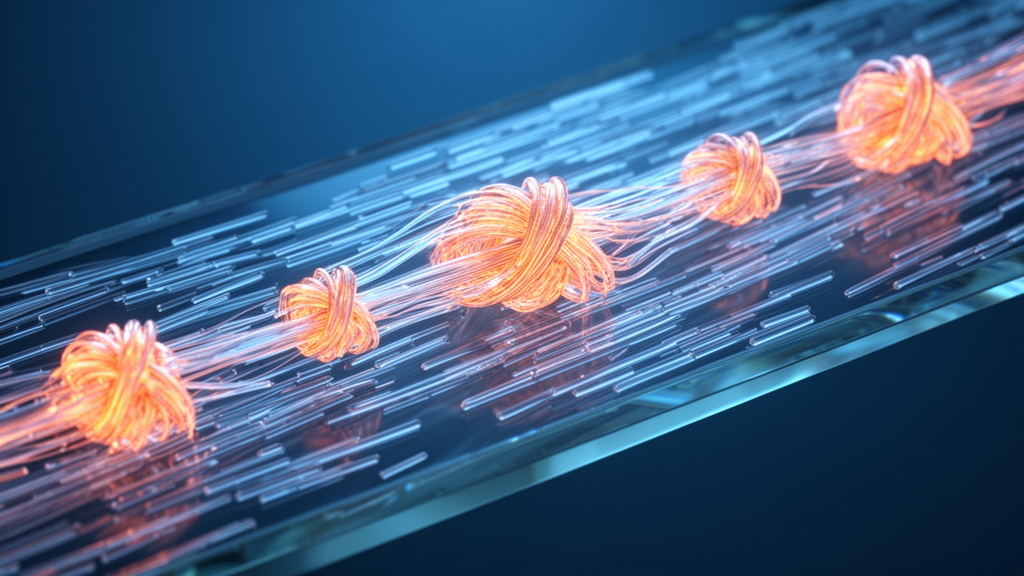
Topological solitons have long been celebrated as some of the most striking manifestations of topology in physics, appearing everywhere from particle theory to condensed-matter systems. In magnets, skyrmions—whirl-like spin textures carrying a conserved topological charge—are known to deflect sideways when pushed by an electric current, a phenomenon called the skyrmion Hall effect. A new study published in Nature Physics by Rodrigo C. V. Coelho, Hanqing Zhao, Guilherme N. C. Amaral, Ivan I. Smalyukh, Margarida M. Telo da Gama and Mykola Tasinkevych demonstrates that an analogous effect arises in a completely different physical setting: chiral liquid crystals. When these soft materials are subjected to shear flow, their embedded topological solitons drift transversely, away from the direction of the imposed shear, in a behavior the authors describe as a liquid-crystal analogue of the skyrmion Hall effect.
The solitons at the heart of the study are torons and skyrmion tubes, particle-like configurations of the director field—the local orientation of rod-like molecules—in chiral nematic liquid crystals. In these materials, the director twists with a characteristic pitch set by the molecular chirality, and defects or twisted regions can lock together into stable, localized structures that behave in many ways like particles. Torons, in particular, are triple-twisted, particle-like excitations confined between two bounding glass plates of a liquid-crystal cell. Because their topology is conserved, they cannot simply dissolve into the uniform background; instead, they persist as mobile objects that can be created, moved, and manipulated, for example with laser tweezers.
The experimental team, led by Smalyukh’s group at the University of Colorado Boulder, created individual torons in thin cholesteric cells and then imposed a controlled shear flow by translating one glass plate relative to the other. Using polarization optical microscopy, the researchers tracked the soliton trajectories as the shear rate varied. At low driving speeds, the torons moved essentially along the shear direction, but as the flow intensified, they acquired an increasingly pronounced transverse velocity component, deflecting away from the shear plane much as charged particles deflect in a magnetic field or magnetic skyrmions deflect under current. The team quantified this deflection with a Hall angle, which grew with the Ericksen number, a dimensionless parameter comparing viscous and elastic stresses in the liquid crystal.
Crucially, the experiments revealed that the solitons are not passive tracers of the surrounding fluid. The researchers simultaneously tracked small tracer particles—melamine resin spheres and alumina nanoplates—suspended in the liquid crystal. These tracers, which sample the local flow field, showed no detectable transverse motion across a wide range of shear rates. The torons, by contrast, drifted sideways far more strongly than any underlying transverse mass flow could explain. This discrepancy between the motion of the soliton and the motion of the fluid around it is the central puzzle that the theoretical and numerical parts of the study set out to resolve.
On the theory side, the Lisbon-based team performed a systematic perturbation analysis of the Ericksen–Leslie equations, the continuum description of nematic liquid-crystal hydrodynamics. Treating the shear as a weak perturbation of the static toron configuration, they computed the corrections to the director and velocity fields order by order. Their analysis predicts a weak net transverse mass flow that emerges only at third order in the perturbation parameter, meaning its magnitude scales as the cube of the shear rate. This cubic scaling reflects the nonlinear coupling between director distortion and flow that is characteristic of liquid-crystal rheology, where backflow effects link molecular orientation and fluid motion.
Numerical simulations based on a lattice Boltzmann implementation of the coupled director and flow dynamics confirmed and extended the analytical picture. The simulations reproduced the transverse drift of torons under steady shear, captured the deformation of the soliton as it elongates into finger-like shapes at higher shear rates, and even showed the instability and eventual destruction of torons at very large Ericksen numbers. Importantly, the simulations revealed that in certain parameter regimes the soliton’s transverse motion occurs opposite to the direction of the net transverse mass current predicted by the perturbation theory—a striking result that rules out any simple explanation in which the soliton is merely carried along by a secondary flow.
To rationalize these observations, the authors adapted the Thiele equation, a classical framework developed in the 1970s to describe the steady-state motion of magnetic domains. In its original form, the Thiele equation balances the driving force on a topological soliton against dissipative drag and a gyroscopic term that produces the transverse deflection responsible for the magnetic skyrmion Hall effect. The liquid-crystal version developed in this work replaces the magnetic gyrovector with a term tied to the flow vorticity—the local rotational component of the shear flow surrounding the soliton. This formulation provides a compact physical explanation: it is the vorticity of the backflow generated around the distorted director texture, rather than any net transverse current, that pushes the soliton sideways.
The generality of the effect was tested in several ways. Simulations of skyrmion tubes—solitons that extend through the cell thickness—showed Hall angles comparable to those of torons under identical conditions, and even more complex objects such as skyrmion bags containing multiple antiskyrmions exhibited the same qualitative behavior, with Hall angles of roughly nine to twelve degrees depending on their internal structure. The researchers also examined how boundary conditions at the glass plates influence the effect: tilting the surface anchoring of the director changes both the magnitude and, in some regimes, the sign of the Hall angle. Experiments under a sinusoidal electric field, which stabilizes the solitons against flow-induced distortion, showed torons with Hall angles of about ten degrees, and occasionally small negative angles corresponding to deflection in the opposite transverse direction.
Beyond its fundamental interest, the discovery suggests practical possibilities. Because the transverse drift is controllable—through shear rate, cell geometry, surface anchoring, and applied electric fields—topological solitons in liquid crystals could serve as functional building blocks in microfluidic technologies, acting as self-propelled carriers or as reconfigurable elements whose trajectories are steered by flow rather than by external fields alone. The effect also deepens the analogy between soft matter and magnetic systems, showing that Hall-like dynamics of topological excitations is not tied to electromagnetism or spin, but follows generally from the interplay of topology, dissipation, and vorticity in driven media.
The study, which received support from the Portuguese Foundation for Science and Technology, FAPERJ, CNPq, and the US Department of Energy, establishes a new arena in which the concepts of topological transport can be explored in a soft, transparent, and easily manipulated medium. As the authors show, a simple equation inspired by magnetism, combined with detailed experiments and large-scale simulations, is enough to capture the essence of the phenomenon: when you shear a chiral liquid crystal, its topological solitons refuse to follow the flow—they sidestep it.
Subject of Research: Hall-like transverse drift of topological solitons in sheared chiral liquid crystals
Article Title: A liquid-crystal analogue of the skyrmion Hall effect
Article References: Coelho, R. C. V., Zhao, H., Amaral, G. N. C., Smalyukh, I. I., Telo da Gama, M. M., & Tasinkevych, M. (2026). A liquid-crystal analogue of the skyrmion Hall effect. Nature Physics. https://doi.org/10.1038/s41567-026-03379-0
Image Credits: AI Generated
DOI: 10.1038/s41567-026-03379-0
Keywords: liquid crystals, skyrmions, topological solitons, torons, shear flow, Hall effect, Ericksen-Leslie theory, Thiele equation, microfluidics, soft matter, lattice Boltzmann simulations, cholesteric liquid crystals
Cite Scienmag News
Katie Riggs. (October 19, 2026). Liquid Crystal Solitons Show a Hall-Like Drift Under Shear Flow. Scienmag. https://scienmag.com/liquid-crystal-solitons-show-a-hall-like-drift-under-shear-flow/
Katie Riggs. "Liquid Crystal Solitons Show a Hall-Like Drift Under Shear Flow." Scienmag, 19 October 2026, https://scienmag.com/liquid-crystal-solitons-show-a-hall-like-drift-under-shear-flow/. Accessed 19 October 2026.
Katie Riggs. "Liquid Crystal Solitons Show a Hall-Like Drift Under Shear Flow." Scienmag. October 19, 2026. https://scienmag.com/liquid-crystal-solitons-show-a-hall-like-drift-under-shear-flow/


