


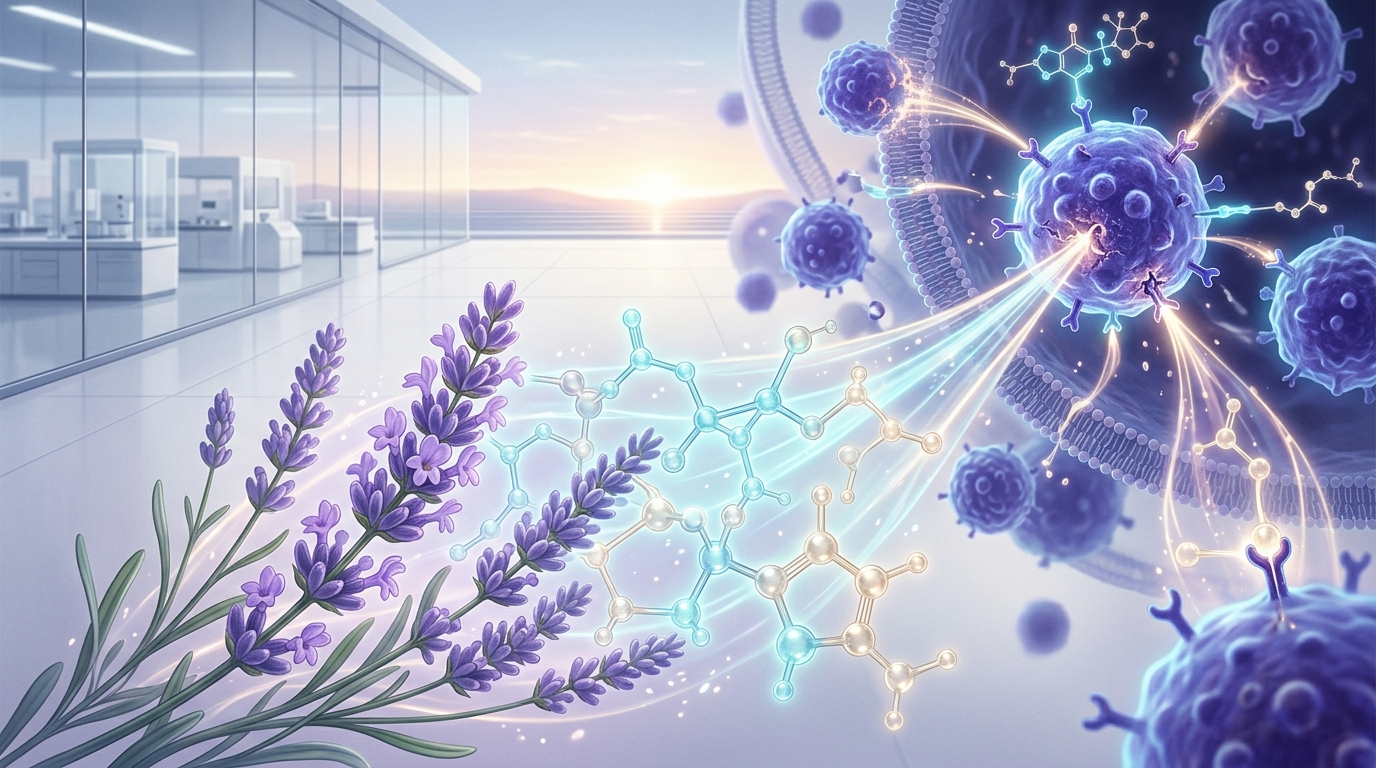
Linalool, a volatile monoterpene found in many aromatic plants, has attracted sustained attention for its ability to interfere with cancer cells through several molecular targets at once. A review published in Medical Oncology in November 2026 now brings together the evidence on this compound’s anticancer potency, the mechanisms proposed to explain it, and the practical obstacles that still stand between laboratory findings and clinical use. The authors, led by V. Nandana and V. M. Berlin Grace, systematically collected research published between 2000 and 2025, capturing both foundational work and recent advances on linalool’s activity against malignancies.
The review’s central conclusion is that linalool demonstrates meaningful anticancer effects across a range of cancer types, but with notable variation in potency. The authors report that low IC50 values, indicating stronger cytotoxic effects at lower concentrations, were observed in leukaemia, cervical, oral and prostate cancer cells. By contrast, the compound showed relatively weaker activity in more resistant models, including lung and colorectal cancers. This pattern suggests that linalool’s effectiveness depends heavily on the specific cellular context, a finding that the authors argue should guide future research toward the malignancies where the compound performs best.
What makes linalool interesting to researchers is not simply that it kills cancer cells, but how it does so. According to the review, the compound modulates numerous molecular activities and signalling pathways, with evidence drawn from both in vitro cell studies and in vivo animal experiments. The authors also cite in silico molecular docking studies showing that linalool binds with measurable affinity to signalling proteins, providing a computational complement to the experimental observations. This multi-targeted profile distinguishes linalool from agents designed to hit a single molecular vulnerability, and it may help explain why the compound retains activity across several distinct malignancies.
Safety data, while encouraging, remain narrow. The review notes that cytotoxicity studies have reported insignificant levels of toxicity toward non-cancerous cells, suggesting some selectivity for malignant tissue. However, the authors are careful to state that this evidence is limited to specific experimental models. In other words, the apparent safety margin has not been demonstrated across the broad range of cell types and animal systems that would be needed before any confident prediction about human tolerability could be made.
The more serious barriers to clinical translation are pharmacological rather than mechanistic. Linalool is highly volatile and poorly soluble in water, two properties that complicate formulation and delivery. Pre-clinical studies have also reported limited in vivo bioavailability, meaning that only a small fraction of an administered dose may reach target tissues in an active form. The review highlights inadequate in vivo validation and scarce intravenous delivery data as further gaps. Perhaps most importantly, no clinical trials of linalool as an anticancer agent have been conducted, leaving the compound without any human efficacy or safety data.
Nanoformulation emerges from the review as the most promising route around these physicochemical limitations. The authors describe advances involving lipid-based and gold-based nanoparticles that have improved linalool’s in vivo stability, bioavailability and targeted distribution. In pre-clinical models, these nanocarrier systems also enhanced anticancer activity while reducing toxicity. By encapsulating the volatile molecule within a delivery vehicle, researchers can protect it from degradation, improve its solubility and potentially direct it toward tumour tissue. The review frames this strategy as a credible path to making linalool pharmacologically viable, though all such results remain at the pre-clinical stage.
The authors are explicit about what these findings do and do not establish. Linalool shows consistent multi-pathway anticancer activity in vitro and in vivo, and nanocarrier formulations offer a promising strategy to address its physicochemical limitations. But given the scarcity of pharmacokinetic, toxicity and clinical efficacy data in humans, they conclude that substantial translational and clinical research is needed before any therapeutic potential can be established. The review calls for clear potency benchmarks, molecular target identification and bioavailability data specific to each cancer type, generated through adequate cell and animal models, as prerequisites for advancing toward clinical trials.
For researchers in natural product oncology, the review serves as both a summary of two decades of work and a roadmap for what comes next. The compound’s multi-targeted mechanism, its selectivity in early cytotoxicity screens and the progress in nanoparticle delivery form a coherent pre-clinical case. What is missing is everything that separates a laboratory compound from a medicine: human pharmacokinetics, defined toxicity profiles and evidence of clinical benefit. Until those data exist, linalool remains a promising research subject rather than a treatment option, and the review makes clear that closing that gap will require far more than the encouraging cell and animal results accumulated so far.
Subject of Research: The anticancer mechanisms, potency and translational barriers of the natural monoterpene linalool
Article Title: Linalool as a multi-targeted natural anticancer agent: review on molecular mechanisms, potency, limitations and prospects of translation
Article References: Nandana, V., Wilson, D. D., Jenitha, V., Raj, G. M., Kokelavani, N. B., Srividhya, M., & Berlin Grace, V. M. (2026). Linalool as a multi-targeted natural anticancer agent: review on molecular mechanisms, potency, limitations and prospects of translation. Medical Oncology, 43(12), Article 363. https://doi.org/10.1007/s12032-026-03487-0
Image Credits: AI Generated
DOI: 10.1007/s12032-026-03487-0
Keywords: linalool, monoterpene, anticancer, nanoformulation, bioavailability, molecular docking, preclinical, cancer research, natural products, drug delivery, multi-targeted, natural
Cite Scienmag News
Nathaniel Bowman. (November 4, 2026). Linalool Shows Multi-Target Anticancer Activity, But Clinical Translation Remains Distant. Scienmag. https://scienmag.com/linalool-shows-multi-target-anticancer-activity-but-clinical-translation-remains-distant/
Nathaniel Bowman. "Linalool Shows Multi-Target Anticancer Activity, But Clinical Translation Remains Distant." Scienmag, 4 November 2026, https://scienmag.com/linalool-shows-multi-target-anticancer-activity-but-clinical-translation-remains-distant/. Accessed 4 November 2026.
Nathaniel Bowman. "Linalool Shows Multi-Target Anticancer Activity, But Clinical Translation Remains Distant." Scienmag. November 4, 2026. https://scienmag.com/linalool-shows-multi-target-anticancer-activity-but-clinical-translation-remains-distant/




