Doctors in Tokyo have reported an unusual skin reaction in a 7-year-old boy who developed blistering and lasting pigmentation on his hands after squeezing limes and then bathing in seawater in the sun. The case, published in the Journal of Cutaneous Immunology and Allergy, is described by its authors as the first reported instance of lime-induced phytophotodermatitis in a Japanese child.
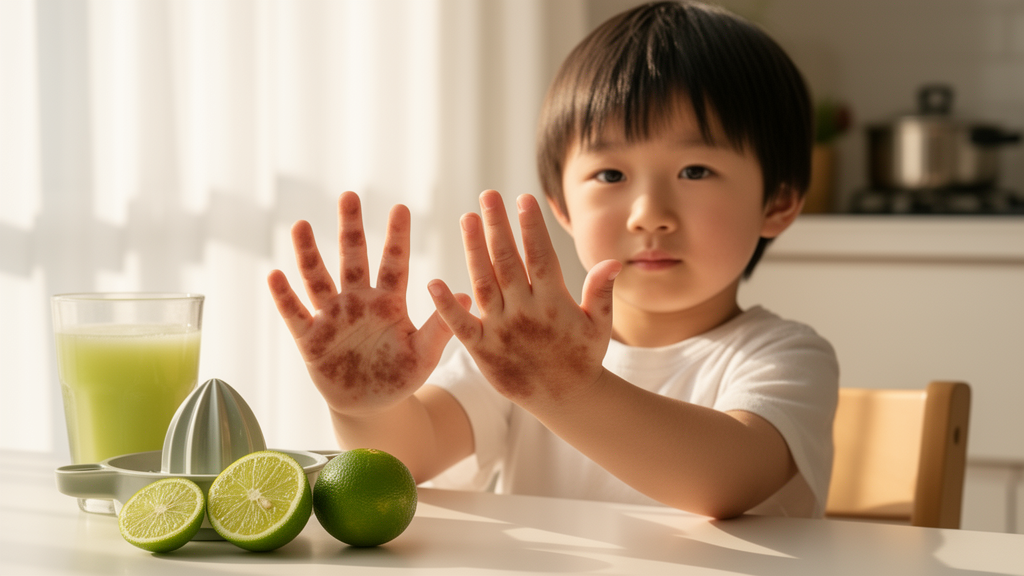
The boy, who had a history of food allergies and atopic dermatitis, presented to the Allergy Center and Division of Dermatology at the National Center for Child Health and Development with a one-month history of a hand eruption. Four days before the skin lesions first appeared, he had squeezed limes. Three days before onset, he squeezed limes again and then bathed in seawater while exposed to sunlight.
Erythematous lesions first appeared on the dorsal aspects of both thumbs and index fingers and subsequently developed into small vesicles, without itching or pain. Notably, no skin lesions appeared on other sun-exposed areas or lime-exposed areas, including the face, neck, lower extremities, or palms. There was also no history of exposure to potential contact allergens, such as rubber products, before the lesions developed.
By the time the boy was examined, the erythema and vesicles had already resolved, leaving well-demarcated pigmentation extending from the backs of both thumbs to the inner sides of the index fingers, with confluent pigmentation on the third and fourth fingers of the left hand. Based on the characteristic clinical course and exposure history, the clinicians diagnosed phytophotodermatitis. He was advised to apply emollients and practice photoprotective measures, and the skin lesions resolved without residual pigmentation four months after onset.
Phytophotodermatitis is a non-allergic contact dermatitis caused by exposure to furocoumarins, phototoxic agents found in certain plants, followed by exposure to sunlight. The reaction is not an allergy in the immunological sense but a direct phototoxic effect that occurs when these plant chemicals on the skin are activated by ultraviolet light.
The authors note that phytophotodermatitis is primarily a clinical diagnosis and generally does not require additional examinations such as phototesting or photopatch testing. In this case, the absence of lesions at sites exposed to either sunlight or lime alone argued against photosensitivity or lime-induced contact dermatitis, while the sharply demarcated lesion distribution corresponding to the sites of lime and sunlight supported the diagnosis of lime-induced phytophotodermatitis.
Pediatric lime-induced phytophotodermatitis is rarely reported in Japan, and the authors believe this is the first such case reported in a Japanese child. They suggest this may be because exposure to lime is uncommon among Japanese children and because the diagnosis may not be readily considered in routine clinical practice.
Timing is a key diagnostic challenge. Phytophotodermatitis typically develops within 48 hours after exposure to furocoumarins and sunlight, but in this case the skin lesions were noted three days after the exposure to lime and sunlight. Such a delayed onset can obscure the causal relationship for patients, caregivers, and healthcare professionals alike, increasing the risk of misdiagnosis as contact dermatitis, infectious skin diseases, thermal burns, or even child abuse.
The authors emphasize that recognizing the characteristic lesion morphology and obtaining a detailed history of recent exposure to furocoumarin-containing plants and sunlight are essential for an accurate diagnosis and for differentiating the condition from other dermatological conditions. The case was published as a letter to the editor on 28 October 2026, with written informed consent obtained from the patient’s legal guardians for the use of clinical data and publication of the report, including the accompanying clinical figure.
Subject of Research: A case report of lime-induced phytophotodermatitis in a Japanese child
Article Title: Pediatric lime-induced phytophotodermatitis in Japan: a case report
Article References: Yaguchi, T., Fukuda, R., Hashimoto, K., Yoshida, K., & Fukuie, T. (2026). Pediatric lime-induced phytophotodermatitis in Japan: a case report. Journal of Cutaneous Immunology and Allergy, 9, Article 17631. https://doi.org/10.3389/jcia.2026.17631
Image Credits: AI Generated
Keywords: phytophotodermatitis, lime, furocoumarins, pediatric dermatology, phototoxicity, case report, Japan, contact dermatitis, sun exposure, skin pigmentation, Pediatric, lime-induced
Cite Scienmag News
Harold Sullivan. (October 28, 2026). Lime juice and sunlight left a Japanese boy with hand pigmentation: a rare pediatric phytophotodermatitis case. Scienmag. https://scienmag.com/lime-juice-and-sunlight-left-a-japanese-boy-with-hand-pigmentation-a-rare-pediatric-phytophotodermatitis-case/
Harold Sullivan. "Lime juice and sunlight left a Japanese boy with hand pigmentation: a rare pediatric phytophotodermatitis case." Scienmag, 28 October 2026, https://scienmag.com/lime-juice-and-sunlight-left-a-japanese-boy-with-hand-pigmentation-a-rare-pediatric-phytophotodermatitis-case/. Accessed 28 October 2026.
Harold Sullivan. "Lime juice and sunlight left a Japanese boy with hand pigmentation: a rare pediatric phytophotodermatitis case." Scienmag. October 28, 2026. https://scienmag.com/lime-juice-and-sunlight-left-a-japanese-boy-with-hand-pigmentation-a-rare-pediatric-phytophotodermatitis-case/