


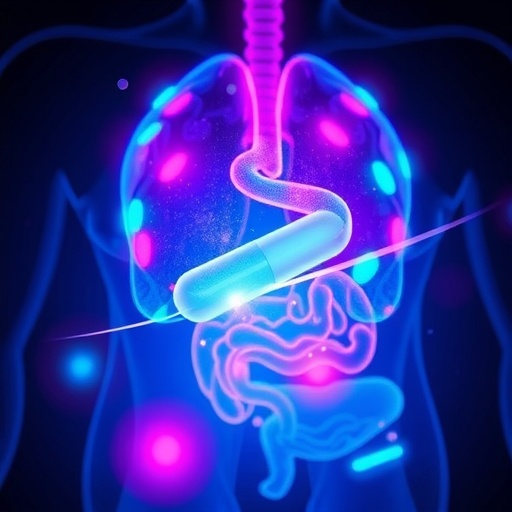
Scientists have been grappling with the complex task of studying the gut’s extensive nervous system—this intricate network is often referred to as the body’s “second brain.” Traditional methodologies for such research have been fraught with complications as they regularly entail invasive procedures that can impede the normal functions of the gut. This longstanding conundrum has stymied the scientific community, hindering deeper explorations that could lead to better understanding gastrointestinal health and disorders.
In a breakthrough that could redefine the way scientists interact with the gut’s neural pathways, a team of researchers led by Khalil Ramadi, an assistant professor of bioengineering at NYU Tandon School of Engineering, has unveiled a groundbreaking technology called ICOPS—Ingestible Controlled Optogenetic Stimulation devices. These innovative ingestible capsules present an unprecedented opportunity for researchers to deliver targeted light stimulation directly to specific regions of the intestinal tract, allowing for a more refined observation of neural activities and their effects on digestion.
By utilizing the principles of optogenetics, Ramadi’s approach transforms the study of gut function by harnessing light to activate nerve cells. In this technique, specific neurons are genetically modified to become responsive to light. Once this transformation is achieved, a patient simply swallows the ICOPS capsule, which is fitted with miniature LEDs designed to emit light at precise wavelengths. Whenever illumination is initiated, researchers can effectively monitor how the activated cells interact with the rest of the enteric nervous system—this opens the pathway to exploring how various neural circuits engage in regulating digestion.
Interestingly, this marks the first instance of a non-invasive platform for wireless optical stimulation specifically targeting the gut, a realm previously limited to invasive surgical techniques involving implanting optical fibers. The significance of such a shift cannot be understated; it ushers in entirely new possibilities for mapping the intricate neural circuits that govern gut functions, which might be central to addressing a variety of gastrointestinal disorders.
Beyond just a technological marvel, the ICOPS device embodies critical advancements in materials science and engineering. Ramadi’s team successfully created this capsule using in-house, 3D printing technology that enabled them to fabricate the device without reliance on cleanroom capabilities. This innovative manufacturing process allows for scalable production while ensuring that micro-LEDs and custom coils are integrated seamlessly within the capsule structure. The battery-free design relies on wireless power supplied via magnetic induction from an external transmitter, making it compact enough to traverse the gastrointestinal system naturally over one to two days without causing harm.
The implications of this research could extend well beyond academic curiosity. The potential therapeutic applications of the technology are vast, particularly for conditions related to gut motility disorders such as gastroparesis, where the stomach fails to empty efficiently. Conventional treatments have proven to be broadly unfocused, relying on general prokinetic or antikinetic agents without targeting specific neural pathways. ICOPS could facilitate more nuanced treatment strategies that directly stimulate specific neuronal populations within the gut.
Moreover, the modulation of neural activity in targeted regions of the gastrointestinal tract may elicit hormonal changes that impact overall metabolism. This connection could lead to pioneering methodologies for addressing metabolic diseases and eating disorders that have long eluded effective treatment options. With the capacity to manipulate gut functions with unprecedented precision, the potential for improving therapeutic outcomes in these areas appears promising.
As the initial studies demonstrating the efficacy of these ICOPS devices unfold, the future of research on the gut’s nervous system looks fundamentally transformed. This technology not only allows scientists to monitor gut activity dynamically but could also pave the way for subsequent innovations like targeted electrical stimulation or even drug delivery platforms engineered to synchronize with neural activities in real-time.
Although clinical applications are still several years away—likely at least a decade before reaching patients—the foundational work laid by Ramadi and his colleagues represents a significant leap forward in the current understanding of the enteric nervous system. As researchers continue to dissect the complexities of gut-brain interactions, tools like ICOPS could unearth new pathways for exploration that were previously deemed inaccessible.
The overall consensus among the research community is one of hopeful anticipation. The ramifications for both scientific inquiry and potential clinical applications are profound and far-reaching. As researchers explore this newfound ability to manipulate the gut’s neural circuits without the limitations imposed by traditional methods, we may be staring down the barrel of a pivotal moment in gastrointestinal research—one that not only enhances our knowledge but could fundamentally alter treatment paradigms for an array of debilitating conditions.
Ultimately, the innovative nature of ICOPS underscores how emerging technologies in bioengineering compellingly blend molecular biology, neurology, and materials science to challenge existing paradigms of scientific inquiry. As this research progresses, it will undoubtedly spur further innovations, driving a new frontier in the quest to understand and optimize gut health, thereby enriching human well-being in ways yet to be imagined.
Keywords
Cite Scienmag News
Cassandra Pierce. (August 27, 2025). Light-Activated Pills: Revolutionizing Our Knowledge of Gut-Brain Interaction. Scienmag. https://scienmag.com/light-activated-pills-revolutionizing-our-knowledge-of-gut-brain-interaction/
Cassandra Pierce. "Light-Activated Pills: Revolutionizing Our Knowledge of Gut-Brain Interaction." Scienmag, 27 August 2025, https://scienmag.com/light-activated-pills-revolutionizing-our-knowledge-of-gut-brain-interaction/. Accessed 4 September 2026.
Cassandra Pierce. "Light-Activated Pills: Revolutionizing Our Knowledge of Gut-Brain Interaction." Scienmag. August 27, 2025. https://scienmag.com/light-activated-pills-revolutionizing-our-knowledge-of-gut-brain-interaction/


