


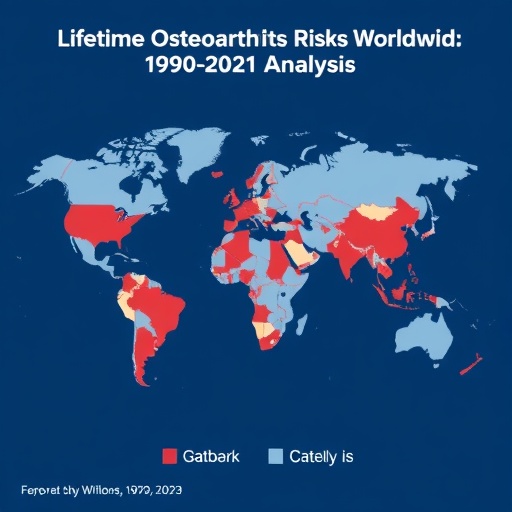
In a groundbreaking study published in Global Health Research and Policy, researchers led by Zhang, X., Huang, C., and Hu, Z. have unveiled comprehensive global, regional, and country-specific lifetime risks of osteoarthritis (OA) spanning an extensive timeline from 1990 to 2021. This systematic analysis, part of the Global Burden of Disease (GBD) 2021 Study, sheds new light on the evolving epidemiology of osteoarthritis, a chronic degenerative joint condition that significantly compromises quality of life worldwide. As populations age and lifestyles shift globally, the implications of this pioneering work are profound, potentially reshaping public health strategies and clinical approaches for managing a disease that affects millions.
Osteoarthritis, characterized by the progressive breakdown of joint cartilage and underlying bone, remains one of the leading causes of disability across all age groups, particularly in older adults. Despite its prevalence, OA lacks a definitive cure, making an understanding of its lifetime risk crucial for healthcare planning and early intervention strategies. This study fills a vital gap by delivering precise estimations of lifetime OA risk with unprecedented granularity, analyzing data at global, regional, and country-specific levels. In doing so, it elucidates patterns of disease burden influenced by demographic, socioeconomic, and environmental factors.
The methodology underlying this comprehensive analysis is anchored in rigorous epidemiological modeling. Harnessing vast datasets collated over more than three decades, the researchers employed sophisticated statistical techniques to adjust for variations in disease definition, diagnostic criteria, and reporting methods across diverse health systems. This approach enabled robust, comparable prevalence and incidence estimates of OA globally. By leveraging disability-adjusted life years (DALYs) and years lived with disability (YLDs), the study not only quantifies the prevalence but also translates these figures into a meaningful assessment of the true burden OA imposes on populations worldwide.
A salient revelation from the study is the dramatic increase in lifetime OA risk, reflecting shifting demographics such as increased life expectancy and the rise of obesity, one of the primary risk factors for joint degeneration. The authors underscore that while OA has traditionally been viewed as an affliction of the elderly, its lifetime risk is rising markedly even in younger demographics in many regions, linked to changes in lifestyle and environmental exposures. This trend portends a growing public health challenge that necessitates urgent policy attention.
Regionally, the data unveil stark disparities. High-income countries, despite advanced healthcare infrastructures, show high OA prevalence, likely due to aging populations and greater obesity rates. In contrast, certain low- and middle-income countries (LMICs) demonstrate emerging OA burdens concomitant with urbanization and changing occupational patterns. This geographical heterogeneity highlights the complex interplay of socio-economic development, healthcare access, and cultural factors in shaping disease trajectories. Such insights may catalyze region-specific interventions tailored to local needs.
Furthermore, the study’s country-specific risk assessments reveal nuances often masked in broader analyses. For instance, nations with robust health surveillance systems report higher OA lifetime risks, potentially reflecting better case ascertainment rather than actual disease prevalence. Conversely, underreported cases in countries with limited healthcare access pose challenges for accurate estimation, emphasizing the need for improved global health data infrastructure. The authors call for enhanced standardized surveillance mechanisms to enable more precise tracking of OA trends moving forward.
The clinical implications of these findings are far-reaching. Understanding that a significant proportion of populations face substantial lifetime OA risk reinforces the imperative for early diagnostic tools and preventive strategies. Current therapeutic options primarily focus on symptom management rather than disease modification, underscoring the urgent need for research into disease-modifying agents. This study’s data provide a critical epidemiological foundation for prioritizing funding and resources towards innovative treatments that could alter the disease course.
From a biological standpoint, the study rekindles interest in the multifactorial etiology of OA, integrating mechanical, inflammatory, and metabolic contributors. The rise in lifetime risk aligns with increasing prevalence of metabolic syndrome and systemic inflammation seen in aging populations. These insights pave the way for exploring targeted interventions that address underlying pathogenic mechanisms beyond joint degradation alone. A holistic approach encompassing lifestyle modification, pharmacological treatment, and rehabilitation emerges as essential in disease management.
Public health strategies informed by this extensive analysis must reckon with the socioeconomic implications of a growing OA burden. Lost productivity, increased healthcare costs, and diminished quality of life collectively strain individuals, families, and national economies. Prevention programs emphasizing weight management, physical activity, and injury avoidance are underscored as cost-effective measures. Moreover, the study advocates for integrating OA risk reduction into broader chronic disease frameworks, leveraging synergistic prevention efforts.
Importantly, the study’s temporal scope—covering from 1990 through 2021—enables an appraisal of how global changes, including urbanization, lifestyle transitions, and healthcare improvements, have influenced OA epidemiology. The longitudinal perspective facilitates the identification of trends that might otherwise be obscured in shorter-term analyses. This historical contextualization enhances the predictability of future OA burden and supports long-term healthcare planning.
The research team emphasizes the need for continued surveillance and regular updating of OA burden estimates to monitor the impact of public health interventions and emerging risk factors. Given the dynamic nature of global demographics and disease drivers, adaptive strategies informed by real-time data will be critical for effective disease control. Collaborative international efforts and data sharing are pivotal in this regard, fostering a coordinated global response.
Challenges persist in translating these findings into widespread clinical practice, particularly in resource-limited settings where diagnostic capabilities and treatment options are scarce. Capacity building, education, and health system strengthening are vital to ensure that advancements in understanding OA’s burden translate into tangible health benefits globally. The authors call on international health agencies to prioritize OA in their agendas, reflecting its significant and growing impact.
Intriguingly, the study also explores gender-specific differences in OA Lifetime risk, noting that women consistently exhibit higher risks compared to men. Hormonal influences, genetic predisposition, and differences in joint biomechanics are posited as contributing factors. These distinctions underscore the importance of sex-specific research and personalized intervention strategies to effectively combat OA.
Finally, this landmark study serves as a clarion call to researchers, clinicians, policymakers, and the public alike. By illuminating the extensive lifetime risks of osteoarthritis worldwide, it compels a reevaluation of how this condition is perceived and managed. With millions affected and numbers projected to increase steeply, a concerted, multidisciplinary effort is essential to mitigate the impending OA epidemic and improve quality of life for millions globally.
Cite Scienmag News
Phoebe Ingram. (July 31, 2025). Lifetime Osteoarthritis Risks Worldwide: 1990–2021 Analysis. Scienmag. https://scienmag.com/lifetime-osteoarthritis-risks-worldwide-1990-2021-analysis/
Phoebe Ingram. "Lifetime Osteoarthritis Risks Worldwide: 1990–2021 Analysis." Scienmag, 31 July 2025, https://scienmag.com/lifetime-osteoarthritis-risks-worldwide-1990-2021-analysis/. Accessed 9 September 2026.
Phoebe Ingram. "Lifetime Osteoarthritis Risks Worldwide: 1990–2021 Analysis." Scienmag. July 31, 2025. https://scienmag.com/lifetime-osteoarthritis-risks-worldwide-1990-2021-analysis/


