


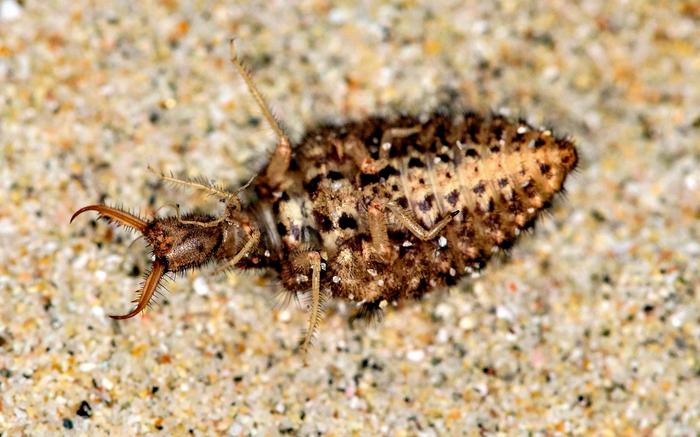
A new study led by scientists from the University of Bristol has revealed what animals do after they have feigned death in order to avoid being killed by a predator and what the context of this behaviour is.

Credit: Nigel R Franks, University of Bristol
A new study led by scientists from the University of Bristol has revealed what animals do after they have feigned death in order to avoid being killed by a predator and what the context of this behaviour is.
Many animals, as a last-ditch defence, become motionless after being contacted by a predator.
This behaviour is so common that it’s recognised in such phrases as “playing possum”. It is even said to occur in humans in extreme circumstances.
In previous studies, carried out by the same team using antlion larvae, scientists noticed that they become motionless after being individually handled.
At one point the larvae needed to be weighed, which with such small insects can be very difficult, if they move on the pan of the weighing balance, determining their mass can be a challenge.
However, when the antlion larvae were dropped, very gently, onto the pan of a weighing balance, they remained completely stationary for more than enough time for their weight to be recorded accurately.
Emeritus Professor Nigel Franks from the University of Bristol’s School of Biological Sciences, who led the study, said: “We chose to investigate this so-called ‘death-feigning’ behaviour and we found that the amount of time individual antlions remain stationary is completely unpredictable for any one individual.
“This is confirmed by looking at the durations of post-contact immobility in a large number of antlions. Such data shows an exponential distribution. So just as with radioactive atoms, when an individual changes state is unpredictable, but the population pattern is perfectly predictable.”
The study shows that the behaviour of antlions hiding in plain sight, in this way, is likely to be adaptive because a predator having picked up and then dropped an antlion larva could not know how long to wait for its potential victim to move again and once more become a recognisable prey item. Indeed, one of the antlions recorded remained completely stationary for more than an hour.
Even though it cannot be predicted when a motionless antlion will spring back to life this does not mean that the predator will necessarily have left the scene to look for alternative prey.
The team’s next question was what animals do after playing possum. In the new study, they show that what antlions do depends on the situation in which they find themselves.
Antlion larvae are burrowing animals and might seek safety in submerging into the friable substrate where they normally build their pits. But it is quite possible that a predator might drop an antlion on to a hard substrate that wouldn’t permit escape through borrowing.
By using sophisticated automated video tracking of the intermittent locomotion of individual antlions on different substrates researchers found that what an antlion does after terminating its period of motionlessness depends on what escape strategies are available.
Professor Franks added: “Our study might well be the first to determine what animals do after they have played dead, and we show that what they do is context dependent. It is a trade-off. So, our work opens up the field of studying life after death in the huge range of animals that exhibit death feigning, thanatosis or what we prefer to call post-contact immobility.”
Journal
PLoS ONE
Subject of Research
Animals
Article Title
‘Seeking safety: Movement dynamics after post-contact immobility’
Article Publication Date
22-Aug-2024
Cite Scienmag News
Drew Townsend. (August 22, 2024). Life after (feigned) death. Scienmag. https://scienmag.com/life-after-feigned-death/
Drew Townsend. "Life after (feigned) death." Scienmag, 22 August 2024, https://scienmag.com/life-after-feigned-death/. Accessed 6 September 2026.
Drew Townsend. "Life after (feigned) death." Scienmag. August 22, 2024. https://scienmag.com/life-after-feigned-death/

