


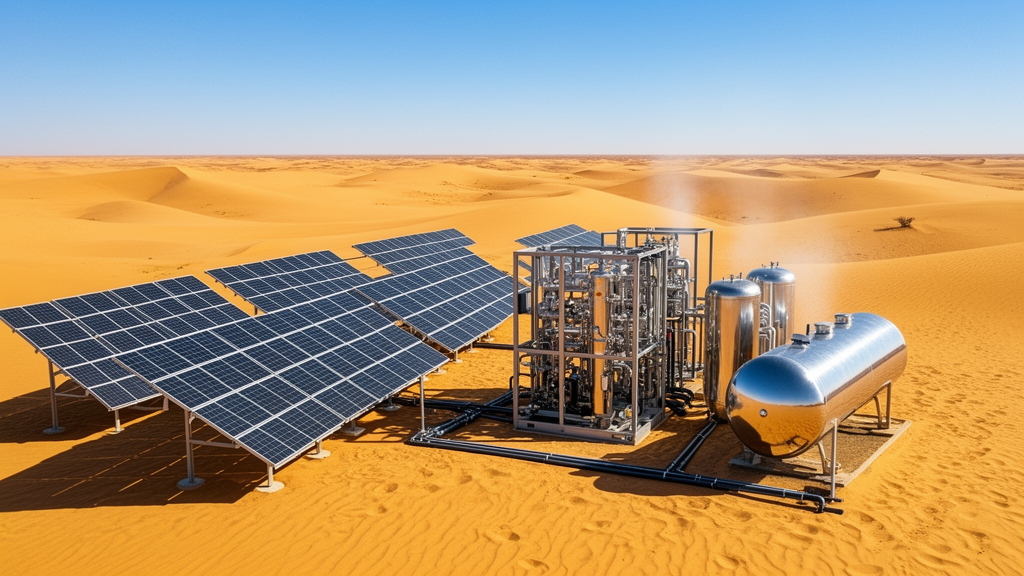
Researchers have proposed a comprehensive off-grid solar photovoltaic hydrogen system designed to meet the annual electricity demand of Wadi Al-Shati, a city in southern Libya. The study, published in Discover Energy, presents a combined energy, economic, environmental, and technical assessment of this hybrid configuration. The primary objective is to provide a reliable alternative to fossil-fuel-based electricity generation in a region characterized by high solar potential and significant energy access challenges. The proposed system integrates a large-scale solar array with a hydrogen production and storage subsystem to ensure continuous power supply despite the intermittent nature of solar radiation.
The technical design centers on a 625.5 MW solar photovoltaic plant, which serves as the primary source of renewable energy. To manage the variability of solar output, the system includes a 337 MW electrolyzer that converts excess solar power into hydrogen gas. This hydrogen is then stored in a high-pressure compressed-gas tank with a volume of 24,285 cubic meters at a pressure of 100 MPa. When solar generation is insufficient to meet the electrical load, a 177 MW fuel cell utilizes the stored hydrogen to generate electricity, thereby bridging the gap between supply and demand throughout the year.
The simulation was based on local climatic conditions and annual load data collected from the Renewable Energy and Sustainable Development Research Center meteorological station at Wadi Al-Shati University. The dataset, covering the period from 2023 to 2024, included hourly global horizontal irradiance and ambient temperature readings. The electrical load profile, provided by the Libya electricity company, indicated a total annual demand of approximately 590 GWh. The highest monthly demand occurred in July, while the lowest was observed in April, with an average monthly energy demand of 49,168 MWh.
Methodologically, the study employed an iterative optimization technique to size the system components. The goal was to satisfy the system energy balance and stability constraints while minimizing the levelized cost of electricity. A key constraint was that the loss of power supply probability must equal zero, ensuring that the system could meet the full electrical load at all times. Additionally, the hydrogen storage level at the start of the year had to match the level at the end of the year to guarantee long-term operational stability without external replenishment.
The results demonstrate that the proposed configuration can reliably satisfy the full annual electricity demand of Wadi Al-Shati. The PV field generated a total of 987,168 MWh annually, with an average hourly output of 112.7 MWh and a peak output of 477 MWh. Of this total generation, 283,137 MWh was supplied directly to the electrical load, representing 48% of the total supplied energy. The remaining 704,031 MWh was directed to the hydrogen production system to address periods of low solar irradiance.
The fuel cell system played a critical role in maintaining grid stability, supplying 306,836 MWh of electricity, which accounted for 52% of the total energy delivered to the load. This dynamic interaction highlights the importance of hydrogen storage in compensating for PV intermittency. The hydrogen production rate varied significantly throughout the day, reaching a maximum of 10.1 tons per hour during peak solar irradiance. During nighttime hours or periods of low solar output, the electrolyzer operation ceased, and the fuel cell relied entirely on the stored hydrogen to meet the electrical demand.
Economically, the study estimates the total investment cost of the system at approximately USD 1.742 billion. The levelized cost of electricity was calculated to be nearly USD 338 per MWh, with a payback period of 16.64 years. The capital expenditure is heavily weighted toward the hydrogen subsystem, which constitutes about 65% of the total system cost. This distribution underscores the significant financial impact of the electrolyzer and fuel cell technologies on the overall economics of the project. The economic analysis also included a social cost of carbon of USD 70 per ton, reflecting the environmental value of avoided emissions.
From an environmental perspective, the system offers substantial mitigation potential by avoiding approximately 611,849 tons of CO2 emissions each year. This reduction is achieved by replacing fossil-fuel-based electricity generation with renewable solar and hydrogen power. The carbon emission factor for the Libyan power system was taken as 1.037 kgCO2 per kWh. The study notes that accounting for environmental damage costs within the economic framework can improve the relative competitiveness of clean energy systems, particularly in contexts where energy prices may be supported by subsidies.
The researchers identified several practical challenges for the deployment of such a system in southern Libya. These include the need for frequent maintenance to address dust accumulation and sandstorms, which can reduce PV efficiency. The water-energy nexus is also a critical consideration, as hydrogen production requires high-purity water, necessitating the integration of desalination units or the use of existing water infrastructure. Furthermore, the remote location of Wadi Al-Shati complicates the supply chain for specialized components and the transport of hydrogen, potentially requiring localized microgrids before a broader distribution network can be established.
The study acknowledges several limitations and assumptions that may affect the generalizability of the results. The model treats hydrogen as an ideal gas and assumes constant operating efficiencies for the electrolyzer and fuel cells throughout the project lifetime. It excludes equipment salvage values and ignores potential transmission or leakage losses. Additionally, the analysis does not factor in optimal geographical siting beyond the selected location, nor does it account for component degradation over time. Uncertainties in climatic, economic, and environmental data may also impact the system performance and economic assessment.
Future work suggested by the authors includes extending the framework to use multi-year meteorological datasets and stochastic reliability assessment methods to better account for inter-annual solar variability. They plan to implement uncertainty-based optimization and Monte Carlo simulations to evaluate how fluctuations in solar irradiance and equipment degradation influence the system’s resilience. From an economic perspective, future studies will incorporate a granular breakdown of capital and operational expenses, including the staggered replacement costs of electrolyzer and fuel cell stacks. A full Life Cycle Analysis is also planned to quantify the embodied energy of system components and the water footprint of electrolysis in water-scarce zones.
The findings confirm that PV-hydrogen systems represent a promising pathway for improving energy security and reducing dependence on fossil-fuel-based electricity generation in Libya. The study highlights the relevance of such systems for the wider North African context, supporting national objectives related to renewable deployment and emissions reduction. However, successful implementation requires supportive policy frameworks, investment de-risking mechanisms, and capacity-building programs tailored to harsh desert environments. The research provides a technical baseline for further development of off-grid renewable energy solutions in remote regions with high solar potential.
To capture realistic outdoor operating conditions, the technical formulation incorporated specific module parameters and transposition modeling. The solar array design relied on the Stion SN-115 thin-film photovoltaic module, evaluated with an eighty percent derating factor to account for operational losses. Solar irradiance on the tilted array was calculated using the Liu and Jordan diffuse transposition model adapted to Brack Alshatti city. Power conversion units, encompassing both direct-current and alternating-current converters, were modeled with a fixed efficiency of ninety-five percent. Auxiliary equipment was sized to sustain standalone equilibrium, including a 4.1 MW compressor station running at ninety-five percent efficiency to inject hydrogen into storage at a pressure of 100 MPa, where gas density reaches 71.59 kilograms per cubic meter. The accompanying desalination facility, rated at 400 kW with an hourly throughput of 111.4 cubic meters, accounts for water requirements of approximately eleven kilograms of purified water per kilogram of hydrogen produced, adding an estimated 0.0075 USD per kilogram to hydrogen generation costs.
The energy-flow simulations also quantified component-level conversion rates and significant seasonal curtailment. Sizing formulations applied an eighty percent efficiency for the electrolyzer and a sixty percent efficiency for the fuel cell subsystem, anchored to a hydrogen lower heating value of 33.33 kWh per kilogram. When active during nighttime or low-solar hours, the 177 MW fuel cell consumes hydrogen at an hourly rate of 5.3 tons. Although 283,137 MWh of photovoltaic generation feeds local demand directly and 704,031 MWh energizes water electrolysis, the system produces a notable surplus. Approximately 389,757 MWh of annual electricity generation is curtailed, demonstrating the substantial margin of excess energy produced during midday generation peaks under hyper-arid desert irradiance.
The modeled generation costs also contextualize Libya within broader regional research across North Africa and the Middle East, where southern Libyan solar resources provide up to 2045 kWh per kilowatt annually over 3100 to 3900 sunshine hours. Comparative studies in Kuwait, Oman, and Pakistan reported levelized electricity costs between 0.30 and 0.708 USD per kilowatt-hour, while off-grid hydrogen costs frequently exceeded 8.0 USD per kilogram due to substantial storage requirements. In contrast, grid-independent microgrids in the United Arab Emirates achieved generation costs around 145 USD per megawatt-hour. To overcome capital hurdles in remote regions such as Brack, Ubari, and Kufra, the authors suggest establishing targeted feed-in tariffs and allocating dedicated national oil revenues to finance initial renewable infrastructure for decentralized communities and agricultural water pumping.
Subject of Research: Integrated energy economic environmental and technical assessment of an off grid solar photovoltaic hydrogen system for electricity supply in Wadi Al Shati, Libya
Article Title: Integrated energy economic environmental and technical assessment of an off grid solar photovoltaic hydrogen system for electricity supply in Wadi Al Shati, Libya
Article References: Latiwash, I., Mohammed, M., Al Bari, M. A., El-Khozondar, H. J., & Nassar, Y. (2026). Integrated energy economic environmental and technical assessment of an off grid solar photovoltaic hydrogen system for electricity supply in Wadi Al Shati, Libya. Discover Energy, 6(1), Article 84. https://doi.org/10.1007/s43937-026-00174-z
Image Credits: AI Generated
DOI: 10.1007/s43937-026-00174-z
Keywords: Integrated, energy, economic, environmental, technical, assessment, grid, solar, photovoltaic, hydrogen, system, electricity
Cite Scienmag News
Denise Maddox. (November 12, 2026). Libyan Study Models Off-Grid Solar Hydrogen Grid. Scienmag. https://scienmag.com/libyan-study-models-off-grid-solar-hydrogen-grid/
Denise Maddox. "Libyan Study Models Off-Grid Solar Hydrogen Grid." Scienmag, 12 November 2026, https://scienmag.com/libyan-study-models-off-grid-solar-hydrogen-grid/. Accessed 12 November 2026.
Denise Maddox. "Libyan Study Models Off-Grid Solar Hydrogen Grid." Scienmag. November 12, 2026. https://scienmag.com/libyan-study-models-off-grid-solar-hydrogen-grid/




