


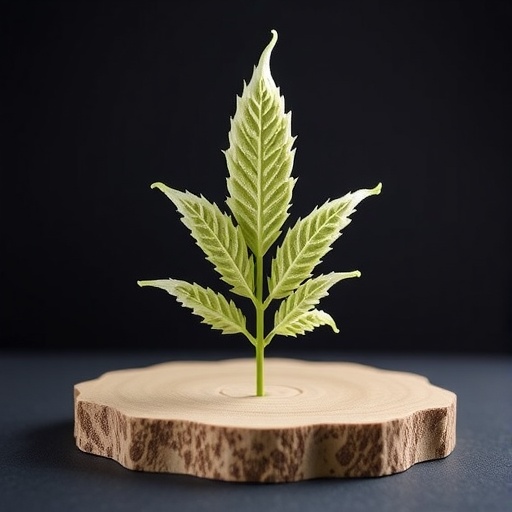
In a groundbreaking study, researchers have unveiled the potential of hemp processing waste as a sustainable and innovative feedstock for 3D printing biocomposites. The investigation, led by Ji, A., Han, N., and Zhang, S., showcases how this often-overlooked byproduct can be transformed into valuable materials for various applications, pushing the frontiers of both environmental sustainability and advanced manufacturing technologies. Hemp, a versatile plant known for its high strength-to-weight ratio and biodegradability, has been used for centuries in various applications, from textiles to construction.
The rise of 3D printing technology has opened new avenues for material science, enabling the fabrication of complex geometries and customized structures for various industries, including aerospace, automotive, and medical sectors. However, traditional feedstocks used in 3D printing, such as plastics and synthetic materials, raise significant environmental concerns due to their non-biodegradable nature and the polluting production processes involved. The need for more eco-friendly alternatives has sparked interest in agricultural and forestry waste, with hemp processing waste emerging as a frontrunner.
Hemp processing generates a considerable amount of waste, primarily in the form of stalks and leaves, which are often discarded or poorly managed. This not only represents a lost opportunity for resource recovery but also contributes to environmental degradation. The study highlights how harnessing hemp processing waste can mitigate these issues by converting what would otherwise be waste into valuable resources. The researchers employed various methods to investigate the mechanical properties and printability of the hemp-based biocomposites, placing particular emphasis on determining their suitability for various applications.
Through a series of experiments, the researchers discovered that when appropriately processed, hemp waste can be blended with biodegradable polymers to create composite materials that retain desirable mechanical properties while minimizing environmental impact. The results indicated that these biocomposites could match, and even in some cases exceed, the performance characteristics of conventional plastics, thereby positioning them as competitive alternatives in the field of additive manufacturing.
The study also explored the processing techniques required to prepare hemp waste for 3D printing. Techniques such as grinding and thermomechanical processing were employed to convert the fibrous hemp waste into a fine powder, facilitating easier blending with polymers. The findings suggest that optimizing the ratio of hemp waste to polymer can significantly enhance the mechanical performance of the final 3D-printed product. This research paves the way for creating custom formulations tailored for specific applications, thereby expanding the versatility of 3D printed items.
In terms of environmental sustainability, the implications of utilizing hemp processing waste are staggering. As the world grapples with the ramifications of plastic pollution, shifting towards biocomposites derived from natural and renewable materials can alleviate some of these challenges. Such practices not only promote waste reduction but also foster a circular economy where materials are kept in use for as long as possible before being returned to the environment in harmless forms. This approach aligns with global efforts to reduce carbon footprints and improve ecological health.
The study also examined the lifecycle impact of hemp-based biocomposites compared to traditional plastics. By utilizing hemp processing waste, the researchers found that the carbon emissions associated with the production and disposal of these materials could be significantly lower than their synthetic counterparts. Furthermore, given that industrial hemp is a fast-growing crop that thrives with minimal agricultural inputs, its cultivation can contribute positively to soil health and biodiversity.
One of the unique aspects of this research is its focus on local production. By sourcing hemp waste from local processing facilities, not only can the carbon footprint associated with transportation be minimized, but it also supports local economies. This community-centered approach may encourage farmers and manufacturers to collaborate, thus creating a closed-loop system where waste is transformed into valuable resources while bolstering regional economies.
The potential applications for hemp-based biocomposites are vast and varied. From 3D printed molds and automotive components to medical devices and packaging materials, the versatility of these materials offers exciting new possibilities. The ability to customize mechanical properties allows designers and engineers to explore new frontiers in product development, potentially revolutionizing industries that rely heavily on additive manufacturing technology.
The research by Ji and colleagues represents merely the tip of the iceberg in exploring sustainable materials derived from agricultural waste. As interest and investment in bio-based materials grow, the possibilities for innovation within this space expand drastically. Further research will be essential in addressing potential challenges, such as large-scale production practices and market acceptance, which will be critical for the broader adoption of hemp-based biocomposites.
In conclusion, the utilization of hemp processing waste for 3D printing biocomposites holds significant promise for creating sustainable materials that can replace traditional plastics. By identifying an innovative way to repurpose hemp waste, this research not only serves to address waste management issues associated with hemp production but also contributes to a greener and more sustainable future. As industries continue to seek alternatives to environmentally damaging materials, the findings of this study are timely and vital, ushering in an era where technology and sustainability converge to benefit both the economy and the environment.
The journey towards the widespread adoption of hemp-based biocomposites is undoubtedly one worth following. As this research gains traction, it may well inspire further studies and innovations, driving the trajectory of sustainable materials in additive manufacturing to new heights. Observers can look forward to a future where biocomposites from hemp waste are commonplace, transforming not just the landscape of manufacturing but also our relationship with natural resources and sustainability.
Ji, A., Han, N., Zhang, S. et al. Utilization of Hemp Processing Waste for 3D Printing of Biocomposites.
Waste Biomass Valor (2025). https://doi.org/10.1007/s12649-025-03314-z
Cite Scienmag News
Denise Maddox. (September 16, 2025). Leveraging Hemp Waste for Sustainable 3D Biocomposites. Scienmag. https://scienmag.com/leveraging-hemp-waste-for-sustainable-3d-biocomposites/
Denise Maddox. "Leveraging Hemp Waste for Sustainable 3D Biocomposites." Scienmag, 16 September 2025, https://scienmag.com/leveraging-hemp-waste-for-sustainable-3d-biocomposites/. Accessed 5 September 2026.
Denise Maddox. "Leveraging Hemp Waste for Sustainable 3D Biocomposites." Scienmag. September 16, 2025. https://scienmag.com/leveraging-hemp-waste-for-sustainable-3d-biocomposites/


