


When scientists talk about climate change, the conversation almost always gravitates toward temperature. Thermometers rising by fractions of a degree dominate headlines, drive policy debates, and anchor most ecological forecasting. But a new study from the Virginia Institute of Marine Science and the Batten School of Coastal & Marine Sciences at William & Mary argues that this fixation overlooks a second, equally powerful consequence of a warming world: shifting rainfall. Published in the journal Ecology, the research demonstrates that precipitation, not temperature, acts as the dominant force reorganizing the food webs of coastal plain streams — and that drier conditions fundamentally destabilize the way energy moves through aquatic ecosystems.
The findings carry implications far beyond the rivers where the work was conducted. As rainfall patterns grow more erratic across the globe, the study suggests that the productivity, stability, and very architecture of river ecosystems may be undergoing a quiet but profound transformation. Lead author Bradley Strickland, a former postdoctoral research associate at VIMS and the Batten School, described the shifting food webs as a potential early warning sign of deeper ecological change. If rain can reshape the foundations of a river’s energy economy this dramatically, he noted, then any rainfall-dependent system — from grasslands to coastal seas — may be vulnerable to similar restructuring as the climate continues to change.
The research team found its ideal testing ground in an unlikely place: the Gulf Coast prairie ecoregion of South Texas. There, dry air spilling out of the Chihuahuan Desert collides with moisture-laden winds from the Gulf of Mexico, producing a steep and remarkably clean rainfall gradient. Annual precipitation drops sharply over a short geographic distance, and crucially, rainfall is the only major variable that changes along that gradient. Co-author Chris Patrick, an associate professor at VIMS and the Batten School, explained why this matters. In most of the United States, a comparable rainfall gradient would be driven by geological features such as mountain ranges, which confound the picture by altering soils, geology, and hydrology simultaneously. In South Texas, rainfall stands alone as the explanatory factor, making the region what Patrick called a natural laboratory — one he described as unique within the continental United States, with few parallels anywhere in the world.
Over four years, Patrick’s team sampled fish, snails, algae, and other organisms across nine rivers, while also measuring water quality, temperature, and a suite of physical and chemical variables. The result is a dataset of unusual scope, tracking both vertebrate and invertebrate communities across multiple sites and multiple years. But the researchers were not simply cataloging species. Their central goal was to quantify a metric that ecologists consider one of the most informative — and most labor-intensive — measures of ecosystem function: secondary production.
Secondary production, as Patrick defined it, is essentially the growth of new animal tissue over time. It captures how much living biomass a community generates, which in turn reflects the flow of energy from the base of the food web upward through consumers. Compared with simpler metrics like species abundance or diversity, secondary production integrates efficiency, ecological structure, population dynamics, and community organization into a single number. Strickland called it truly one of the best measures available for understanding how an ecosystem actually functions. And the scale of the measurement effort was extraordinary. Patrick noted that empirical, directly measured secondary production is rare even for a single species; doing it for an entire invertebrate community and an entire fish community, across multiple years and multiple sites, is essentially unheard of in the field.
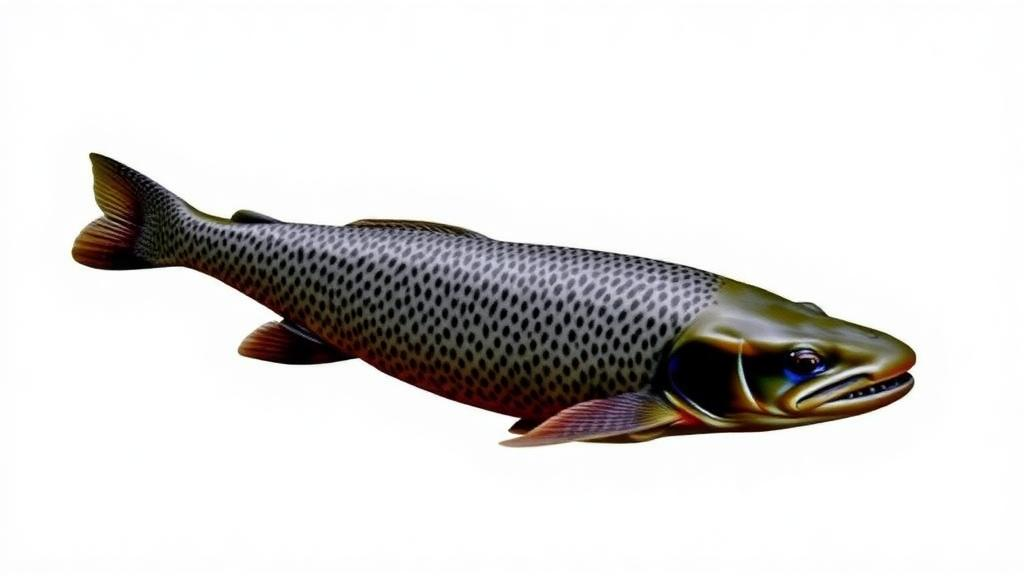
The analysis confirmed one of the team’s expectations while delivering a genuine surprise. Along the gradient, streams receiving less rainfall showed higher secondary production — a pattern rooted in the physics of light and the biology of algae. Less precipitation means less tree canopy, and less canopy means more sunlight reaching the streambed. That light fuels abundant algal growth, which feeds fast-reproducing invertebrates such as non-biting midges. In the drier streams, this resource pulse also favored herbivorous fish like sailfin mollies, females of which reach sexual maturity within roughly 32 days. Together, these rapid-turnover consumers supported a comparatively small population of predators, including fish like spotted gar.
What startled the researchers was the shape of the biomass distribution that emerged. The drier streams displayed a classic bottom-heavy biomass pyramid — a structure ecologists associate with terrestrial ecosystems, not aquatic ones. Marine and many freshwater systems typically show inverted, top-heavy pyramids because algae and phytoplankton at the base cycle so quickly, being consumed nearly as fast as they reproduce. A bottom-heavy pyramid in a stream signals that the entire energy pathway has been rerouted. Strickland put it plainly: rainfall changes the amount and type of resources at the base of the food web, and consumers respond dramatically. In the wetter streams, by contrast, the team observed inverted pyramids supported not only by algae but also by detritivorous invertebrates — organisms feeding on leaves, animal carcasses, and other litter falling into the water. Strickland characterized that wetter-end existence as a slower, steadier way of living, compared with the stressful, fast-paced life of the drier streams.
The quantitative contrast between the two ends of the gradient was stark. Streams receiving less annual rainfall exhibited twice the secondary production and twice the biomass turnover rates of their wetter counterparts, despite being otherwise similar. On the strength of that result, the study characterizes rainfall as a master variable — a single environmental factor with the power to reshape the foundations of an ecosystem, from the resources fueling primary producers to the trophic structure of the animal communities above them. In the drier systems, energy flows fast and shallow, channeled through a few rapidly reproducing species. In the wetter systems, it moves slowly and diffusely through more diverse webs built on decaying organic matter. Neither configuration is inherently better, but the transition between them represents a wholesale reorganization of how a river works.
The study’s authors argue that this conclusion resonates well beyond South Texas. Precipitation’s capacity to control energy flow through animal communities, they note, has parallels in ecosystems ranging from grasslands and savannas to coastal and marine environments. As rainfall becomes more variable under climate change, Strickland said, we should expect big changes in the productivity, energy flow, and stability of river ecosystems — and possibly in any rainfall-dependent system. The research therefore calls for improved models and continued field data collection to understand how precipitation regimes shape biodiversity and productivity across ecosystem types, improving our ability to predict ecological responses to a changing climate. Patrick framed the takeaway in similarly broad terms: some regions will see deserts expand while others grow wetter on average year-round, and rainfall stands as another important mechanism through which climate change will alter ecosystems.
For river managers and conservation scientists, the message is that monitoring rainfall-driven shifts in food web structure may provide an earlier and more sensitive indicator of climate stress than temperature records alone. A stream can look superficially intact — the same channels, the same general cast of species — while its internal energy economy has been quietly rebuilt around a different resource base. Detecting that reorganization requires exactly the kind of exhaustive, multi-year, multi-trophic measurement this study pioneered. As drying trends advance across many of the world’s river basins, the bottom-heavy pyramids of South Texas may offer a preview of what happens when the rain that rivers depend on begins to fade.
Subject of Research: Effects of rainfall gradients on stream secondary production, trophic structure, and energy flow in riverine food webs
Article Title: Rainfall reshapes river ecosystems and food webs, study finds
Article References: Rainfall reshapes river ecosystems and food webs, study finds. (n.d.). Original publication
Image Credits: AI Generated
DOI: Not provided
Keywords: rainfall, stream ecosystems, food webs, secondary production, climate change, biomass pyramid, energy flow, South Texas, trophy structure, aquatic ecology, precipitation gradient, Virginia Institute of Marine Science
Cite Scienmag News
Gavin Prescott. (October 13, 2026). Less Rain Rewrites the Rules of River Food Webs, Four-Year Study Reveals. Scienmag. https://scienmag.com/less-rain-rewrites-the-rules-of-river-food-webs-four-year-study-reveals/
Gavin Prescott. "Less Rain Rewrites the Rules of River Food Webs, Four-Year Study Reveals." Scienmag, 13 October 2026, https://scienmag.com/less-rain-rewrites-the-rules-of-river-food-webs-four-year-study-reveals/. Accessed 13 October 2026.
Gavin Prescott. "Less Rain Rewrites the Rules of River Food Webs, Four-Year Study Reveals." Scienmag. October 13, 2026. https://scienmag.com/less-rain-rewrites-the-rules-of-river-food-webs-four-year-study-reveals/


