


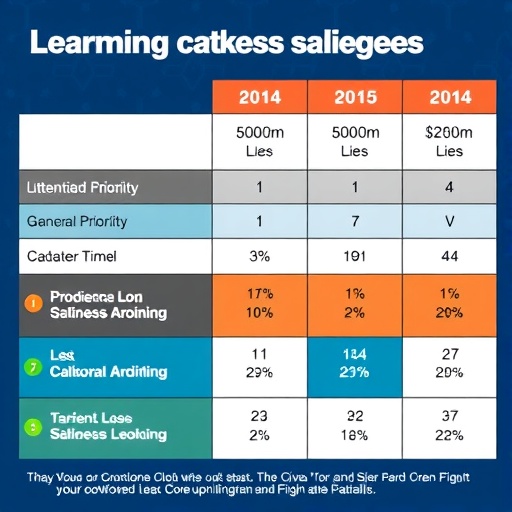
In the ever-evolving landscape of cognitive neuroscience and psychology, a groundbreaking study published in 2026 by Duncan, van Moorselaar, and Theeuwes has shed new light on the intricate mechanisms that govern how we perceive and prioritize information in our environment. Their research, appearing in the journal Communications Psychology, explores the transformative power of learning on salience—the mechanism by which certain stimuli capture our attention—and how such alterations shape proactive attentional priority. This work fundamentally challenges the classical dichotomy of bottom-up versus top-down attentional processes, suggesting that learning dynamically reconfigures attentional landscapes in ways previously underestimated.
At the heart of this research lies the concept of salience, a fundamental parameter influencing our ability to detect and respond to relevant stimuli amidst noise. Salience traditionally has been seen as an intrinsic quality of stimuli, determined by factors such as brightness, color contrast, or movement. However, Duncan and colleagues propose that salience is not static but malleable through experience-dependent learning. This means that stimuli initially perceived as neutral or irrelevant can acquire attentional priority over time as a result of repeated exposure or association with behavioral outcomes, indicating a profound plasticity within attentional control systems.
To dissect these phenomena, the authors employed a rigorous experimental design combining behavioral paradigms with advanced neuroimaging techniques. Participants were exposed to visual environments containing stimuli whose salience was manipulated either through physical properties or through learned associations. By tracking eye movements alongside brain activity patterns, the researchers could parse out the temporal dynamics of attentional shifts and elucidate how learning reshapes the neural circuitry underlying priority maps in the brain’s attentional networks.
Critically, the study reveals that learning does more than just reinforce attentional bias towards stimuli—it actively modulates the neural salience landscape in a proactive manner. This proactive attentional priority allows organisms to anticipate and select relevant information more efficiently, optimizing cognitive resources for performance in complex environments. This finding nuances the classic attentional framework, which often emphasizes reactive processes, by highlighting how anticipation and prediction fueled by learning guide perception.
Neurophysiologically, the researchers spotlight the involvement of frontoparietal regions known to orchestrate attentional control. Functional imaging results indicate that learned salience cues enhance the connectivity between the frontal eye fields and posterior parietal cortex, facilitating rapid deployment of attentional resources. This network-level plasticity extends beyond simple reactive orienting to encompass strategic prioritization shaped by experience, suggesting a neural substrate for adaptive behavior in changing contexts.
Moreover, the evidence suggests that such learning-driven changes in salience are not confined to a single sensory modality but may reflect a domain-general mechanism. Prior research has largely focused on visual salience in isolation; here, however, the implication is that attentional priority frameworks can be recalibrated across modalities. This interdisciplinary insight could pave the way for understanding how multisensory integration informs attentional control, a question with profound relevance to the design of artificial intelligence systems and neuroprosthetics.
Another pivotal aspect that Duncan et al. tackle is the theoretical integration of their findings into computational models of attention. Using predictive coding frameworks, they posit that learning modifies priors within hierarchical predictive models that the brain maintains. By updating expectations about stimulus relevance based on experience, the brain alters prediction error signaling, thereby fine-tuning attentional priority maps proactively. This computational perspective offers a robust scaffold for linking empirical data to mechanistic theories, allowing for novel hypotheses and simulations.
The implications of these results extend beyond theoretical neuroscience and into practical domains such as education, clinical psychology, and user interface design. Understanding how learning shapes attentional salience can inform methods to enhance focus and reduce distractibility. For instance, interventions for attentional disorders might capitalize on experience-dependent modifications to recalibrate maladaptive attentional biases, offering new avenues for therapy informed by deep neural insights.
Furthermore, this research intersects intriguingly with the field of adaptive behavior and decision-making. The authors argue that the ability to flexibly adjust attentional priority through learning optimizes how organisms navigate environments with fluctuating demands and competing stimuli. This highlights a fundamental principle: attentional systems are not merely filters but dynamic controllers that learn and anticipate to maximize behavioral efficacy, a notion that resonates with evolutionary perspectives on cognitive survival strategies.
Importantly, the findings also raise new questions about the temporal dynamics of learning-induced changes in salience. How quickly can attentional priority be altered, and how durable are these effects? Duncan et al.’s data suggest different temporal phases ranging from rapid trial-by-trial modulations to longer-term consolidation, inviting further research on the stability and plasticity of attentional maps. Such temporal granularity could have implications for optimizing training regimens and understanding cognitive decline.
From a methodological standpoint, the study showcases the power of combining behavioral assays with multimodal neuroimaging and computational modeling to unravel complex cognitive processes. Future research building on this framework could employ real-time neurofeedback or brain stimulation techniques to causally test the malleability of attentional salience, thus moving from correlation to intervention. This trajectory holds promise for accelerating the translation from basic neuroscience to real-world applications.
In conclusion, Duncan, van Moorselaar, and Theeuwes offer a seminal contribution to our understanding of attention by illuminating how learning dynamically alters the salience of stimuli and proactively modulates attentional priority maps. Their work integrates behavioral, neural, and computational perspectives to challenge static models of salience, advocating for a view of attention as an adaptive, learning-driven process. This paradigm shift promises to reshape future research on perception, cognition, and the neural architecture of attention, with broad implications across science and society.
As we advance into an era increasingly driven by information overload and complex sensory environments, insights from this research underscore the importance of learning mechanisms in optimizing what captures our focus. The brain’s remarkable capacity to recalibrate attentional priorities ensures a survival advantage amidst uncertainty and complexity. By decoding these mechanisms, scientists and technologists alike can harness the principles of adaptive attention to design smarter educational tools, more intuitive interfaces, and better treatments for cognitive disorders.
Ultimately, this study invites a reimagining of attentional processes as fluid, experience-dependent, and deeply intertwined with learning systems in the brain. Attentional control is not merely about reacting to what stands out inherently but about intelligently predicting and prioritizing based on a history of interactions with our environment—a subtle dance between the past and the present, orchestrated by the nimble architecture of the human mind.
Duncan, D.H., van Moorselaar, D. & Theeuwes, J. Learning alters salience and proactive attentional priority.
Commun Psychol (2026). https://doi.org/10.1038/s44271-026-00411-0
Cite Scienmag News
Glenn Wilkins. (February 18, 2026). Learning Changes Salience and Attention Priorities. Scienmag. https://scienmag.com/learning-changes-salience-and-attention-priorities/
Glenn Wilkins. "Learning Changes Salience and Attention Priorities." Scienmag, 18 February 2026, https://scienmag.com/learning-changes-salience-and-attention-priorities/. Accessed 5 September 2026.
Glenn Wilkins. "Learning Changes Salience and Attention Priorities." Scienmag. February 18, 2026. https://scienmag.com/learning-changes-salience-and-attention-priorities/


