


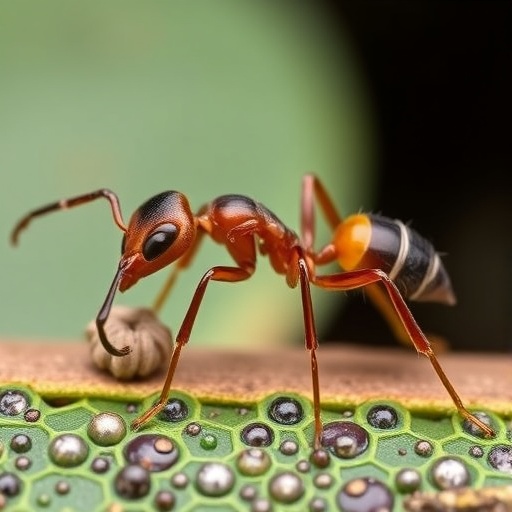
In the heart of tropical forests, leafcutter ants exemplify remarkable strength and coordination, capable of carrying loads multiple times their own body weight. However, new research from the Smithsonian Tropical Research Institute in Panama reveals that this extraordinary ability comes with an unexpected trade-off: the phenomenon of “blind spots” created by oversized loads affects their navigation and efficiency on foraging trails. This discovery not only enhances our understanding of ant behavior but also draws intriguing parallels to vehicular traffic dynamics and logistical efficiency studies in human societies.
Leafcutter ants are among the strongest organisms relative to their size, frequently transporting leaf fragments up to eight times their own weight. Their capacity to organize complex foraging expeditions while managing waste and disease control positions them as exemplary models of natural logistical systems. Yet, when burdened with overly large loads, these ants slow their pace significantly, a phenomenon closely mirroring the “truck-driver effect” observed in highway traffic, where large vehicles impede the flow of trailing traffic up to 50 percent.
The root cause of this impediment, as uncovered by STRI scientists Sabrina Amador and her intern Katherine Porras, lies in the ants’ reliance on their antennae for crucial sensory input. Antennae function as tactile and chemical sensors, allowing ants to detect trail pheromones and environmental features critical for navigation. By analyzing video footage of ants transporting leaves versus those carrying no load, the researchers noted a marked decrease in the frequency of antennae taps per step when ants bore heavy fragments.
To rigorously test this hypothesis, the research team innovatively introduced artificial “leaves” made from paper dipped in orange juice—an alluring stimulus for the ants. Once an ant had grasped such a paper fragment, researchers carefully reduced the load by half using tiny scissors while the ant continued moving. This manipulation revealed a rapid and consistent increase in antennae tapping after load reduction, confirming that excessive weight restricts an ant’s ability to adequately perceive trail cues.
This sensory limitation has profound implications for the ants’ trail-following accuracy. By diminishing tactile interaction with the substrate, heavy loads induce “blind spots,” making it more difficult for ants to detect obstacles or irregularities on their path. Larger ants, which carry comparatively bigger loads, experience this problem more acutely, akin to how oversized trucks face greater navigational challenges on narrow or uneven roads.
The findings elucidate an essential behavioral strategy: despite possessing the physical strength to carry enormous loads, ants may preferentially select smaller fragments to maintain sensory input and thus travel efficiency. This balance between load size and navigational acuity reflects an evolved optimization of foraging logistics, illustrating how mechanical capacity alone does not dictate transport efficacy in social insects.
Beyond their individual plight, the study offers broader insights into collective ant traffic flows. The reduced speed induced by heavily laden ants causes downstream delays analogous to traffic congestion, influencing the entire colony’s resource acquisition rate. Understanding these dynamics contributes to ecological models predicting how foraging efficiency impacts nutrient cycling and forest ecosystem health, given that leafcutter ants harvest an impressive 1–2 tons of plant material annually.
Moreover, the research holds exciting biomimetic potential. The sophisticated coordination and load management exhibited by leafcutter ants have already inspired robotic designs aimed at replicating collective problem-solving and efficient trail navigation. Insights into how these insects mitigate sensory blind spots could inform advancements in swarm robotics, particularly for tasks requiring cooperative transport and obstacle negotiation in complex environments.
Lead intern Katherine Porras reflects on the meticulous observations that led to these revelations: “Paying attention to the minutest behaviors revealed countless questions that fueled our investigations. It’s a testament to the perpetual nature of scientific discovery, that every answer always opens new doors.” Her sentiments underscore the intricate relationship between behavior, physiology, and environmental interaction that defines leafcutter ant societies.
Senior scientist Sabrina Amador emphasizes the real-world parallels drawn from this study: “Leafcutter ants are masters of solving complex logistical challenges. Their strategies for balancing load and sensor feedback resonate with human efforts in optimizing transport networks. Learning from these insects might not only advance entomology but also inspire innovative solutions in human engineering and logistics.”
Ecologically, leafcutter ants play a keystone role in tropical forests, enriching the soil through their foraging activities and influencing plant community dynamics via seed dispersal. Enhancing our understanding of the limitations and adaptations in their foraging strategies has ripple effects across ecosystem management and conservation biology, informing how insect behavior underpins critical ecological processes.
In summary, the STRI team’s discovery of sensory “blind spots” caused by oversized load carriage advances entomological knowledge while drawing fascinating analogies to traffic science and logistics. By combining detailed behavioral observations with experimental manipulations, the researchers decoded a subtle yet significant constraint shaping the foraging performance of one of nature’s most industrious species. This research highlights the sophistication underlying even the tiniest workers in the natural world and opens new avenues for interdisciplinary studies bridging biology, ecology, and engineering.
News Publication Date: 2025
References: Porras-Brenes, K., & Amador-Vargas, S. 2025. Carrying oversized loads may create “blind spots” in leafcutter ants. Insectes Sociaux, 1-13.
Cite Scienmag News
Drew Townsend. (October 7, 2025). Leafcutter Ants Have Blind Spots — Just Like Truck Drivers. Scienmag. https://scienmag.com/leafcutter-ants-have-blind-spots-just-like-truck-drivers/
Drew Townsend. "Leafcutter Ants Have Blind Spots — Just Like Truck Drivers." Scienmag, 7 October 2025, https://scienmag.com/leafcutter-ants-have-blind-spots-just-like-truck-drivers/. Accessed 6 September 2026.
Drew Townsend. "Leafcutter Ants Have Blind Spots — Just Like Truck Drivers." Scienmag. October 7, 2025. https://scienmag.com/leafcutter-ants-have-blind-spots-just-like-truck-drivers/


