


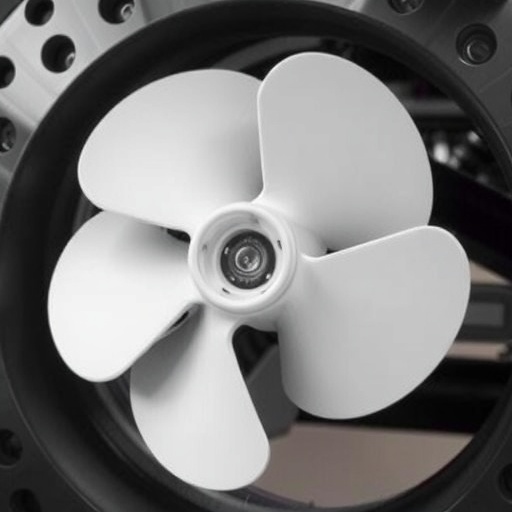
A small change to the leading edge of a propeller blade could help drones generate more thrust while losing less energy to turbulent airflow, according to a new computational study from aerospace engineers in India. The design is inspired by the rounded bumps, known as tubercles, that line the front edges of humpback whale flippers. In simulations, propellers equipped with carefully shaped sinusoidal tubercles outperformed conventional blades, producing higher thrust and improved propulsion efficiency while reducing the regions of separated flow that can undermine aerodynamic performance.
The work, published in Aerospace Systems by Mayuri R. Gore and Ganapati N. Joshi of the Defence Institute of Advanced Technology in Pune, examines whether a feature evolved for maneuverable swimming can solve a persistent problem in rotating machinery. Propellers must transform the mechanical energy of a spinning shaft into thrust, but the flow of air around their blades is highly three-dimensional and unsteady. As each blade rotates, it experiences changing relative wind speeds and angles of attack from hub to tip. Under unfavorable conditions, the boundary layer—the thin layer of air slowed by friction along the blade surface—can detach from the surface. This flow separation creates recirculating regions, increases drag, reduces lift and can trigger fluctuations in thrust, vibration and noise.
Tubercles alter that process by dividing the flow over the blade into a series of spanwise channels. On a smooth leading edge, an adverse pressure gradient can cause the boundary layer to lose momentum and peel away over a broad area. A sinusoidal leading edge instead produces alternating peaks and valleys that redistribute pressure and generate streamwise vortices. These vortices can transfer higher-momentum air toward the surface, helping the boundary layer remain attached for longer. The result is not simply a smoother flow: the bumps reorganize the flow field, potentially preventing a large-scale separation event from spreading across the blade. The approach is biomimetic engineering in its clearest form—copying a physical principle found in nature rather than reproducing an animal’s shape for its own sake.
The researchers used computational fluid dynamics, or CFD, to compare a conventional propeller with versions modified using sinusoidal tubercles. CFD solves the governing equations of fluid motion numerically, allowing researchers to estimate pressure, velocity, turbulence and forces across a complex geometry. For a rotating propeller, the simulation must account for the moving air around the blades and the rotation itself. The study distinguished between a rotating domain, which represents the propeller’s motion, and a stationary or static domain surrounding it. By coupling these regions, the model could calculate how the blades interacted with the surrounding airflow as they turned.
Rather than treating tubercles as a one-size-fits-all feature, the study varied their amplitude and wavelength. Amplitude describes the height of the leading-edge undulations, while wavelength is the distance from one peak to the next. These dimensions determine the strength and spacing of the vortices generated by the bumps. If the undulations are too shallow, they may have little influence on separation; if they are too pronounced, they can add surface area and form drag. Likewise, a wavelength that does not match the blade’s local aerodynamic conditions may generate inefficient vortices or produce uneven loading. Because propeller blades change chord, twist and local velocity along their span, the best geometry is likely to depend on where the tubercles are placed and how their dimensions interact with the operating point.
The simulations evaluated performance using standard propeller measures. Thrust, measured in newtons, is the force that pushes a drone or aircraft forward or holds it aloft. Power describes the energy required to turn the propeller. Dimensionless thrust and power coefficients, commonly written as Kₜ and Kₚ, allow designs to be compared across different sizes and rotational speeds. The advance ratio, J, relates the vehicle’s forward speed to the propeller’s rotational speed and diameter; it helps describe whether a propeller is operating in hovering, climbing or forward-flight conditions. Together, these quantities reveal whether a blade produces more useful force for the same energy input, rather than merely generating a larger force by consuming substantially more power.
According to the study’s abstract, the optimized tubercle configuration generated a notable increase in thrust and overall propulsion efficiency compared with the conventional design, while also reducing flow separation. The aerodynamic benefit is especially relevant to small uncrewed aircraft, whose propellers often operate at low Reynolds numbers. At these scales, viscous effects are relatively strong and the boundary layer can be more vulnerable to separation than on a large aircraft propeller. Small drones also frequently operate close to buildings, vegetation and people, where abrupt changes in flight conditions can produce unstable loading. A blade that maintains attached flow across a broader operating range could improve control as well as energy use, although the present findings come from numerical analysis rather than flight testing.
Noise reduction is another reason the result is likely to attract attention beyond specialist aerodynamics. Propeller noise is produced by several mechanisms, including periodic loading as blades pass through the air, turbulent fluctuations in the boundary layer, tip vortices and interactions between rotating and stationary components. Flow separation can amplify unsteady pressure on the blade, which is then transmitted as sound and vibration. By smoothing the development of separated regions and organizing turbulence into more stable structures, tubercles may reduce some of these fluctuations. The researchers describe the design as capable of reducing noise and vibration, but the supplied study summary does not provide acoustic measurements or numerical noise levels. That distinction matters: improved aerodynamic flow is a promising route to quieter operation, but it does not establish how much quieter a finished drone would be in real conditions.
The implications extend from consumer drones to autonomous delivery aircraft, inspection vehicles and other compact aerial systems that must extract maximum performance from limited battery capacity. Higher propulsive efficiency could lengthen flight time or allow a vehicle to carry additional sensors and payload. More stable blade loading could also reduce mechanical stress on motors and mounts, potentially improving reliability. Yet the geometry introduces practical questions that CFD alone cannot settle. Tubercles may complicate manufacturing, increase sensitivity to surface roughness and affect performance differently during hover and forward flight. Their interaction with blade pitch, rotational speed, air density and neighboring blades will need to be tested experimentally. The researchers’ methodology nevertheless provides a pathway for optimizing those variables rather than relying on a visually appealing but aerodynamically arbitrary pattern. With all data generated or analyzed reported in the article and no external datasets used, the study offers a computational foundation for prototypes that can be evaluated in wind tunnels and on operating drones. The broader lesson is that the next leap in rotor technology may not require a radically new motor or battery: it could begin with a row of whale-like bumps placed in exactly the right position.
Cite Scienmag News
Denise Maddox. (August 27, 2026). Leading-Edge Propeller Blade Tubercles Control Flow Separation and Boost Performance. Scienmag. https://scienmag.com/leading-edge-propeller-blade-tubercles-control-flow-separation-and-boost-performance/
Denise Maddox. "Leading-Edge Propeller Blade Tubercles Control Flow Separation and Boost Performance." Scienmag, 27 August 2026, https://scienmag.com/leading-edge-propeller-blade-tubercles-control-flow-separation-and-boost-performance/. Accessed 4 September 2026.
Denise Maddox. "Leading-Edge Propeller Blade Tubercles Control Flow Separation and Boost Performance." Scienmag. August 27, 2026. https://scienmag.com/leading-edge-propeller-blade-tubercles-control-flow-separation-and-boost-performance/


