


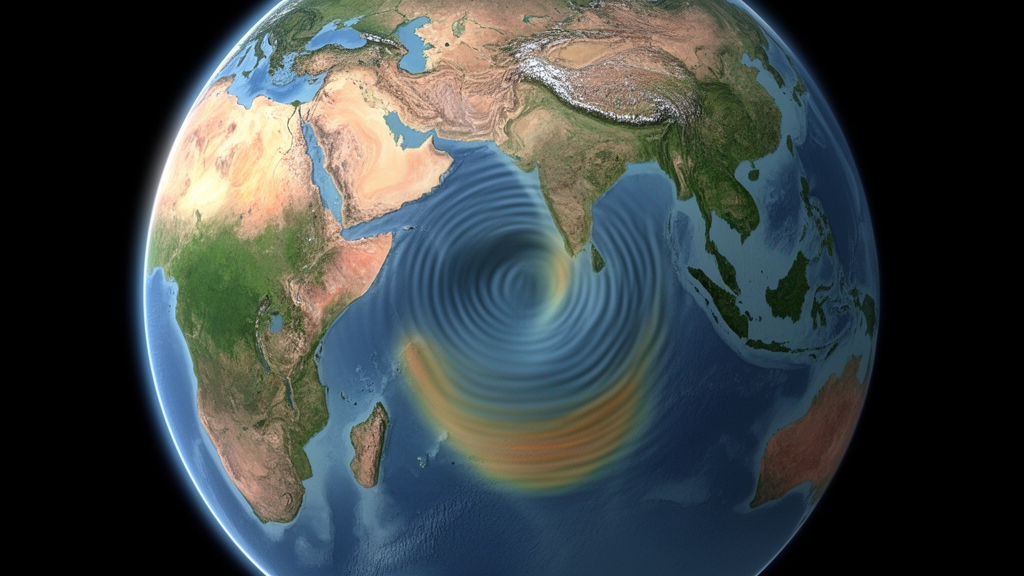
A standardized review of 54 sea-level index points from South Asia and the Indian Ocean reveals a striking geographic contrast: Last Interglacial shorelines now sit high on tectonically uplifted coasts, close to present sea level along peninsular India, and deep below the ocean surface on subsiding reefs. The synthesis covers evidence from southern Iran, northern Oman, western and southern India, the Maldives and the Cocos (Keeling) Islands, drawing on 17 peer-reviewed studies and their chronological data. It is a review and re-evaluation of previously published observations rather than a new field survey, and the authors note that it fills a geographic gap in global compilations of Last Interglacial sea-level indicators.
The study covers the broadly defined Last Interglacial, or Marine Isotope Stage 5, from about 132,000 to 80,000 years ago. Its authors re-evaluated the stratigraphic context, elevation measurements, depositional environments and age constraints of each index point within the World Atlas of Last Interglacial Shorelines, or WALIS, framework. Seven types of evidence were represented: beach deposits or beachrock, beach ridges, coral reef terraces, shallow or intertidal marine fauna, marine terraces and tidal notches. Chronological constraints came from uranium-thorium dating of corals and mollusks, luminescence dating, electron spin resonance and one cosmogenic nuclide measurement. The resulting database is designed to support more consistent comparisons among sites that preserve sea-level evidence in very different tectonic and geomorphic settings.
Central to the re-analysis was the concept of an indicator’s “indicative meaning”: the vertical range in which a particular coastal feature can form, together with a reference water level at the midpoint of that range. This matters because a coral reef, marine terrace or tidal notch does not necessarily form at exactly the same vertical level as a beach deposit. The researchers used IMCalc software to generate ex situ estimates of reference water level and indicative range from global tidal and wave data, allowing evidence from different indicator types to be treated more consistently. This approach was particularly important where direct observations of modern analogues were unavailable, although the authors emphasize that the estimates remain dependent on the available global datasets and the limitations of the original site records.
The elevation measurements also reveal the uneven quality of the historical archive. Most index-point elevations had been determined with barometric altimeters or with tape and Abney levelling, methods the review describes as inherently less precise and potentially associated with substantial uncertainty. Only a small number used differential GPS, and five Iranian points lacked any reported measurement technique. Exact coordinates were also often unavailable, so locations were estimated from place names or by georeferencing original maps. These gaps do not invalidate the records, but they constrain the precision with which small elevation differences can be interpreted. The review therefore treats the database as a standardized synthesis of both observations and uncertainty, not simply a list of numerical heights.
Southern Iran and northern Oman contain the highest Last Interglacial indicators, reflecting uplift associated with the Zagros foreland, salt-related deformation and the Makran subduction system. Marine terraces and coral-bearing reef platforms assigned to MIS 5e, MIS 5c and MIS 5a are preserved at roughly 20–60 metres above present sea level in many locations. At Haleh, corals in growth position from a terrace 33–23 metres above sea level were dated by uranium-thorium to 111,000 ± 4,000 years, with an uplift rate of about 0.2 millimetres per year subsequently estimated by the original researchers. At Jazeh, in-situ Porites corals from a terrace 35–25 metres above sea level produced ages of 121,000 ± 6,000 and 117,000 ± 6,000 years.
Farther east along the Makran coast, the Konarak T3 terrace stands at 32 metres above present sea level and has a fading-corrected luminescence age of 141,300 ± 12,100 years. The Ramin T1 terrace, at 59.5 ± 2.0 metres, is associated with a luminescence age of 140,200 ± 12,500 years, while a lower bench at 3 metres was dated to 78,000 years and linked to MIS 5a. At Lipar, the T3 terrace reaches 58.5 metres above sea level and has an OSL age of 130,280 ± 10,000 years; lower terraces dated between 73,000 and 80,000 years are associated with MIS 5a. The original Lipar study estimated uplift rates of approximately 0.25–0.57 millimetres per year since the Last Interglacial. The islands of Kish and Qeshm also preserve elevated reef terraces, with their complex records suggesting persistent uplift and, in some cases, preservation of reefs from different interglacial stages at similar elevations.
Peninsular India offers a markedly lower and more uniform sequence. Last Interglacial indicators on the Saurashtra coast and along the Tamil Nadu shoreline generally stand 1–4 metres above present sea level. Fossiliferous miliolite at Porbandar and Tunkra occurs at about 4 metres, with electron spin resonance ages of 94,900 ± 10,000, 97,600 ± 10,000 and 105,000 ± 10,000 years. At Cape Comorin, a cemented beach conglomerate 1.2 metres above low-tide level yielded a uranium-thorium age of 112,000 years, with uncertainty extending from plus 16,000 to minus 14,000 years. Additional records occur at Idindakarai, Manappad and Rameshwaram, where shallow-marine sediments, beachrock and in-situ corals fall mostly between 1 and 5 metres above sea level. The authors interpret this low, broadly consistent pattern as evidence for a tectonically stable to slightly subsiding passive margin, potentially affected by glacial isostatic adjustment.
The Indian Ocean islands provide the deepest indicators and clearest evidence of continuing subsidence. At Rasdhoo Atoll in the central Maldives, coralgal deposits lie 14.5 metres below present sea level. Uranium-thorium dating produced a reliable age of 136,900 ± 2,000 years for one well-preserved acroporid coral, alongside two moderately reliable ages of 114,300 ± 1,500 and 117,300 ± 2,700 years that were partly affected by diagenetic alteration. The deposits indicate a shallow back-reef environment with reconstructed water depths below 10 metres. At the Cocos (Keeling) Islands, drilling revealed a boundary between poorly consolidated Holocene sediment and well-lithified reef limestone at 8–11 metres below sea level. A massive faviid coral from 10.5 metres below sea level produced uranium-thorium ages of 118,000 ± 7,000 and 123,000 ± 7,000 years. These submerged reefs support estimated subsidence rates of 0.09–0.16 millimetres per year in the Maldives and 0.1–0.12 millimetres per year at Cocos.
Taken together, the 54 index points show why ancient shoreline height cannot be read as a direct global sea-level gauge. A reef formed at a particular level in the past may now stand tens of metres above sea level in a zone of long-term crustal uplift, remain only a few metres high on a stable continental margin, or lie more than 10 metres below the ocean on a sinking carbonate platform. The review attributes the regional differences primarily to tectonics, dynamic topography and glacio-hydro-isostatic forcing, while also cautioning that the proxy records and age assignments vary in quality. Large gaps remain along Pakistan’s roughly 1,050-kilometre coast and parts of India, where published documentation is insufficient for reliable standardization. The database nevertheless offers a regional baseline for future modelling of sea-level change, vertical land motion and Indian Ocean tectonics, and a set of varied coastlines against which the long-term response of shorelines to rising seas can be compared.
Subject of Research: Last Interglacial relative sea-level indicators and vertical land motion across South Asia and the Indian Ocean
Article Title: A review of Last Interglacial sea-level proxies in South Asia and the Indian Ocean
Article References: Ali, M., Cerrone, C., & Rovere, A. (2026). A review of Last Interglacial sea-level proxies in South Asia and the Indian Ocean. Earth System Science Data, 18(10), 7627-7643. https://doi.org/10.5194/essd-18-7627-2026
Image Credits: AI Generated
DOI: 10.5194/essd-18-7627-2026
Keywords: Last Interglacial sea level, Indian Ocean, South Asia, relative sea level, paleo-reefs, marine terraces, tectonic uplift, glacial isostatic adjustment, WALIS, coral chronology, review, Last
Cite Scienmag News
Violet Maxwell. (October 20, 2026). Last Interglacial sea levels reveal sharply contrasting motions across the Indian Ocean. Scienmag. https://scienmag.com/last-interglacial-sea-levels-reveal-sharply-contrasting-motions-across-the-indian-ocean/
Violet Maxwell. "Last Interglacial sea levels reveal sharply contrasting motions across the Indian Ocean." Scienmag, 20 October 2026, https://scienmag.com/last-interglacial-sea-levels-reveal-sharply-contrasting-motions-across-the-indian-ocean/. Accessed 20 October 2026.
Violet Maxwell. "Last Interglacial sea levels reveal sharply contrasting motions across the Indian Ocean." Scienmag. October 20, 2026. https://scienmag.com/last-interglacial-sea-levels-reveal-sharply-contrasting-motions-across-the-indian-ocean/


