For children undergoing chemotherapy, one of the most dreaded consequences of treatment is not the cancer itself but a side effect that most people have never heard of. Oral mucositis, a painful inflammation and ulceration of the lining of the mouth, strikes between 50 and 80 percent of pediatric cancer patients depending on the regimen they receive. It typically emerges three to ten days after chemotherapy, can persist for up to three weeks, and in severe cases brings ulceration, secondary infection, and even sepsis. Now a new study from Brazil suggests that the way clinicians deliver a promising light-based therapy to prevent this condition may matter almost as much as the therapy itself, at least in the eyes of the families who endure it.
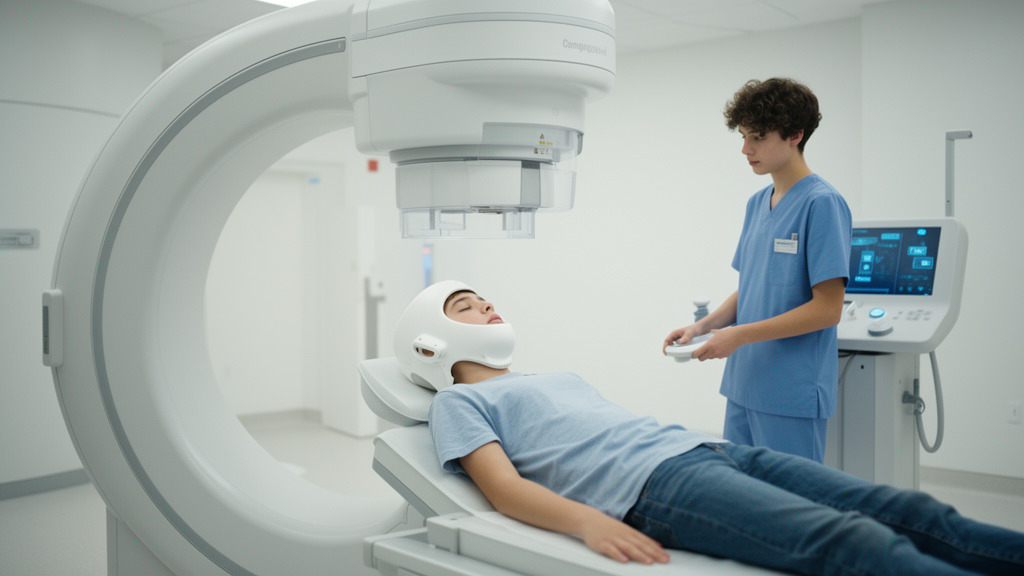
The research, published in the journal Supportive Care in Cancer, compared two ways of administering photobiomodulation therapy, a technique that uses low-level lasers to stimulate tissue healing and reduce inflammation. In the intraoral approach, the laser is applied directly inside the mouth, touching the mucosa at dozens of precisely mapped points. In the extraoral approach, light is delivered from outside the cheek and lips, requiring no mouth opening and no contact with sensitive tissue. A team led by researchers at the Federal University of Paraná and Erasto Gaertner Hospital in Curitiba found that when families experienced both methods, nearly two-thirds preferred the extraoral technique, driven overwhelmingly by one factor: comfort.
The study enrolled pediatric patients aged eighteen or younger who were being treated for leukemia, lymphoma, or osteosarcoma with high-dose methotrexate, a chemotherapy drug strongly associated with mucositis. Because the trial used a crossover design, every child received both forms of photobiomodulation during successive chemotherapy cycles, typically spaced three weeks apart. Treatment began before the methotrexate infusion and continued daily until hospital discharge, with a median of four sessions per cycle. After experiencing both modalities, parents and caregivers completed a structured nine-item questionnaire about their preferences, the discomfort they observed, and their impressions of how well each method controlled pain.
The technical contrast between the two protocols was striking. The intraoral protocol, adapted from guidelines issued by the Multinational Association of Supportive Care in Cancer and the International Society of Oral Oncology, required irradiation at forty-two separate points distributed across the buccal mucosa, the tongue, the floor of the mouth, the lips, and the soft palate. Light delivery alone took roughly seven minutes, with total clinical time stretching from twenty to forty minutes. The extraoral device, by comparison, used eight emitters firing simultaneously, four lateral ones delivering 4.30 joules per square centimeter and four central ones delivering 34.50 joules per square centimeter, across just three anatomical regions: the orbicularis oris muscle and the left and right buccinator muscles. Each region received ten seconds of irradiation, and the entire appointment lasted five to ten minutes.
The results were unambiguous on the question of tolerability. Discomfort during application was reported by 43.8 percent of caregivers for the intraoral method but only 6.3 percent for the extraoral method, a difference that reached statistical significance with a p-value of 0.001 using McNemar’s test for paired comparisons. When asked which modality they preferred, 65.6 percent chose the extraoral approach, citing greater comfort and the advantage of not needing to hold the mouth open. This matters enormously in pediatric oncology, where children may suffer from trismus, pain, or simply limited cooperation during mucositis episodes, making prolonged intraoral procedures difficult or impossible to complete.
Yet the story grew more nuanced when the researchers examined perceptions of pain control. Although families preferred the extraoral device for its comfort, 34.4 percent believed the intraoral method provided better pain relief, compared with only 12.5 percent who favored the extraoral route for analgesia. The authors offer a plausible biophysical explanation: when light must traverse multiple tissue barriers from outside the face, some energy is dissipated before reaching the target tissue, potentially weakening the analgesic effect. Differences in the severity and distribution of mucositis lesions between cycles may also have confounded how caregivers judged pain relief. Notably, however, these subjective impressions did not correspond to measurable differences in the occurrence or severity of oral mucositis between the two modalities.
Indeed, half of the children in the sample developed oral mucositis during follow-up, and no statistically significant association emerged between the preferred modality and mucositis occurrence. The researchers are careful to frame this as exploratory rather than as proof that the two methods are clinically equivalent, given the small sample of thirty-two respondents and a 15.6 percent rate of missing data caused by the inability to link some online questionnaire responses to clinical records. The study was also not prospectively registered, lacked a formal sample-size calculation for the questionnaire component, and relied on retrospective caregiver recall, all of which introduce the possibility of bias, particularly recency effects from the most recent treatment cycle.
What the findings do establish, the authors argue, is that acceptance and tolerability deserve a seat at the table when clinicians choose supportive care protocols. Photobiomodulation is already recommended by international guidelines for preventing oral mucositis in adults receiving head and neck radiotherapy or hematopoietic stem cell transplantation, but pediatric protocols remain fragmented, with no consensus on optimal dosimetric parameters. Because the therapy must be repeated daily across several days of hospitalization, the cumulative burden of an uncomfortable procedure compounds quickly. The extraoral approach also avoids direct contact with ulcerated tissue, which may reduce the risk of opportunistic infections in immunocompromised children and simplifies clinical logistics in busy inpatient units.
The Brazilian results align with a growing international literature. Earlier feasibility studies of extraoral photobiomodulation in pediatric inpatient settings reported successful daily prophylaxis without pain or treatment interruption, and a combined intraoral-extraoral therapeutic protocol achieved success in 77 percent of mucositis episodes with no adverse events. A recent multicenter randomized trial in adults with head and neck cancer found no relevant differences between the two routes in mucositis severity, lesion duration, or functional impairment. In the absence of evidence that one delivery method is clinically superior, one research group has suggested that the best parameter set may simply be the one that is fastest and most comfortable for the patient, a principle the new caregiver data strongly reinforce.
For the roughly 34 percent of families in the study who still preferred the intraoral method, and for the caregivers who perceived it as more effective at controlling pain, the trade-off is not trivial. The authors emphasize that perceived efficacy in their study reflects subjective impressions, not measured clinical outcomes, and they call for larger, prospectively designed trials to settle questions of comparative effectiveness. But their central message is one that resonates far beyond laser dentistry: in pediatric medicine, the treatment a child can tolerate day after day may be the treatment that ultimately works best. When a therapy’s success depends on repeated administration in patients too young, too sick, or too sore to cooperate, comfort is not a luxury. It is a clinical variable, and one that the extraoral laser, in this study at least, decisively won.
Subject of Research: Acceptance and perceived efficacy of intraoral versus extraoral photobiomodulation for preventing oral mucositis in pediatric oncology patients
Article Title: Acceptance and perceived efficacy of intraoral versus extraoral photobiomodulation for oral mucositis prevention in pediatric patients
Article References: Acceptance and perceived efficacy of intraoral versus extraoral photobiomodulation for oral mucositis prevention in pediatric patients. (n.d.). https://doi.org/10.1007/s00520-026-11227-3
Image Credits: AI Generated
DOI: 10.1007/s00520-026-11227-3
Keywords: photobiomodulation, oral mucositis, pediatric oncology, low-level laser therapy, chemotherapy side effects, supportive care, high-dose methotrexate, caregiver-reported outcomes, extraoral laser, intraoral laser, treatment tolerability, MASCC/ISOO guidelines
Cite Scienmag News
Nathaniel Bowman. (October 8, 2026). Lasers Outside the Mouth Win Over Young Cancer Patients, Study Finds. Scienmag. https://scienmag.com/lasers-outside-the-mouth-win-over-young-cancer-patients-study-finds/
Nathaniel Bowman. "Lasers Outside the Mouth Win Over Young Cancer Patients, Study Finds." Scienmag, 8 October 2026, https://scienmag.com/lasers-outside-the-mouth-win-over-young-cancer-patients-study-finds/. Accessed 8 October 2026.
Nathaniel Bowman. "Lasers Outside the Mouth Win Over Young Cancer Patients, Study Finds." Scienmag. October 8, 2026. https://scienmag.com/lasers-outside-the-mouth-win-over-young-cancer-patients-study-finds/