


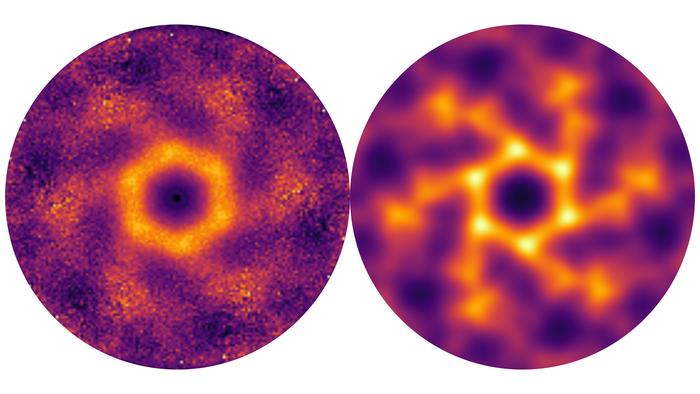
A 3D quantum spin liquid has been discovered in the vicinity of a member of the langbeinite family. The material’s specific crystalline structure and the resulting magnetic interactions induce an unusual behaviour that can be traced back to an island of liquidity. An international team has made this discovery with experiments at the ISIS neutron source and theoretical modelling on a nickel-langbeinite sample.

Credit: HZB
A 3D quantum spin liquid has been discovered in the vicinity of a member of the langbeinite family. The material’s specific crystalline structure and the resulting magnetic interactions induce an unusual behaviour that can be traced back to an island of liquidity. An international team has made this discovery with experiments at the ISIS neutron source and theoretical modelling on a nickel-langbeinite sample.
When spins in a crystal lattice cannot align to reach a minimum energy together, this is called magnetic frustration. If this frustration becomes large enough, the spins continue to fluctuate in a disordered way, even as the temperature approaches zero and the material behaves as a quantum spin liquid. Quantum spin liquids (QSLs) have remarkable properties, including topologically protected phenomena, potentially useful, for example, for future, particularly stable qubits. Initially, quantum spin liquids were mainly studied in two-dimensional structures, but the phenomenon can also occur in 3D structures, although much less frequently.
The search for frustration
An international collaboration has now demonstrated this behaviour in a new class of materials with a 3D structure: Langbeinites are sulphate minerals, rarely found in nature; replacing one or two elements in the sum formula produces variations that all belong to this class of materials.
Artificial langbeinite crystals with the molecular formula K2Ni2(SO4)3 were created for the study. The magnetic element nickel plays a key role here: the nickel ions form two so-called trillium lattices that are entangled with each other. This creates the desired magnetic frustration, which is further enhanced when an external magnetic field is applied: The magnetic moments of the nickel ions cannot all align in an energetically favourable way, but fluctuate and form a quantum spin liquid.
Neutron data and theory: a nearly perfect fit
The team led by Ivica Živkovič at the EPFL was able to measure the magnetic fluctuations at the British neutron source ISIS in Oxford. The samples behave like a quantum spin liquid, not only at extremely low temperatures, but even at “lukewarm” 2 Kelvin.
The team led by HZB theorist Johannes Reuther was able to explain the measured data using several theoretical methods. “Our theoretical phase diagram even identifies an “island of liquidity” at the centre of a strongly frustrated tetratrillium lattice,” says Matias Gonzalez, first author of the study and postdoctoral researcher in Reuther’s team, who carried out the Monte Carlo simulations. PhD student Vincent Noculak calculated the interactions between the spins using a method based on Feynman diagrams that Reuther developed several years ago (pseudo-fermion function renormalisation group, PFFRG). The agreement between the measured data and the theoretical results is surprisingly good. “Despite its extremely complex interactions, we can reproduce this system very well,” says Reuther.
QSL-candidates in the Langbeinites
Langbeinites are a large and largely unexplored class of materials. The study shows that the search for quantum behaviour can be worthwhile here. The team led by HZB physicist Bella Lake has already synthesised new representatives of this class of materials, which could also be regarded as 3D quantum spin liquids. “This is still purely fundamental science,” emphasises Johannes Reuther, “but with the growing interest in new types of quantum materials, the Langbeinite materials could become interesting for applications in quantum information.”
arö
Journal
Nature Communications
Method of Research
Experimental study
Subject of Research
Not applicable
Article Title
Dynamics of K2Ni2(SO4)3 governed by proximity to a 3D spin liquid model
Article Publication Date
21-Aug-2024
COI Statement
none
Cite Scienmag News
Katie Riggs. (August 23, 2024). Langbeinites show talents as 3D quantum spin liquids. Scienmag. https://scienmag.com/langbeinites-show-talents-as-3d-quantum-spin-liquids/
Katie Riggs. "Langbeinites show talents as 3D quantum spin liquids." Scienmag, 23 August 2024, https://scienmag.com/langbeinites-show-talents-as-3d-quantum-spin-liquids/. Accessed 4 September 2026.
Katie Riggs. "Langbeinites show talents as 3D quantum spin liquids." Scienmag. August 23, 2024. https://scienmag.com/langbeinites-show-talents-as-3d-quantum-spin-liquids/

