


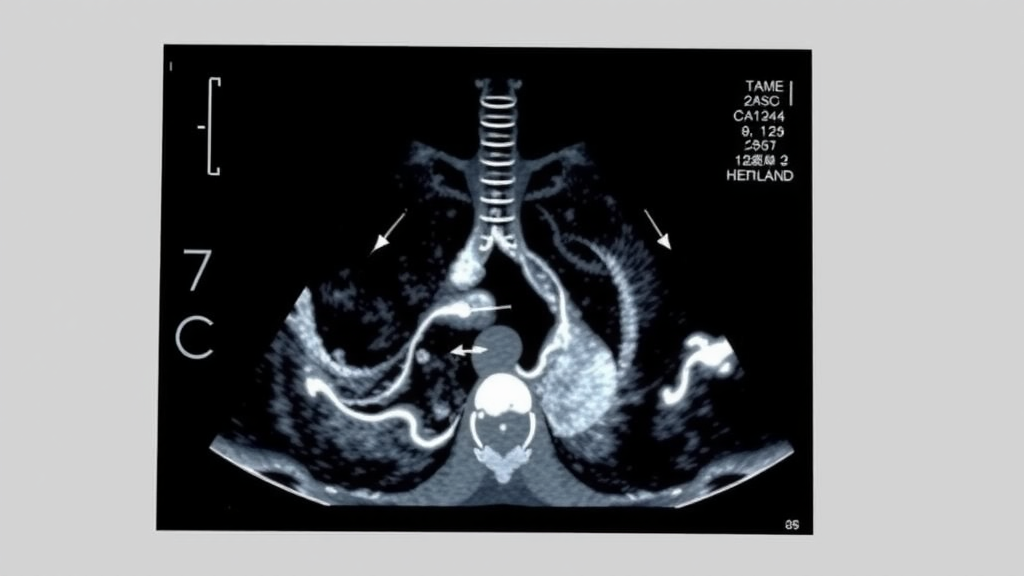
In a move that could reshape how doctors sample suspicious lung lesions around the world, a coalition of more than ten leading Chinese medical societies has released the first comprehensive expert consensus dedicated to ultrasound-guided percutaneous lung needle biopsy, a technique that lets physicians extract tissue from lung tumors without a single X-ray. The document, published in Clinical Cancer Bulletin as the 2025 edition, distills the collective experience of nearly one hundred specialists from ultrasound, radiology, thoracic surgery, respiratory medicine, oncology, tuberculosis, and interventional medicine into eighteen evidence-based recommendations covering every stage of the procedure, from the first preoperative scan to the final follow-up visit.
The technique at the heart of the consensus, known as US-PLNB, exploits a simple physical fact: sound waves cannot travel through air. That limitation once confined ultrasound to soft tissues like the liver and thyroid, but it becomes an unexpected advantage at the lung’s edge. When a tumor sits directly against the chest wall—the so-called subpleural position—with no aerated lung in between, ultrasound can see it with exquisite clarity, and in real time. Unlike computed tomography, which offers only static snapshots and exposes patients to ionizing radiation, ultrasound shows the needle, the lesion, and the beating, breathing anatomy between them continuously, allowing operators to adjust course millimeter by millimeter. The consensus notes that this real-time capability makes ultrasound particularly valuable for small, mobile lesions near the heart, great vessels, or the lung apex, where a misplaced needle could prove catastrophic.
The document does not pretend ultrasound is a universal solution. Because air blocks sound, the technique applies only to lesions abutting the parietal pleura or to central tumors made visible by surrounding collapse, consolidation, or fluid that creates an acoustic window. CT guidance remains superior for deep and central lesions, offering precise localization at the cost of radiation and longer procedure times. The consensus positions US-PLNB as the first-line method for subpleural lesions, citing reported complication rates of 1.1 to 32.7 percent and safety data consistently favoring ultrasound over CT guidance, including a retrospective series of 3,043 consecutive patients and comparative studies showing shorter wait times and procedure durations.
What distinguishes the new document from prior guidelines, such as those from the British Thoracic Society and the Korean Society of Thoracic Radiology, is its embrace of multimodal ultrasound. Beyond conventional gray-scale imaging, the consensus details how color Doppler imaging maps blood flow within and around a lesion, distinguishing the bidirectional, high-resistance waveform of pulmonary arteries—typical of benign lesions—from the low-resistance bronchial arterial signals and chaotic arteriovenous waveforms that betray malignancy. Elastography adds another dimension: stiff, blue-dominant lesions on strain imaging, or those with shear wave velocities above 2.47 meters per second, are highly likely to be malignant, with reported sensitivity and specificity reaching 98 percent in some series. These tools let operators target the most suspicious, viable regions of a tumor before the needle ever advances.
The most technically sophisticated section concerns contrast-enhanced ultrasound. After an intravenous injection of sulfur hexafluoride microbubbles, malignant lesions typically light up in a snowing-like or curly hair-like pattern as disorganized tumor neovessels fill from the periphery, while benign lesions enhance in a tree-like pattern radiating from the hilum, reflecting preserved pulmonary arterial supply. Because normal lung receives roughly 85 percent of its blood from pulmonary arteries and only 15 percent from bronchial arteries—and because tumors progressively destroy the pulmonary supply in favor of bronchial arteries—the timing of contrast arrival becomes a diagnostic signature. The consensus highlights an arrival-time difference ratio, comparing lesion enhancement against both adjacent lung and chest wall references, that achieved 91 percent diagnostic accuracy at a threshold of 43 percent in published studies. Contrast imaging also reveals necrotic, non-enhancing zones that would yield useless specimens, allowing operators to steer toward viable tissue and reduce false negatives.
Procedural detail in the consensus is granular to the point of being a manual. It specifies that warfarin should be bridged with low-molecular-weight heparin a week before biopsy, aspirin stopped three days ahead, clopidogrel five days ahead, platelets kept above 50 billion per liter, and the international normalized ratio below 1.5. Bevacizumab, the anti-angiogenic drug, must be withheld for roughly four weeks. The document contrasts fine-needle aspiration, which yields cytology with sensitivity of 90 to 95 percent for malignancy, against core needle biopsy, which provides intact histology essential for immunohistochemistry and molecular typing, and recommends combining both to maximize diagnostic yield. Needle selection, firing mechanisms, coaxial techniques that allow multiple samples through a single pleural puncture, and even methods to improve needle visibility on screen—jiggling the needle, injecting saline to outline its track—are all codified.
Complications receive equally rigorous treatment. Hemorrhage, the most common adverse event at 0.3 to 9.9 percent incidence, is managed with a graded protocol from bed rest for minor bleeding through vasopressin and tranexamic acid for moderate hemoptysis to emergency embolization for massive hemorrhage. Pneumothorax, occurring in 0.8 to 11.6 percent of cases, can often be resolved on the spot by aspirating air through the coaxial introducer needle—a maneuver the consensus illustrates with cases in which lesions obscured by escaped air became fully visible again after 20 milliliters were withdrawn. The rarest and deadliest complication, systemic arterial air embolism, carries a mortality of up to 26 percent; the consensus explains that as little as half a milliliter of air in the coronary circulation can be fatal and mandates avoiding aerated bronchi, upright positioning, and positive-pressure ventilation during puncture.
The methodology behind the consensus is as notable as its content. Developed according to the WHO Handbook for Guideline Development and registered on the PREPARE platform, it employed a three-tier structure—a steering committee of five senior experts, a fifteen-member writing group, and a voting panel of nearly one hundred multidisciplinary specialists. Clinical questions were gathered through surveys of more than one hundred physicians, evidence was systematically retrieved from eight Chinese and international databases through August 2025, study quality was assessed with Cochrane, Newcastle-Ottawa, and QUADAS tools, and recommendations were graded using the GRADE framework and ratified through two rounds of anonymous Delphi voting requiring at least 80 percent agreement.
The consensus also looks forward. It endorses image fusion and volume navigation technology, in which electromagnetic sensors track the ultrasound probe and biopsy needle in space, fusing real-time ultrasound with pre-acquired CT volumes to guide biopsies of lesions once considered beyond ultrasound’s reach. The authors acknowledge that large prospective randomized trials directly comparing ultrasound with other guidance modalities are still lacking, and they commit to annual literature monitoring and timely updates as new evidence emerges. For now, the document stands as both a practical manual and a statement of ambition: that a technique once dismissed as too limited for the air-filled lung has matured, with the help of contrast agents, elastography, and navigation systems, into a precise, radiation-free first-line approach for the growing population of patients whose lung lesions sit within reach of a sound wave.
Subject of Research: Development of the first Chinese expert consensus standardizing ultrasound-guided percutaneous lung needle biopsy for subpleural pulmonary lesions
Article Title: Chinese expert consensus on ultrasound-guided percutaneous lung needle biopsy (2025 Edition)
Article References: Wang, Y., Xu, H., & on behalf of Chinese Society of Ultrasound in Medicine, Interventional Physicians Branch of the Chinese Medical Doctor Association, Minimally Invasive Therapy for Oncology Committee of Chinese Anti-Cancer Association, Ultrasound Branch of the Chinese Anti-Tuberculosis Association, Tuberculosis Control and Prevention Branch of the China International Exchange and Promotive Association for Medical and Health Care, Ultrasound Equipment Technology Branch of China Association of Medical Equipment, Ultrasound Su (2026). Chinese expert consensus on ultrasound-guided percutaneous lung needle biopsy (2025 Edition). Clinical Cancer Bulletin, 5(1), Article 4. https://doi.org/10.1007/s44272-026-00055-5
Image Credits: AI Generated
DOI: 10.1007/s44272-026-00055-5
Keywords: ultrasound-guided biopsy, lung biopsy, subpleural pulmonary lesions, expert consensus, contrast-enhanced ultrasound, elastography, interventional ultrasound, pneumothorax, lung cancer diagnosis, image fusion navigation, core needle biopsy, clinical guideline
Cite Scienmag News
Nathaniel Bowman. (September 23, 2026). Landmark Chinese Consensus Sets First Global Standard for Ultrasound-Guided Lung Biopsy. Scienmag. https://scienmag.com/landmark-chinese-consensus-sets-first-global-standard-for-ultrasound-guided-lung-biopsy/
Nathaniel Bowman. "Landmark Chinese Consensus Sets First Global Standard for Ultrasound-Guided Lung Biopsy." Scienmag, 23 September 2026, https://scienmag.com/landmark-chinese-consensus-sets-first-global-standard-for-ultrasound-guided-lung-biopsy/. Accessed 5 October 2026.
Nathaniel Bowman. "Landmark Chinese Consensus Sets First Global Standard for Ultrasound-Guided Lung Biopsy." Scienmag. September 23, 2026. https://scienmag.com/landmark-chinese-consensus-sets-first-global-standard-for-ultrasound-guided-lung-biopsy/


