

Tuesday, October 20, 2026
Science
No Result
View All Result
  • Login
  • HOME
  • SCIENCE NEWS
  • CONTACT US
  • HOME
  • SCIENCE NEWS
  • CONTACT US
No Result
View All Result
Scienmag
No Result
View All Result
Home Science News Technology and Engineering

Lab study links Sb2S3/BiOBr heterojunction to H2O2 production and tetracycline removal

October 20, 2026
in Technology and Engineering
Denise Maddox
By Denise Maddox Scienmag Editorial Profile - Mechanical Engineering
Reading Time: 2 mins read
0
Core-Shell Photocatalyst Turns Antibiotic Wastewater Into Hydrogen Peroxide

Core-Shell Photocatalyst Turns Antibiotic Wastewater Into Hydrogen Peroxide

65
SHARES
587
VIEWS
Share on FacebookShare on Twitter
ADVERTISEMENT

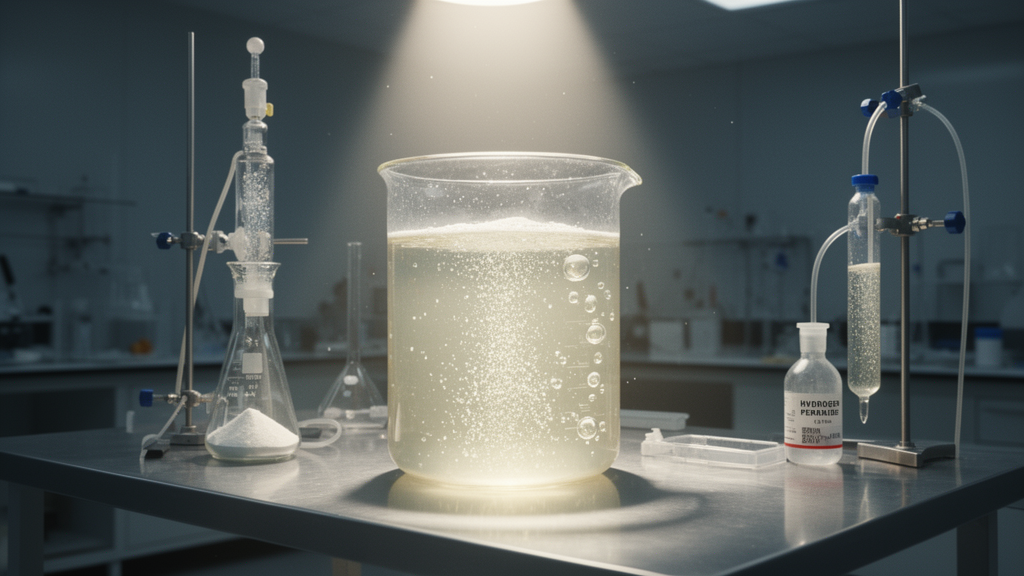
An experimental materials study reports that a visible-light-responsive core-shell Sb2S3/BiOBr S-scheme heterojunction generated hydrogen peroxide while removing tetracycline hydrochloride from contaminated water without an external sacrificial agent. The composite, designated SS/BOB-0.6, produced 419.54 µmol L−1 of H2O2 within 2 hours in a solution containing 60 mg L−1 tetracycline hydrochloride, according to the journal abstract. Under the same test, the material removed 84.50% of the antibiotic. This summary is based on the published abstract; the full article was not available for independent assessment of the experimental methods or results.

The composite was designed around one-dimensional Sb2S3 microrods as the light-harvesting core, with BiOBr nanoparticles attached through in situ precipitation to form the shell. The architecture was intended to create intimate interfacial contact and improve light absorption. The optimized SS/BOB-0.6 formulation generated 2.71 times more H2O2 than was obtained in isopropanol, indicating that the measured hydrogen peroxide production was higher under the reported conditions without that sacrificial agent. The abstract does not provide the full reaction setup, replicate count, error estimates or other measures of variability.

Electron spin resonance, in-situ irradiated X-ray photoelectron spectroscopy and radical-trapping experiments were used to support an S-scheme charge-transfer mechanism. The reported mechanism retains high-reduction-potential electrons in the Sb2S3 conduction band for an indirect two-electron oxygen-reduction pathway that yields H2O2, while high-oxidation-potential holes remain in the BiOBr valence band for direct tetracycline hydrochloride oxidation and hydroxyl-radical generation. At the interface, lower-energy electrons from BiOBr recombine with lower-energy holes from Sb2S3. These observations and mechanistic assignments are conclusions reported by the authors, rather than independently verified findings available in the supplied abstract.

The work concerns a laboratory photocatalytic material tested with a single antibiotic under visible-light illumination. Although the abstract describes simultaneous H2O2 generation and tetracycline hydrochloride mineralization as a route to converting antibiotic-contaminated wastewater into a source of a useful green oxidant, it does not report performance in real wastewater, the selectivity of the material across other contaminants, its recovery or reuse, or potential environmental and economic impacts. It also does not establish performance beyond the reported concentration, two-hour duration and optimized composite under the conditions described. The findings therefore demonstrate a materials-level proof of concept rather than a field-validated treatment process.

Subject of Research: Laboratory photocatalysis using an Sb2S3/BiOBr S-scheme heterojunction for H2O2 generation and tetracycline degradation

Article Title: Rational design of a broadband-responsive core-shell Sb2S3/BiOBr S-scheme heterojunction for simultaneous H2O2 production and tetracycline hydrochloride degradation

Article References: Guo, B., Sun, X., Wu, X., Zhang, Y., Liu, X., Xin, S., & Zhao, Z. (2026). Rational design of a broadband-responsive core-shell Sb2S3/BiOBr S-scheme heterojunction for simultaneous H2O2 production and tetracycline hydrochloride degradation. Journal of Materials Science, 61(43), 33574-33596. https://doi.org/10.1007/s10853-026-13741-5

Image Credits: AI Generated

DOI: 10.1007/s10853-026-13741-5

Keywords: Sb2S3/BiOBr, S-scheme heterojunction, photocatalysis, hydrogen peroxide, tetracycline hydrochloride, antibiotic degradation, visible light, core-shell composite, materials research, Rational, design, broadband-responsive

Cite Scienmag News

Denise Maddox. (October 20, 2026). Lab study links Sb2S3/BiOBr heterojunction to H2O2 production and tetracycline removal. Scienmag. https://scienmag.com/lab-study-links-sb2s3-biobr-heterojunction-to-h2o2-production-and-tetracycline-removal/


Denise Maddox. "Lab study links Sb2S3/BiOBr heterojunction to H2O2 production and tetracycline removal." Scienmag, 20 October 2026, https://scienmag.com/lab-study-links-sb2s3-biobr-heterojunction-to-h2o2-production-and-tetracycline-removal/. Accessed 20 October 2026.

Denise Maddox. "Lab study links Sb2S3/BiOBr heterojunction to H2O2 production and tetracycline removal." Scienmag. October 20, 2026. https://scienmag.com/lab-study-links-sb2s3-biobr-heterojunction-to-h2o2-production-and-tetracycline-removal/

Tags: antibiotic degradationantibiotic degradation using heterojunction photocatalystsbroadband-responsivecore-shell compositeDesigneco-friendly water purificationenhanced light absorption in heterostructuresenvironmental remediation with semiconductor nanostructuresheterojunction for photocatalytic hydrogen peroxide productionhydrogen peroxidehydrogen peroxide generation withoutin situ synthesis of composite materialsmaterials researchPhotocatalysisradical-trapping and electron spin resonance analysisRationalS-scheme charge transfer mechanismS-scheme heterojunctionSb2S3/BiOBrSb2S3/BiOBr core-shell heterojunctiontetracycline hydrochloridetetracycline removal from contaminated watervisible lightvisible light-driven photocatalysis
Share26Tweet16
Previous Post

Teacher-governed LLM scaffolding associated with stronger formative support, not significant post-test gain, in quasi-experimental study of 357 online programming learners

Next Post

Radiocesium purification materials compared for seawater and nuclear wastewater

Related Posts

Thiadiazole Molecules Modeled on a Natural Compound Show Potent Anticancer Activity
Technology and Engineering

Cell assays and molecular modeling assess 1,2,3-thiadiazole derivatives against cancer cell lines

October 20, 2026
Machine Learning Reveals Which Small Firms Are Most Likely to Embrace ESG
Technology and Engineering

Explainable machine learning predicts self-reported ESG adoption among bank-connected Malaysian SMEs

October 20, 2026
Lab-on-Chip Detects Heart Failure Peptide at Attogram Levels in Seconds
Technology and Engineering

Lab-on-chip measures C-type natriuretic peptide in patient blood, saliva and urine

October 20, 2026
AI Model Slashes Error in Predicting Toxic Algae Risk in Dam Reservoirs
Technology and Engineering

Mahabad Dam modeling study reports 80% lower mean absolute error for total nitrogen predictions

October 20, 2026
Who Do You Trust When AI Passes the Message? A New Map of Trust in Human-AI Communication
Technology and Engineering

Scoping review maps trust across firsthand and secondhand human-AI communication

October 20, 2026
Stacking Order Reshapes Ferroelectricity in Two-Dimensional Indium Selenide
Technology and Engineering

Stacking Order Reshapes Ferroelectricity in Two-Dimensional Indium Selenide

October 20, 2026
Next Post
Radiocesium purification materials compared for seawater and nuclear wastewater

Radiocesium purification materials compared for seawater and nuclear wastewater

  • Mothers who receive childcare support from maternal grandparents show more optimized

    Mothers who receive childcare support from maternal grandparents show more parental warmth, finds NTU Singapore study

    27656 shares
    Share 11059 Tweet 6912
  • University of Seville Breaks 120-Year-Old Mystery, Revises a Key Einstein Concept

    1061 shares
    Share 424 Tweet 265
  • Bee body mass, pathogens and local climate influence heat tolerance

    682 shares
    Share 273 Tweet 171
  • Researchers record first-ever images and data of a shark experiencing a boat strike

    546 shares
    Share 218 Tweet 137
  • Groundbreaking Clinical Trial Reveals Lubiprostone Enhances Kidney Function

    531 shares
    Share 212 Tweet 133
Science

Embark on a thrilling journey of discovery with Scienmag.com—your ultimate source for cutting-edge breakthroughs. Immerse yourself in a world where curiosity knows no limits and tomorrow’s possibilities become today’s reality!

RECENT NEWS

  • Camp Century was ice-free 416,000 years ago during warmer summers
  • DFG Commission revises workplace chemical exposure recommendations
  • Beta-Blocker Use Shows Interaction With AF Recurrence Radiomics
  • Knowledge-distilled multispectral model classifies wheat stripe mosaic virus stages

Categories

  • Agriculture
  • Anthropology
  • Archaeology
  • Athmospheric
  • Biology
  • Biotechnology
  • Blog
  • Bussines
  • Cancer
  • Chemistry
  • Climate
  • Earth Science
  • Editorial Policy
  • Marine
  • Mathematics
  • Medicine
  • Pediatry
  • Policy
  • Psychology & Psychiatry
  • Science Education
  • Science News
  • Social Science
  • Space
  • Technology and Engineering

Subscribe to Blog via Email

Enter your email address to subscribe to this blog and receive notifications of new posts by email.

Join 5,150 other subscribers

© 2025 Scienmag - Science Magazine

Welcome Back!

Login to your account below

Forgotten Password?

Retrieve your password

Please enter your username or email address to reset your password.

Log In
No Result
View All Result
  • HOME
  • SCIENCE NEWS
  • CONTACT US

© 2025 Scienmag - Science Magazine

Discover more from Science

Subscribe now to keep reading and get access to the full archive.

Continue reading