


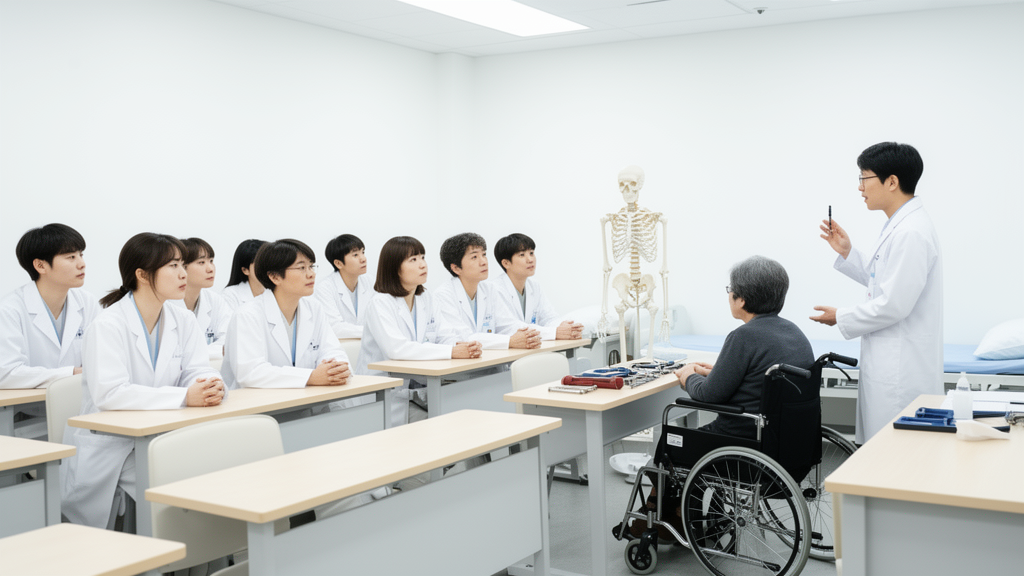
A descriptive survey of all 40 medical and graduate medical schools registered with the Korea Association of Medical Colleges found no publicly documented standalone course on disability understanding as of May 2026. Instead, 35 schools, or 87.5%, offered medical humanities courses in which the available curriculum information identified no disability-related content. The remaining five schools, representing 12.5%, had disability-related keywords that could be inferred from course titles or descriptions. Because the investigators could not verify those references at the syllabus level, the study does not establish that disability education was systematically taught in those courses.
The researchers analyzed publicly available curriculum data in a cross-sectional survey, assigning each institution to one of four codes. Code A represented a standalone required disability course, Code B a standalone elective course, Code C medical humanities courses containing indirectly inferable disability-related keywords, and Code D medical humanities courses with no identifiable disability-related content. Neither Code A nor Code B occurred at any of the 40 institutions, meaning that the survey documented neither a required nor an elective course devoted specifically to disability. The study examines what could be identified from public curricula; it does not report classroom instruction, learning outcomes or student competencies.
The findings were compared with selected international settings—the United States, United Kingdom, Australia and Japan—using five criteria: disability-related legislation, accreditation standards, competency frameworks, mandatory status and national survey research. All five countries were found to have disability-related legislation, but the comparison did not identify direct links between such legislation and medical school curricula. Only the United States had a dedicated competency framework, although that framework was not formally connected to accreditation standards. Dedicated national survey research was identified only in Australia, with partially available national survey research in the United Kingdom and United States.
The authors conclude that the curricular gap documented in Korea is not unique. The Korean data indicate that broad medical humanities provision has not translated into publicly identifiable, standalone disability education within the surveyed institutions, while the international comparison shows that the absence of a direct legislative link to curricula is also not confined to Korea. The study identifies a possible policy direction: develop a Korea-specific framework of disability competencies for physicians, incorporate that framework into accreditation standards, and monitor its implementation over time. These are proposed responses to the documented gap, not evidence that such measures have already been adopted or that they would improve clinical outcomes. The article was published as an early, open-access version in BMC Medical Education and was described as still subject to further editorial changes before replacement by the final version of record.
Subject of Research: Survey of disability education in Korean medical school curricula
Article Title: Disability education in Korean medical school curricula: current status and challenges
Article References: Lee, B., & Chae, S. J. (2026). Disability education in Korean medical school curricula: current status and challenges. BMC Medical Education, 26(1), Article 1655. https://doi.org/10.1186/s12909-026-10332-5
Image Credits: AI Generated
DOI: 10.1186/s12909-026-10332-5
Keywords: disability education, medical curricula, Korean medical schools, medical humanities, competency frameworks, accreditation standards, curriculum analysis, health education, Disability, education, Korean, medical
Cite Scienmag News
Courtney Benton. (October 26, 2026). Korean medical schools show no standalone disability courses. Scienmag. https://scienmag.com/korean-medical-schools-show-no-standalone-disability-courses/
Courtney Benton. "Korean medical schools show no standalone disability courses." Scienmag, 26 October 2026, https://scienmag.com/korean-medical-schools-show-no-standalone-disability-courses/. Accessed 26 October 2026.
Courtney Benton. "Korean medical schools show no standalone disability courses." Scienmag. October 26, 2026. https://scienmag.com/korean-medical-schools-show-no-standalone-disability-courses/


