


Proprioception, often called the sixth sense, is the body’s internal GPS. It tells us where our limbs are in space without our having to look at them, and it underpins every smooth movement we make. For children with cerebral palsy, the most common childhood motor disability, this hidden sense has long been suspected of playing a role in their movement difficulties, yet it has been remarkably underexplored, especially in the legs. A new observational study from researchers at Karolinska Institutet and the Astrid Lindgren Children’s Hospital in Stockholm, published in BMC Pediatrics, has now mapped how well children with spastic cerebral palsy can sense and control the position of their knees, and the results reveal a surprising split in how the brain’s body-position sense falters depending on which side of the body is affected.
The research team, led by Annika Ericson and including Åsa Bartonek, Israel Luis, Marie Eriksson and Cecilia Lidbeck, recruited 57 children aged 6 to 18 years with spastic cerebral palsy, alongside 42 typically developing children as controls. The children with cerebral palsy spanned the full spectrum of the Gross Motor Function Classification System, from level I, meaning they walk with minor limitations, to level IV, meaning they use wheeled mobility most of the time. Twenty of the children had unilateral spastic cerebral palsy, where one side of the body is affected, while 37 had the bilateral form, where both sides are involved. This distinction turned out to be crucial to what the study found.
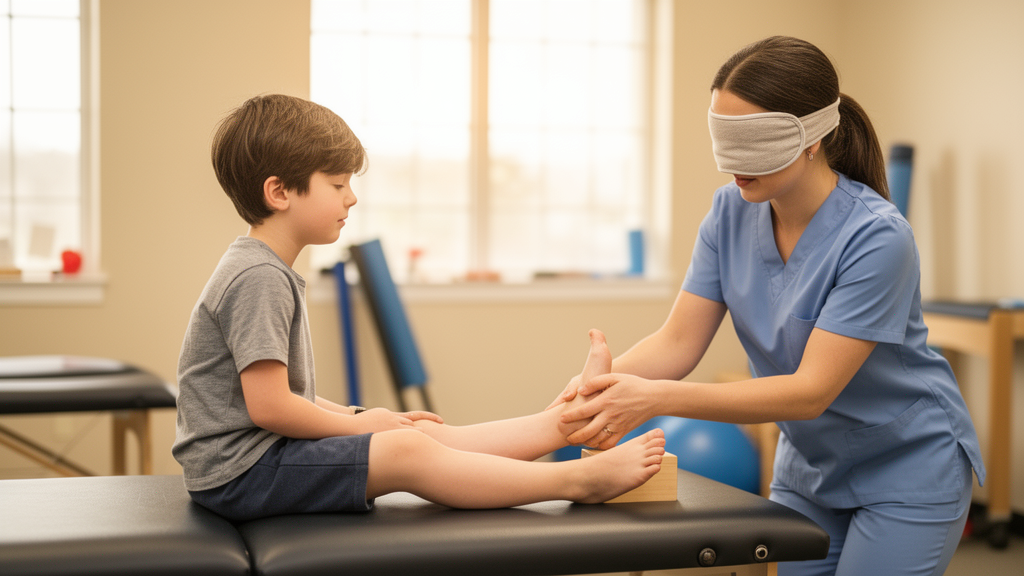
To measure proprioception with precision, the team turned to three-dimensional motion analysis, a laboratory technique that tracks body segments in space using cameras and reflective markers. The children sat with their vision occluded, removing the visual cues that normally compensate for a weak body-position sense. The test had two parts. In the first, called the criterion angle trial, an examiner passively elevated the child’s lower leg to a knee flexion angle of 45 degrees, and the child had to maintain that position. In the second, the reproduced angle trial, the child had to actively reproduce and hold the same angle from memory. The difference between the target angle and the reproduced angle served as a measure of joint position sense, a core component of proprioception.
The researchers went beyond simply measuring how accurately the children could copy an angle. They also analyzed how steadily the children could hold the leg in place over 2.5 seconds, quantifying fluctuations using the root mean square error of the knee angle signal and calculating drift through linear regression of the angle over time. This dual approach separated two distinct abilities: the capacity to sense where the knee is, and the capacity to keep it there. Data were analyzed with non-parametric statistics, appropriate for the sample sizes and distributions involved.
The headline finding is a divergence that cuts against simple intuition. Children with unilateral spastic cerebral palsy made larger joint position sense errors than children with the bilateral form, with a statistically significant difference, and their reproduced angles tended toward a more extended knee than the 45-degree target. In other words, when asked to copy a knee angle from memory, the children with one-sided cerebral palsy were less accurate, often overshooting toward a straighter leg. This suggests that the sensory maps governing a single affected limb may be particularly distorted when the brain must integrate information from one impaired side while the other side provides a competing reference.
Yet when the task shifted from sensing to holding, the pattern reversed. When the leg was passively positioned by the examiner and the children had to maintain the angle for 2.5 seconds, the entire cerebral palsy group showed increased knee flexion and greater movement fluctuations compared with typically developing children, a difference that reached statistical significance. The children’s knees drifted toward further bending as they tried to hold still, and their angle traces wobbled more. Maintaining a position, it turns out, is a different proprioceptive challenge from reproducing one, and it depends on continuously updating the sense of where the limb is as forces act on it.
Within the cerebral palsy group, the finer-grained analysis sharpened this picture. Children with bilateral spastic cerebral palsy showed significantly greater increases in knee flexion when holding the passively assumed position compared with the actively assumed one, and the same held true for children classified at Gross Motor Function level II. The bilateral group also showed significantly greater drift over time toward knee flexion during passive positioning than during active positioning. This asymmetry between passive and active conditions hints at a specific vulnerability: when the examiner sets the limb and the child’s own muscles are not driving the movement, the sensory feedback that normally anchors the position appears less reliable in these children.
The authors propose that these two dissociated deficits, reproducing versus maintaining a knee angle, reflect different components of the proprioceptive system. Active reproduction draws on motor efference copies and the integration of the child’s own movement commands with sensory feedback, while passive maintenance relies more heavily on the raw sensory signal from muscle spindles, joint receptors and skin mechanoreceptors. The finding that children with unilateral cerebral palsy struggle more with reproduction, while those with bilateral involvement struggle more with maintenance, suggests that the neural substrates of these two abilities can be affected differently by the brain injuries that cause cerebral palsy.
Why does this matter clinically? Proprioception is vital for motor control, and rehabilitation for cerebral palsy has traditionally focused on strengthening muscles, managing spasticity and training gross motor skills. If a child cannot accurately sense where the knee is, or cannot hold it steady against gravity, then even well-trained movements may become unstable. Gait, standing balance and the control of crouch, a common pattern of excessive knee flexion in cerebral palsy, all depend on this hidden sense. The study’s use of objective three-dimensional motion analysis, rather than subjective clinical tests, provides a template for measuring lower-limb proprioception in a way that could be integrated into assessments and treatment planning.
The study is observational, so it cannot establish causal mechanisms, and the authors note that it was not registered as a clinical trial for that reason. But the findings open a concrete path forward. If proprioceptive deficits in the lower extremities can be reliably measured in children with cerebral palsy, then sensory training protocols, biofeedback approaches and task-specific interventions could be designed to target the specific component that is impaired, whether that is sensing a position or stabilizing one. For the children and families who participated, and for the field at large, the study transforms a vague notion of poor body awareness into a measurable, dissociable and potentially treatable set of sensory functions, hidden no longer.
Subject of Research: Knee proprioception measurement in children with spastic cerebral palsy using three-dimensional motion analysis
Article Title: Knee proprioception in children with spastic cerebral palsy: an observational study
Article References: Ericson, A., Bartonek, Å., Luis, I., Eriksson, M., & Lidbeck, C. (2026). Knee proprioception in children with spastic cerebral palsy: an observational study. BMC Pediatrics, 26(1), Article 871. https://doi.org/10.1186/s12887-026-07652-2
Image Credits: AI Generated
DOI: 10.1186/s12887-026-07652-2
Keywords: cerebral palsy, proprioception, joint position sense, pediatrics, three-dimensional motion analysis, sensorimotor processing, GMFCS, rehabilitation, Karolinska Institutet, BMC Pediatrics, Knee, children
Cite Scienmag News
Ophelia Keating. (October 19, 2026). Knee Proprioception Reveals Distinct Sensory Deficits in Children with Spastic Cerebral Palsy. Scienmag. https://scienmag.com/knee-proprioception-reveals-distinct-sensory-deficits-in-children-with-spastic-cerebral-palsy/
Ophelia Keating. "Knee Proprioception Reveals Distinct Sensory Deficits in Children with Spastic Cerebral Palsy." Scienmag, 19 October 2026, https://scienmag.com/knee-proprioception-reveals-distinct-sensory-deficits-in-children-with-spastic-cerebral-palsy/. Accessed 19 October 2026.
Ophelia Keating. "Knee Proprioception Reveals Distinct Sensory Deficits in Children with Spastic Cerebral Palsy." Scienmag. October 19, 2026. https://scienmag.com/knee-proprioception-reveals-distinct-sensory-deficits-in-children-with-spastic-cerebral-palsy/


