


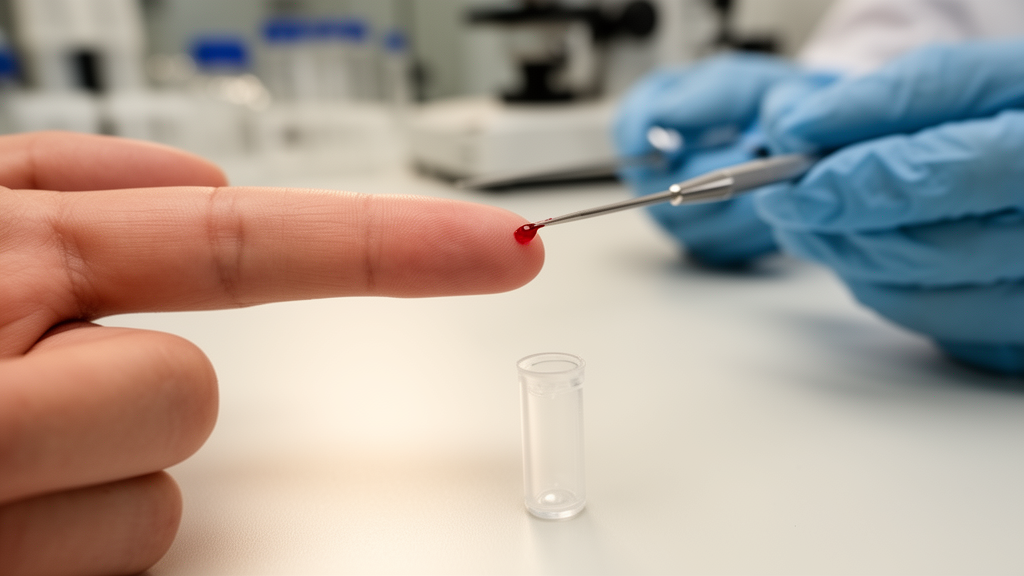
For decades, measuring how much lead or cadmium is circulating in a person’s blood has required a needle, a trained phlebotomist, a laboratory-grade tube, and a cold chain to keep the sample intact until analysis. That logistical burden has long been a barrier to biomonitoring studies in remote regions, disaster zones, and communities where medical infrastructure is thin on the ground. Now a team of researchers at LMU Munich has shown that a device small enough to clip onto a keychain can do much of the same work, provided it is washed properly first. In a study published in Environmental Monitoring and Assessment, Claus Gutknecht, Stefan Rakete and their colleagues demonstrated that volumetric absorptive microsampling, known as VAMS, can reliably capture enough blood from a simple fingertip prick to quantify both toxic metals simultaneously, with performance approaching that of conventional venipuncture.
The problem the team set out to solve is both chemical and practical. Cadmium and lead are persistent environmental pollutants: neither is metabolized into a less toxic form, and both bioaccumulate in tissues and bone, making them a permanent fixture of the human exposure landscape. Blood levels of these metals reflect recent exposure from external sources, which is why blood is the matrix of choice for surveillance programs such as the German Environmental Survey. But the gold standard sampling method, venipuncture, demands medically trained personnel and relatively high logistical costs. In structurally weak regions or occupational settings where repeated monitoring is needed, those requirements can make large-scale studies impractical or impossible.
Microsampling has long promised a way around this. Dried blood spots, the technique used in newborn screening for decades, involve blotting a drop of capillary blood onto filter paper. The sample dries, can be stored at ambient temperature, and can be collected by non-medical personnel or even by participants themselves. Studies have repeatedly shown high participant acceptability for such methods. But dried blood spots carry two well-documented flaws when it comes to trace metals. First, the filter paper itself can contain background levels of lead and cadmium so high that they exceed the blood levels of non-exposed people, rendering quantification impossible in some earlier studies. Second, the volume of blood absorbed by the paper depends on hematocrit, the proportion of red blood cells in the blood, which varies between individuals and distorts the apparent concentration.
VAMS was designed to overcome the hematocrit problem. The device consists of a hydrophilic polymer tip mounted on a plastic handle. When the tip briefly touches a drop of blood, it wicks up a fixed volume, roughly 24 microliters in the devices used in this study, regardless of the blood’s viscosity or cell content. Until recently, VAMS was mainly the province of pharmaceutical scientists monitoring drug molecules, peptides, and proteins, and of forensic and anti-doping laboratories. Only a handful of studies had applied it to trace element analysis in human blood, including work on prosthesis-related metals, mercury, and lead, and one recent study that attempted simultaneous monitoring of a broader panel of elements under field conditions. Relatively high limits of quantification remained a persistent obstacle.
The Munich team’s study design was deliberately rigorous. They recruited occupationally non-exposed adults at the university hospital and collected paired samples from each participant: about seven milliliters of venous blood drawn by needle, and three separate capillary samples taken by fingertip prick onto VAMS tips, with a fourth tip left empty to measure background contamination. Sixty participants provided samples using VAMS devices straight from the manufacturer. A further twenty-seven participants were sampled with devices that had been pre-cleaned in an ultrasonic bath of 0.5 percent nitric acid at 60 degrees Celsius for 45 minutes, then rinsed in ultrapure water, in an effort to strip out the metals lurking in the polymer itself. All samples were extracted or diluted in nitric acid and analyzed by triple quadrupole ICP-MS, with terbium as an internal standard and helium collision gas to suppress polyatomic interferences.
The background contamination they found was striking. In untreated devices, blank levels equivalent to as much as 373 micrograms per liter of lead were observed, wildly variable and batch-dependent, against participant blood lead levels that ranged from just 4.57 to 49.77 micrograms per liter. For cadmium, the situation was different: background levels were low, around 0.07 micrograms per liter, and pre-cleaning barely changed them. But for lead, the acid wash was transformative. Pre-cleaning reduced the mean lead background by more than 90 percent, from 3.61 to 0.35 micrograms per liter, and cut the variance of the blanks by more than 85 percent. That collapse in uncertainty drove the limit of quantification for lead down from 15.3 to 2.10 micrograms per liter, low enough to detect lead in people with ordinary, low-level environmental exposure.
How well did the fingertip samples match the venous gold standard? For lead, remarkably well. The Spearman correlation between venous and pre-cleaned VAMS results was 0.98, and the Passing-Bablok regression line sat almost exactly on the identity line, meaning the two methods agreed nearly perfectly across the measured range. For cadmium, the correlation improved from 0.84 with untreated devices to 0.91 with pre-cleaned ones, though the regression slope suggested VAMS slightly overestimates cadmium, likely a residue of the background problem. Recovery, the ratio of the VAMS result to the venous result, averaged 117.2 percent for cadmium and 104.6 percent for lead with pre-cleaned devices, and more than 90 percent of lead samples fell within the accepted 70 to 130 percent recovery window. Difference plots showed no concentration-dependent bias, and the average deviation was tiny: 0.04 micrograms per liter for cadmium and 0.31 for lead.
The team also tackled a question that matters enormously for field deployment: can these tiny dried samples survive real-world logistics? Samples in the study were stored at room temperature in aluminum-coated mylar bags for between 14 and 51 days before analysis. A linear model testing whether recovery declined with storage time found no statistically significant relationship for either metal, suggesting that VAMS samples for cadmium and lead remain stable for at least seven weeks at ambient conditions. That is a decisive advantage over liquid blood, which requires freezing, and it opens the door to mailing samples from remote collection sites to central laboratories. The researchers even replaced the commercial clamshell holders with custom 3D-printed polylactide versions, hinting at how cheap and adaptable the workflow could become.
None of this means the method is foolproof, and the authors are candid about its limits. Because the study population was largely unexposed, most cadmium values fell below the VAMS limit of quantification, inflating uncertainty at the low end. A single unnoticed contamination event, a tip touching a surface, a stray dust particle, can wreck a measurement, which is why the protocol demands obsessive hygiene: washed hands, air-dried disinfectant, the first drop of blood wiped away, and the tip only lightly touching the blood drop. The researchers recommend collecting at least three samples per person so that outliers can be identified, and they applied a statistical rule excluding any replicate whose relative standard deviation exceeded 30 percent. Because an extracted VAMS tip cannot be re-analyzed, this triplicate strategy is the only safety net available.
Even with those caveats, the implications are considerable. In populations with genuine exposure, people living near smelters, recycling operations, or contaminated water supplies, blood levels of both metals would sit well above the quantification limits, and the background problem that dominated this study of low-exposed volunteers would fade into irrelevance. Pre-cleaning the devices is simple, cheap, and reproducible, and the authors argue it should become standard practice, along with batch testing of blanks before any field campaign. If those precautions are followed, a finger prick, a plastic tip, and a sealed envelope could replace the needle and the cold chain for surveillance of two of the world’s most stubborn poisons, bringing toxic metal monitoring within reach of communities that have never had it.
Subject of Research: Volumetric absorptive microsampling for blood cadmium and lead biomonitoring
Article Title: Application of volumetric absorptive microsampling (VAMS) for the simultaneous determination of cadmium and lead in blood
Article References: Gutknecht, C., Burianova, A., Bose-O’Reilly, S., & Rakete, S. (2026). Application of volumetric absorptive microsampling (VAMS) for the simultaneous determination of cadmium and lead in blood. Environmental Monitoring and Assessment, 198(9), Article 1018. https://doi.org/10.1007/s10661-026-15796-y
Image Credits: AI Generated
DOI: 10.1007/s10661-026-15796-y
Keywords: volumetric absorptive microsampling, VAMS, cadmium, lead, human biomonitoring, ICP-MS, microsampling, blood analysis, toxic metals, dried blood spots, background correction, environmental health
Cite Scienmag News
Violet Maxwell. (October 19, 2026). A Finger Prick Could Replace the Needle: Tiny Blood Samples Prove Reliable for Tracking Toxic Lead and Cadmium. Scienmag. https://scienmag.com/a-finger-prick-could-replace-the-needle-tiny-blood-samples-prove-reliable-for-tracking-toxic-lead-and-cadmium/
Violet Maxwell. "A Finger Prick Could Replace the Needle: Tiny Blood Samples Prove Reliable for Tracking Toxic Lead and Cadmium." Scienmag, 19 October 2026, https://scienmag.com/a-finger-prick-could-replace-the-needle-tiny-blood-samples-prove-reliable-for-tracking-toxic-lead-and-cadmium/. Accessed 19 October 2026.
Violet Maxwell. "A Finger Prick Could Replace the Needle: Tiny Blood Samples Prove Reliable for Tracking Toxic Lead and Cadmium." Scienmag. October 19, 2026. https://scienmag.com/a-finger-prick-could-replace-the-needle-tiny-blood-samples-prove-reliable-for-tracking-toxic-lead-and-cadmium/


