


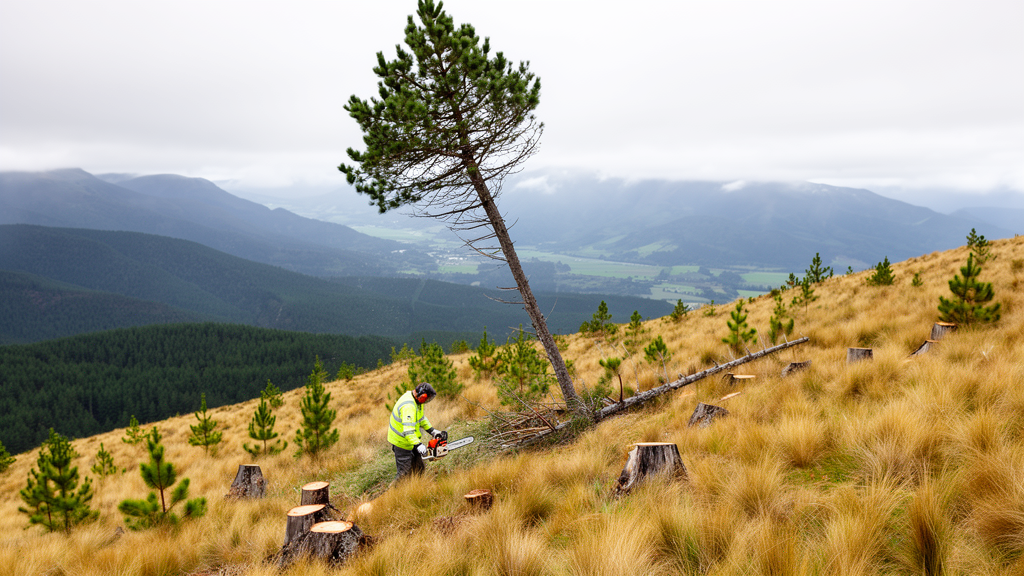
New Zealand’s war on wilding conifers has cost more than NZD 150 million and swept across roughly one million hectares since the National Wilding Conifer Control Programme was launched in 2016. Yet until now, almost nobody had rigorously asked whether the two flagship weapons of that campaign actually work under real-world, operational conditions. A new study published in the journal NeoBiota provides the first large-scale quantification of control effectiveness for invasive lodgepole pine, Pinus contorta, and its findings are a sobering mix of triumph and warning: both major treatment methods kill most of the trees they target, but in every case, enough survivors remain to seed the next invasion unless crews return for follow-up work within just a few years.
The research team surveyed 146 permanently placed plots across five of the most intensively managed regions of New Zealand, spanning both the North and South Islands, from Kaweka Forest to Mid Dome. All plots had received a single operational control treatment one to four years before measurement, with no subsequent intervention, giving the scientists a rare window into what happens when management stops after one round. In total, the team recorded more than 10,000 individual pines, assessing whether each was alive or dead, measuring its height, estimating its age, and noting whether it was producing cones, the key to future reinvasion. The analysis focused on the two dominant control approaches used by the national programme: helicopter-based aerial boom spraying of foliar herbicides in dense, mature infestations, and ground-based methods such as manual pulling, felling, and cut-stump herbicide application in younger or sparser populations.
The scale of New Zealand’s conifer problem is difficult to overstate. More than two million hectares of the country are now invaded by non-native conifers, descendants of mid-twentieth-century government afforestation schemes that planted exotic pines to stabilize erodible soils and shelter livestock. Lodgepole pine, native to western North America, has proven the most aggressive of these escapees. It matures at as young as three years old, produces enormous quantities of seed, and retains cones on its branches for decades, building aerial seed banks that can persist long after the parent tree dies. Roughly eighty percent of the invaded area is sparsely infested, but even low cover can expand rapidly, and the programme’s managers have long operated on the assumption that a single well-executed treatment could largely eliminate local populations.
The new data challenge that assumption in an important way. For aerial boom spray, the news is largely good: mortality climbed steadily over the three years following treatment, rising from an average of seventy-six percent at one year to ninety-five percent at three years. Medium-sized pines between 1.35 and 2 meters tall fared worst, suffering near-total mortality of ninety-nine percent, while even the largest trees, above five meters, succumbed at rates above ninety percent. Crucially, the models showed that mortality was independent of environmental conditions such as temperature, rainfall, and competition from other vegetation, meaning the treatment performed reliably across the wide range of climates and terrains represented in the study. This consistency is a strong endorsement of the herbicide mixtures, which contain triclopyr, dicamba, and picloram, developed through earlier trials.
But here is the catch: even a ninety-five percent kill rate applied to stands that initially held more than ten thousand pines per hectare leaves a substantial rump. Four years after spraying, the researchers estimated that roughly 1,094 surviving pines per hectare remained, and about half of those stood taller than two meters. Approximately seventy-two coning individuals per hectare were still actively producing seed at that point, representing a significant propagule source. The authors attribute the survivors to gaps in spray coverage in dense, uneven canopies that shield some foliage from the herbicide, and to the sheer statistical reality that a small percentage of very large numbers is still a large number. Delayed mortality, in which sprayed trees die slowly over several years, also cautions against judging effectiveness too early.
Ground-based control told a different and more troubling story for small trees. Mortality rose sharply with height: pines taller than two meters were killed almost without exception, and the two-to-five-meter class suffered ninety-nine percent mortality. But pines shorter than sixty centimeters survived at alarming rates, with mortality as low as one percent in that class. The likely culprit is imperfect detection, since crews hunting seedlings through tall grass and shrubland on rugged terrain inevitably miss some individuals. Interestingly, temperature emerged as a significant factor, with mortality estimates for medium-sized pines appearing lower in warmer regions. The researchers interpret this not as a failure of the treatment itself, but as evidence that survivors grow faster in warmer climates, quickly outgrowing their pre-treatment size class and obscuring the picture. At cooler sites, where growth is slow, the data suggest ground methods are in fact highly lethal for anything above sixty centimeters.
The population dynamics that follow each treatment diverge in ways that matter enormously for management planning. After aerial spraying, the residual population is dominated by surviving larger trees, with new recruits playing a minor role, roughly 174 recruits per hectare against 1,094 survivors at four years. After ground-based control, the picture inverts: survivors numbered only about 109 per hectare, while new recruits, seedlings germinating after the treatment, reached roughly 223 per hectare and already outnumbered survivors in the two shortest height classes. Because nearly all actively coning pines in both treatments were survivors rather than post-treatment recruits, the seed source driving reinvasion comes from a different segment of the population depending on the method used: tall trees after spraying, missed seedlings rapidly maturing after ground work.
The cone data add a subtle twist. Following aerial spray, coning among survivors was suppressed for several years, likely because herbicide eliminates cones already in development, and since P. contorta cones take two years to mature, cone production resumes only after a lag. At ground-treated sites, by contrast, thirty-one percent of live pines in the two-to-five-meter class were already coning within the first four years, compared with just four percent at sprayed sites. This timing creates a narrow but critical window: the authors recommend repeating ground-based operations approximately two years after the initial treatment, late enough for missed seedlings to grow and become detectable, but early enough to strike before they begin producing the seed that fuels the next wave.
The findings carry implications well beyond New Zealand. Aerial herbicide spraying is largely prohibited in the European Union and restricted in much of the Northern Hemisphere, making the country’s programme a globally unique experiment in large-scale broadcast control of a woody invader. South Africa’s Working for Water Programme, one of the largest and most costly invasive plant initiatives anywhere, has similarly struggled with questions of long-term effectiveness and monitoring. The new study echoes a persistent theme in invasion science: without formal long-term monitoring, agencies cannot know whether their operations actually suppress the target species, whether ecosystems recover, or whether money is being spent efficiently. The authors suggest that planning aerial operations as a minimum two-stage treatment from the outset, refining herbicide prescriptions, and pairing control with land rehabilitation could improve outcomes and potentially reduce the current cost of 1,800 to 2,500 dollars per hectare.
Perhaps the study’s deepest message is that killing pines is not the same as restoring landscapes. Previous work has shown that after dense lodgepole infestations are sprayed, the recovering vegetation tends to be dominated by exotic grasses rather than native species, suggesting that invasion followed by broadscale herbicide acts as a powerful ecological filter that pushes sites toward simplified, novel communities. Soil microbiome legacies and changes to litter dynamics may further hinder native recovery and favor secondary invasions. The researchers argue that eradication of P. contorta populations will remain out of reach without timely follow-up control, careful surveillance scheduled two to three years after spraying to capture delayed mortality, and, critically, active restoration to build ecosystems resilient enough to resist the next invasion. In the high country of New Zealand, the battle against wilding pines is far from over, but for the first time, managers now have hard numbers to guide exactly when and where to strike next.
Subject of Research: Operational effectiveness of aerial and ground-based control methods for invasive lodgepole pine in New Zealand
Article Title: Effectiveness of operational control of invasive conifers: Mortality, residual populations, and reinvasion
Article References: Turner, R. M., Scott, M. B., Paul, T. S., Carlin, T. F., Richardson, B., & Rolando, C. A. (2026). Effectiveness of operational control of invasive conifers: Mortality, residual populations, and reinvasion. NeoBiota, 109, 129-155. https://doi.org/10.3897/neobiota.109.194587
Image Credits: AI Generated
DOI: 10.3897/neobiota.109.194587
Keywords: invasive conifers, wilding pines, Pinus contorta, New Zealand, herbicide control, aerial boom spray, ground-based control, reinvasion, ecological restoration, invasion biology, forest management, National Wilding Conifer Control Programme
Cite Scienmag News
Patricia Pace. (October 15, 2026). Killing Wilding Pines Is Only Half the Battle, New Zealand’s Biggest Invasion Program Reveals. Scienmag. https://scienmag.com/killing-wilding-pines-is-only-half-the-battle-new-zealands-biggest-invasion-program-reveals/
Patricia Pace. "Killing Wilding Pines Is Only Half the Battle, New Zealand’s Biggest Invasion Program Reveals." Scienmag, 15 October 2026, https://scienmag.com/killing-wilding-pines-is-only-half-the-battle-new-zealands-biggest-invasion-program-reveals/. Accessed 15 October 2026.
Patricia Pace. "Killing Wilding Pines Is Only Half the Battle, New Zealand’s Biggest Invasion Program Reveals." Scienmag. October 15, 2026. https://scienmag.com/killing-wilding-pines-is-only-half-the-battle-new-zealands-biggest-invasion-program-reveals/


