


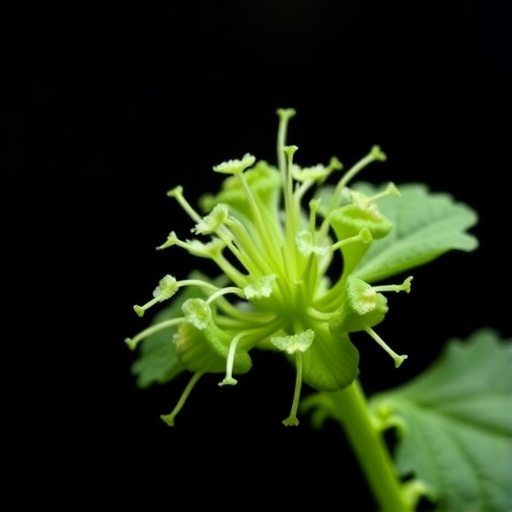
A groundbreaking study led by Hiroshima University has unveiled a pivotal gene that governs the onset of gemma development, effectively acting as a “master switch” for asexual reproduction in the liverwort species Marchantia polymorpha. This research not only sheds light on the genetic underpinnings of clonal propagation but also overcomes a longstanding scientific challenge in plant biology by revealing mechanisms previously elusive due to the limitations of traditional model organisms.
Asexual reproduction allows certain plants to bypass the conventional seed-based cycle, enabling the regeneration of entire organisms from specialized cells. This remarkable capacity, widespread across the plant kingdom, encodes immense evolutionary advantages, providing resilience and adaptability in diverse environments. Despite its importance, the genetics orchestrating this process have remained largely enigmatic, primarily because classical model plants such as Arabidopsis thaliana do not naturally engage in asexual reproduction, constraining experimental inquiry.
Shifting focus to the emerging model organism Marchantia polymorpha—a common liverwort native to many Northern Hemisphere habitats—the researchers were able to tap into its unique biology. This species possesses a flattened, thalloid body with an intrinsic ability to reproduce asexually via gemmae, specialized multicellular propagules that facilitate cloning. Importantly, Marchantia’s genomic tractability and the availability of advanced genetic tools allowed detailed investigation and manipulation of gene function related to asexual reproduction.
Published in the esteemed journal Current Biology on May 4, 2026, the study identifies the gene GEMMIFER, belonging to the AP2/ERF family of transcription factors, as crucial for initiating gemma production. Initial clues came from observations that the CLE peptide hormone suppresses asexual reproduction. A transcriptomic analysis followed, highlighting multiple genes with expression changes upon hormone treatment, among which GEMMIFER stood out due to its regulatory potential.
Employing sophisticated CRISPR-Cas9 genome editing alongside targeted artificial microRNA-mediated knockdowns, the team demonstrated that inactivation of GEMMIFER results in a complete loss of gemma formation. These functional genomics experiments therefore position GEMMIFER as indispensable for triggering the developmental program leading to clonal propagation in Marchantia.
To interrogate the sufficiency of GEMMIFER activation in gemma genesis, a dexamethasone-inducible transgenic line was engineered. Upon drug treatment, GEMMIFER was transiently activated, causing the emergence of new stem cells—the progenitors of gemmae. These nascent cells proliferated and differentiated into fully mature clonal propagules, conclusively proving that GEMMIFER alone can mobilize the cellular machinery required for asexual reproduction initiation.
Subsequent molecular analyses uncovered that GEMMIFER exerts its function upstream of the gene GCAM1, a transcription factor previously implicated in gemma development. This hierarchical interaction suggests that activation of GEMMIFER triggers a genetic cascade culminating in the establishment of stem cell identity, a critical inflection point in reprogramming somatic cells towards a reproductive lineage.
Despite these breakthroughs, the precise mechanistic pathways through which GEMMIFER redefines cell fate remain incompletely elucidated. It is yet unclear how the AP2/ERF domain-containing protein interfaces with chromatin remodelers or other transcriptional regulators to orchestrate such a profound developmental switch. Moreover, while homologs of GEMMIFER exist across diverse plant species, their functional conservation in asexual reproduction is subject to ongoing investigation.
This discovery also challenges the traditional reliance on seed plants as the exclusive models for studying complex developmental processes. The inability to detect such asexual reproduction switches in well-established organisms like Arabidopsis represents a notable scientific blind spot. Marchantia polymorpha, by contrast, offers a unique window into evolutionary ancient and conserved mechanisms of plant regeneration and propagation.
Broader implications of this research extend from fundamental plant developmental biology to applied agriculture and biotechnology. Understanding and harnessing GEMMIFER-mediated pathways may pave the way for novel approaches to clonal propagation in crop species, enhancing efficiency and sustainability. It could also inspire synthetic biology strategies aimed at engineering plants with tailored regenerative capabilities.
In the context of ecological and evolutionary biology, elucidating the genetic switches for asexual reproduction enriches our comprehension of plant adaptability and survival strategies. Considering environmental pressures and climate change, the ability of plants to clone themselves via gemmae or related propagules could become increasingly vital, underscoring the urgency and relevance of this research.
The collaborative study involved scientists from Hiroshima University, Gakushuin University, the University of Cambridge, and Kobe University. This international cooperation reflects a multidisciplinary approach integrating molecular genetics, experimental botany, and plant physiology to decode one of nature’s most fascinating reproductive strategies.
Ultimately, the identification of GEMMIFER as a master regulator inaugurates a new chapter in plant biology, emphasizing that nature’s vast repertoire of life cycles and reproductive modes still harbors many secrets. It serves as a compelling reminder that the exploration of non-traditional models can unlock transformative insights with broad scientific and practical ramifications.
—
News Publication Date: 4-May-2026
Web References: http://dx.doi.org/10.1016/j.cub.2026.03.083
Cite Scienmag News
Juliet Wilcox. (May 4, 2026). Key Gene Discovered in Model Plant That Controls Self-Replication. Scienmag. https://scienmag.com/key-gene-discovered-in-model-plant-that-controls-self-replication/
Juliet Wilcox. "Key Gene Discovered in Model Plant That Controls Self-Replication." Scienmag, 4 May 2026, https://scienmag.com/key-gene-discovered-in-model-plant-that-controls-self-replication/. Accessed 4 September 2026.
Juliet Wilcox. "Key Gene Discovered in Model Plant That Controls Self-Replication." Scienmag. May 4, 2026. https://scienmag.com/key-gene-discovered-in-model-plant-that-controls-self-replication/


