


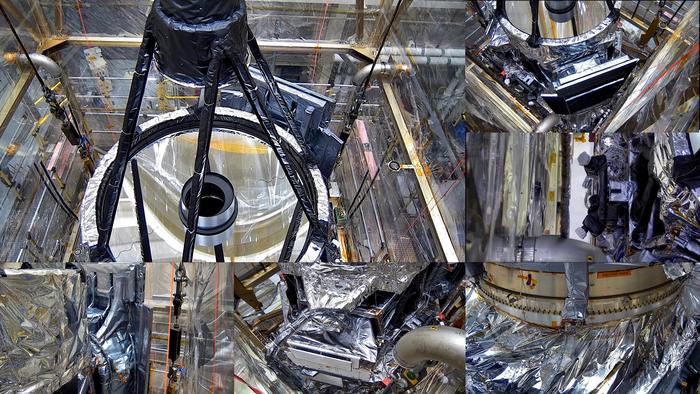
The Nancy Grace Roman Space Telescope, a groundbreaking endeavor by NASA, has recently achieved a major technological milestone. The core assembly of the telescope has successfully undergone rigorous vibration testing at the Goddard Space Flight Center in Greenbelt, Maryland. This testing is critical as it simulates the intense shaking and forces that the telescope will face during its launch into space. Completion of this test not only signifies a step forward in the development of the Roman Space Telescope but also underscores NASA’s commitment to producing a robust observatory capable of tackling some of the most profound questions concerning our universe.
The vibration test, designed to mimic the extreme conditions of a launch, showcased the engineering prowess behind this astronomical project. To create an accurate simulation, NASA filled the propulsion tanks with approximately 295 gallons of deionized water, effectively simulating the weight of propellant that the spacecraft will carry during an actual launch. Cory Powell, a vital member of the Roman team, likened the vibration test to the force of a severe earthquake, although he clarified that the testing method employed is distinctly different. The process involves gradually increasing frequencies and amplitudes, which necessitates a meticulous approach to ensure safety and efficiency.
In preparation for this core testing, the team set up conditions that accurately reflect the complexities involved in launching a space telescope. The design and subsequent tests of the telescope are not standard procedures; they involve a significant amount of planning and engineering innovation. Roman aims to be resilient against the extreme vibrations and accelerations encountered during its ascent through the atmosphere, ensuring the sensitive instruments remain intact and their functionality is not compromised. This rigorous testing phase emphasizes the importance of each aspect of the telescope’s design and construction—a testament to NASA’s attention to detail and forward-thinking mentality.
Furthermore, the successful completion of the vibration test is part of a series of assessments that the Roman Space Telescope will undergo. The testing regimen is designed to tighten tolerances and ensure every component functions within specified limits. Roman is comprised of two significant assemblies: the inner core—the telescope structure, its instrument carrier, and the two scientific instruments—and the outer segment, which includes the outer barrel assembly, solar array sun shield, and deployable aperture cover. Integrating these assemblies into a fully operational observatory is complex and multifaceted, requiring various simulations and tests to ensure their compatibility.
With the vibration testing now behind them, the inner core of the telescope is set to return to Goddard’s clean room for post-test inspections. Here, NASA engineers will closely examine the assembly to confirm that critical components remain properly aligned and functional. One of the key assessments will involve testing the high-gain antenna, crucial for communicating with Earth over vast distances. This step is essential before the next significant series of evaluations commence, focusing primarily on the telescope’s electronics and its capacity to withstand extreme thermal conditions in space.
Cold and hot space environments can dramatically affect equipment. Therefore, plans for a thermal vacuum test are already underway. This test will fundamentally allow engineers to evaluate how the telescope functions under conditions that simulate the temperature fluctuations experienced in space. The combination of these tests assures that the telescope will perform effectively when it embarks on its mission, capturing cosmic phenomena and gathering vital data about dark energy and other fundamental mysteries of the universe.
In parallel with the inner assembly’s testing, engineers at Goddard are also advancing work on the telescope’s outer components. The installation of the solar array sun shield has recently been completed, and this portion has passed its thermal vacuum test as well, verifying that it can maintain appropriate temperatures in the vacuum of space. As part of the ongoing preparations, technicians are currently working on installing flight solar panels, further enhancing the telescope’s capability to generate power in orbit.
Looking ahead, the team is on track to join the two primary segments of the Roman Space Telescope by November. This pivotal assembly will lead to an entire observatory being formed by the end of the year, at which point final testing phases will begin. These extensive tests are designed to ensure that everything operates seamlessly in preparation for the planned launch. NASA aims for the Roman Space Telescope to take flight by May 2027, but early launch opportunities may even materialize in the fall of 2026, depending on the completion of other preparatory phases.
The Nancy Grace Roman Space Telescope, named after the esteemed astronomer, is a significant collaboration among various NASA departments and partner institutions. Managed at Goddard, the project also involves the Jet Propulsion Laboratory in Southern California, Caltech/IPAC, the Space Telescope Science Institute, and contributions from scientists at multiple research institutions. Major industrial players like BAE Systems, L3Harris Technologies, and Teledyne Scientific & Imaging round out the team, bringing a wealth of experience to this ambitious project.
Despite the considerable hurdles that come with developing such intricate technology, the Roman Space Telescope represents a monumental step forward in our quest to understand the cosmos. Its mission targets outstanding questions surrounding dark energy, galaxy formation, and the vast cosmic web connecting the universe. The findings from this telescope could redefine our understanding of the universe, offering insights into not only the fabric of space and time but also the fundamental forces that shape our reality.
As each phase of development progresses, there is a sense of excitement and anticipation within the scientific community—a hope that the Roman Space Telescope will unlock mysteries long sought after by astronomers and physicists alike. The culmination of these efforts promises to produce a scientific instrument that is not only innovative but essential for future discoveries in the field of astronomy and cosmology.
Keywords
Space telescopes, Astronomy, Cosmology, Space research, Space technology.
Cite Scienmag News
Grant Pearson. (June 4, 2025). Key Components of NASA’s Roman Space Telescope Successfully Endure Rigorous Shake Test. Scienmag. https://scienmag.com/key-components-of-nasas-roman-space-telescope-successfully-endure-rigorous-shake-test/
Grant Pearson. "Key Components of NASA’s Roman Space Telescope Successfully Endure Rigorous Shake Test." Scienmag, 4 June 2025, https://scienmag.com/key-components-of-nasas-roman-space-telescope-successfully-endure-rigorous-shake-test/. Accessed 6 September 2026.
Grant Pearson. "Key Components of NASA’s Roman Space Telescope Successfully Endure Rigorous Shake Test." Scienmag. June 4, 2025. https://scienmag.com/key-components-of-nasas-roman-space-telescope-successfully-endure-rigorous-shake-test/


