


The detection of gravitational waves stands as one of the most significant achievements in modern physics. In 2017, gravitational waves from the merger of a binary neutron star were detected for the first time which uncovered crucial information about our universe, from the origin of short gamma-ray bursts to the formation of heavy elements. However, detecting gravitational waves emerging from post-merger remnants has remained elusive due to their frequency range lying outside the range of modern gravitational wave detectors (GWDs). These elusive waves hold important insights into the internal structure of neutron stars, and since these waves can be observed once every few decades by modern GWDs, there is an urgent need for next-generation GWDs.

Credit: Tokyo Tech
The detection of gravitational waves stands as one of the most significant achievements in modern physics. In 2017, gravitational waves from the merger of a binary neutron star were detected for the first time which uncovered crucial information about our universe, from the origin of short gamma-ray bursts to the formation of heavy elements. However, detecting gravitational waves emerging from post-merger remnants has remained elusive due to their frequency range lying outside the range of modern gravitational wave detectors (GWDs). These elusive waves hold important insights into the internal structure of neutron stars, and since these waves can be observed once every few decades by modern GWDs, there is an urgent need for next-generation GWDs.
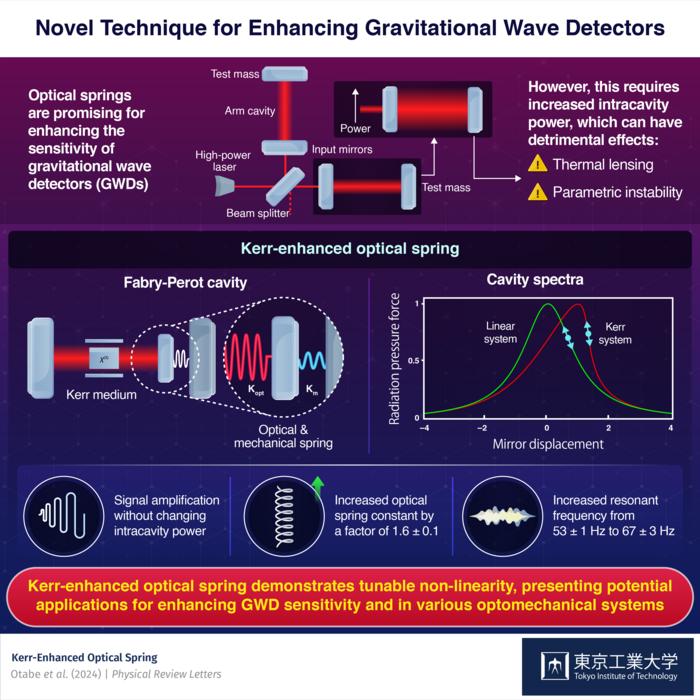
One way to enhance the sensitivity of GWDs is signal amplification using an optical spring. Optical springs, unlike their mechanical counterparts, leverage radiation pressure force from light to mimic spring-like behaviour. The stiffness of optical springs, such as in GWDs, is determined by the light power within the optical cavity. Thus, enhancing the resonant frequency of optical springs requires increasing the intracavity light power which, however, can result in thermally harmful effects and prevent the detector from working properly.
To address this issue, a team of researchers from Japan, led by Associate Professor Kentaro Somiya and Dr. Sotatsu Otabe from the Department of Physics at Tokyo Tech, developed a groundbreaking solution: the Kerr-enhanced optical spring. “A promising method to enhance the impact of optical springs without increasing intracavity power is intracavity signal amplification. This technique enhances the signal amplification ratio of the cavity by using non-linear optical effects and enhances the optical spring constant. Our research revealed that the optical Kerr effect is a promising approach for successfully utilizing this technique,” explains Prof. Somiya. Their findings were published in the journal Physical Review Letters. In addition, this letter has been selected as an Editors’ Suggestion, a weekly recognition aiming to promote interdisciplinary engagement.
This groundbreaking design involves generating intracavity signal amplification effect in a Fabry-Perot type optomechanical cavity by inserting a Kerr medium. The Kerr medium induces an optical Kerr effect in the cavity, in which an optical field changes the refractive index of the medium. This introduces a drastic gradient of the radiation pressure force in the cavity, enhancing the optical spring constant without increasing intracavity power.
Experiments revealed that the optical Kerr effect successfully enhances the optical spring constant by a factor of 1.6. The resonant frequency of the optical spring was increased from 53 Hz to 67 Hz. The researchers anticipate an even larger signal amplification ratio with refinement of technical issues.
“The proposed design is easy to implement and provides a novel tuneable parameter for optomechanical systems. We believe that demonstrated technique will play a key role not only in GWDs but also in other optomechanical systems, such as in cooling macroscopic oscillators to their quantum ground state,” says Dr. Otabe, emphasizing the importance of this study.
Overall, this novel optical spring design represents a significant stride towards harnessing the full potential of optomechanical systems as well as enhanced GWDs capable of unravelling the mysteries of our universe.
Journal
Physical Review Letters
Method of Research
Experimental study
Subject of Research
Not applicable
Article Title
Kerr-Enhanced Optical Spring
Article Publication Date
4-Apr-2024
Cite Scienmag News
Bethany Barker. (April 5, 2024). Kerr-enhanced optical spring for next-generation gravitational wave detectors. Scienmag. https://scienmag.com/kerr-enhanced-optical-spring-for-next-generation-gravitational-wave-detectors/
Bethany Barker. "Kerr-enhanced optical spring for next-generation gravitational wave detectors." Scienmag, 5 April 2024, https://scienmag.com/kerr-enhanced-optical-spring-for-next-generation-gravitational-wave-detectors/. Accessed 3 September 2026.
Bethany Barker. "Kerr-enhanced optical spring for next-generation gravitational wave detectors." Scienmag. April 5, 2024. https://scienmag.com/kerr-enhanced-optical-spring-for-next-generation-gravitational-wave-detectors/

