

Monday, July 27, 2026
Science
No Result
View All Result
  • Login
  • HOME
  • SCIENCE NEWS
  • CONTACT US
  • HOME
  • SCIENCE NEWS
  • CONTACT US
No Result
View All Result
Scienmag
No Result
View All Result
Home Science News Agriculture

KAUST Researchers Create More Precise Method for Engineering Plants

July 27, 2026
in Agriculture
Reading Time: 2 mins read
0
KAUST Researchers Create More Precise Method for Engineering Plants

KAUST Researchers Create More Precise Method for Engineering Plants

65
SHARES
587
VIEWS
Share on FacebookShare on Twitter
ADVERTISEMENT

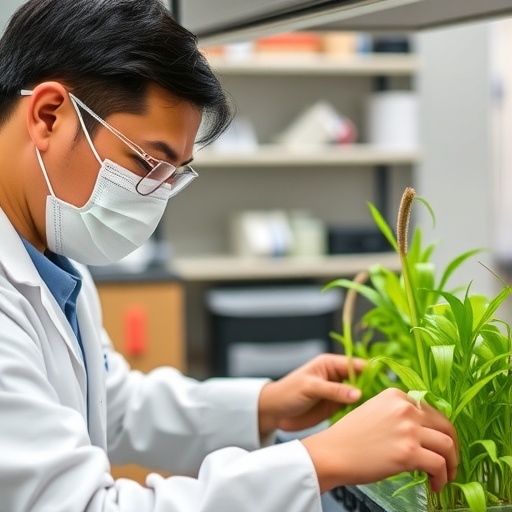
Researchers at King Abdullah University of Science and Technology (KAUST) report a technique that can insert large genetic cargo into plant genomes with high precision—an advance aimed at overcoming a long-standing bottleneck in plant biotechnology. Instead of limiting scientists to small edits, the method enables the addition of entirely new, longer gene sequences at predetermined genomic sites.

The development, described in Nature Biotechnology, could accelerate efforts to engineer crops with multilayered traits, such as improved tolerance to heat and drought, enhanced resistance to disease, and more efficient growth under stress. It also opens a route to plant-based biomanufacturing, where engineered plants could serve as scalable systems for producing therapeutics, biologics, and other high-value compounds.

Gene editing has been transformed by tools such as CRISPR, which can precisely change existing DNA. However, accurately inserting new genes—especially large ones—has remained much more challenging, largely due to difficulties in delivering bulky DNA segments and integrating them without unintended disruptions.

Many future agricultural and biomedical designs require multiple genes working together, meaning successful engineering will depend not only on editing, but also on dependable “site-specific” addition of large genetic instructions. The KAUST approach targets that need directly by focusing on where new DNA lands in the genome.

Rather than relying on pre-made DNA breaks commonly used in several insertion strategies, the KAUST team uses R2 retrotransposons to promote efficient, site-specific gene addition. Retrotransposons are mobile genetic elements that can integrate genetic material, and harnessing their integration behavior allows the researchers to position large sequences more reliably.

In experiments, the method demonstrated the ability to place full-length genes and other genetic elements into targeted locations within plant genomes. The researchers validated the system in both tobacco and rice, illustrating its applicability across different crop-relevant species.

While the work is still at the research stage, the authors emphasize that the new tool broadens the genome engineering toolkit available for plant scientists. By improving control over large-gene insertion, it could make complex trait construction more practical and scalable.

The study represents an early but significant step toward enabling plants to carry sophisticated genetic designs. In doing so, it provides a technical foundation for future engineering of multifunctional crops and plant-based production platforms.

Future advances in plant biotechnology will depend not only on our ability to edit genes, but also on our ability to add entirely new genetic instructions. This work addresses one of the biggest technical challenges in the field and provides researchers with a new tool for building more sophisticated biological traits in plants.

— Professor Magdy Mahfouz, KAUST

Subject of Research: Not applicable
Article Title: Efficient site-specific gene addition using R2 retrotransposons in tobacco and rice
News Publication Date: 21-Jul-2026
Web References: https://www.nature.com/articles/s41587-026-03181-6
References: Nature Biotechnology (Published study)
Image Credits:
Keywords: plant genome engineering, site-specific gene addition, R2 retrotransposons, genetic cargo, CRISPR contrast, tobacco, rice, synthetic biology, crop resilience, plant biomanufacturing, therapeutics

Tags: advancement in crop genetic modificationCRISPR and new gene editing tools in agricultureenhancing disease resistance in cropsimproving drought and heat tolerance in cropslarge DNA cargo delivery in plant biotechnologylarge gene sequence integration in plant genomesovercoming gene editing challenges in plantsPlant genome engineeringplant-based biomanufacturing techniquesprecise gene insertion in plantsscalable production of plant-derived therapeuticssite-specific plant gene editing
Share26Tweet16
Previous Post

Tracking Flight Paths for a Greener Aviation Future

Next Post

CHEST Releases Pregnancy Guideline on Sleep-Disordered Breathing

Related Posts

Collagen Peptides Boost Bone Health in Female Runners, Study Finds
Agriculture

Collagen Peptides Boost Bone Health in Female Runners, Study Finds

July 27, 2026
Fine-flavor native cacao matches commercial yields, study shows
Agriculture

Fine-flavor native cacao matches commercial yields, study shows

July 27, 2026
Unwritten social rules, not government oversight, sustain forests for the future
Agriculture

Unwritten social rules, not government oversight, sustain forests for the future

July 27, 2026
Modeling Study Finds Ancient Language Diversity Was Far Greater Than Today’s
Agriculture

Modeling Study Finds Ancient Language Diversity Was Far Greater Than Today’s

July 26, 2026
Maize likely central to ancient Maya diets, study of bones and teeth suggests
Agriculture

Maize likely central to ancient Maya diets, study of bones and teeth suggests

July 26, 2026
Adaptive Grid-Scale Irrigation System Enhances Rice Yields Amid Climate Swings
Agriculture

Adaptive Grid-Scale Irrigation System Enhances Rice Yields Amid Climate Swings

July 26, 2026
Next Post
CHEST Releases Pregnancy Guideline on Sleep-Disordered Breathing

CHEST Releases Pregnancy Guideline on Sleep-Disordered Breathing

  • Mothers who receive childcare support from maternal grandparents show more

    Mothers who receive childcare support from maternal grandparents show more parental warmth, finds NTU Singapore study

    27656 shares
    Share 11059 Tweet 6912
  • University of Seville Breaks 120-Year-Old Mystery, Revises a Key Einstein Concept

    1061 shares
    Share 424 Tweet 265
  • Bee body mass, pathogens and local climate influence heat tolerance

    682 shares
    Share 273 Tweet 171
  • Researchers record first-ever images and data of a shark experiencing a boat strike

    546 shares
    Share 218 Tweet 137
  • Groundbreaking Clinical Trial Reveals Lubiprostone Enhances Kidney Function

    531 shares
    Share 212 Tweet 133
Science

Embark on a thrilling journey of discovery with Scienmag.com—your ultimate source for cutting-edge breakthroughs. Immerse yourself in a world where curiosity knows no limits and tomorrow’s possibilities become today’s reality!

RECENT NEWS

  • All-Angle Acoustic Topological Insulators Enable Omnidirectional Antennas and Tunable Klein Tunneling
  • Thin Films Adaptively Move on Substrates That Are No Longer Inert
  • How cells locate their ideal matching partners
  • Large-scale crystals may transform next-generation OLED display technology

Categories

  • Agriculture
  • Anthropology
  • Archaeology
  • Athmospheric
  • Biology
  • Biotechnology
  • Blog
  • Bussines
  • Cancer
  • Chemistry
  • Climate
  • Earth Science
  • Editorial Policy
  • Marine
  • Mathematics
  • Medicine
  • Pediatry
  • Policy
  • Psychology & Psychiatry
  • Science Education
  • Social Science
  • Space
  • Technology and Engineering

Subscribe to Blog via Email

Enter your email address to subscribe to this blog and receive notifications of new posts by email.

Join 5,146 other subscribers

© 2025 Scienmag - Science Magazine

Welcome Back!

Login to your account below

Forgotten Password?

Retrieve your password

Please enter your username or email address to reset your password.

Log In
No Result
View All Result
  • HOME
  • SCIENCE NEWS
  • CONTACT US

© 2025 Scienmag - Science Magazine

Discover more from Science

Subscribe now to keep reading and get access to the full archive.

Continue reading
