


As funding cuts threaten decades of scientific research, a groundbreaking study from Johns Hopkins University highlights the potential of supermassive black holes to serve as cost-effective alternatives to the expensive particle colliders traditionally used to explore the universe’s most profound mysteries. This remarkable research suggests that these enigmatic cosmic entities could indeed act as natural laboratories for the discovery of dark matter and other elusive particles that remain at the fringe of human understanding.
The findings, published in the esteemed journal Physical Review Letters, propose that supermassive black holes, which can be billions of times more massive than the Sun, have characteristics that may complement the exorbitant investments and protracted timelines associated with the construction of facilities such as the Large Hadron Collider (LHC) in Europe. This massive circular particle accelerator has been instrumental in revealing the fundamental aspects of matter, yet scientists are still in search of the dark matter particles it is believed to produce, which have yet to be observed.
Joseph Silk, an astrophysics professor at both Johns Hopkins University and the University of Oxford, co-authored the study and articulated the hope that supermassive black holes might illuminate a path to understanding dark matter, which, despite its critical role in the cosmos, remains undetected. The discussion surrounding a next-generation supercollider underscores the urgency of exploring alternatives as budgets and timelines balloon. Silk asserts that while investments in expensive, massive machines are necessary, nature might already showcase the high-energy revelations that scientists have long sought.
In particle colliders, protons and other subatomic particles are accelerated to nearly the speed of light and smashed together, creating conditions under which new particles may be formed. These interactions, unveiling the intricacies of the universe, define our understanding of matter and energy. Yet, despite the LHC’s groundbreaking advancements, there is a growing frustration in the scientific community regarding the lack of evidence for dark matter, fueling the appeal of black holes as natural supercolliders.
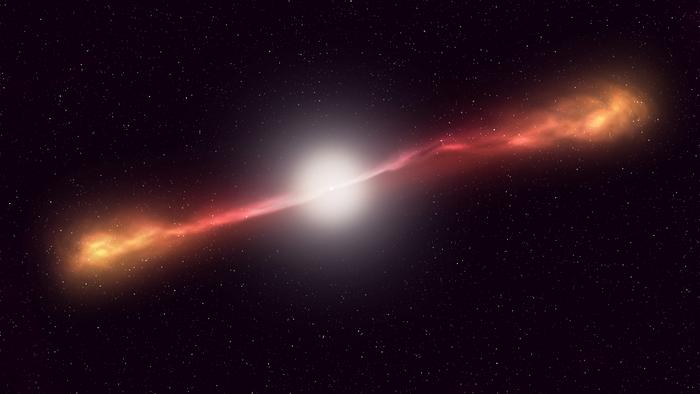
What makes these cosmic giants intriguing is their ability to rotate, generating a powerful gravitational field that can produce jets of plasma. These high-energy phenomena may lead to particle collisions that rival the conditions achieved within human-made colliders. The jets emitted from rapidly spinning black holes can unleash chaotic interactions, leading to collisions on a scale that expands our comprehension of energy dynamics in the universe.
Silk’s research investigates how gas flows near black holes draw energy from their immense rotation, resulting in violent conditions conducive to particle collision. The study indicates that these energetic collisions could potentially represent an untapped resource for high-energy physics, capitalizing on the unique environments of supermassive black holes rather than relying solely on terrestrial laboratories.
When fast-moving particles are created near a black hole, their immense energy could enable a flow of high-energy particles that reach Earth, suggesting a novel connection between cosmic phenomena and terrestrial detection methods. Silk expresses optimism that observatories already deployed for tracking other astronomical events, such as supernovae and cosmic eruptions, might also identify signals from these natural accelerators.
The study emphasizes that when particles are violently collided near a black hole, some are drawn into its depths, while others may escape, gaining energy in the process. This duality offers a promising avenue for researchers to explore, as they work to bridge the gap between the enigmatic nature of dark matter and its potential manifestations. These layers of interaction may provide insights not only into the structural composition of the universe but also into the dynamics of energy at unprecedented levels.
Observatories like the IceCube Neutrino Observatory, located at the South Pole, or advancements in surface monitoring systems, may soon stand on the forefront of this research. By observing particles that escape from black hole collisions, scientists could one day confirm theories of dark matter or discover new particles that redefine our understanding of physics.
Although the vast distance between terrestrial creatures and these cosmic phenomena presents challenges, Silk remains hopeful that signals emitted from high-energy collisions could penetrate the vast reaches of space and make their way to Earth, offering tantalizing evidence of the universe’s hidden workings.
As the scientific community grapples with reducing budgets and the pressures of advancing research, the appeal of supermassive black holes as natural particle colliders offers a fresh perspective. The research underscores a shift in how scientists can leverage cosmic phenomena in the ongoing quest to uncover the nature of dark matter. By analyzing the behavior of particles produced under extreme conditions, researchers stand at the cusp of potentially revolutionary discoveries that could reshape our understanding of the universe.
While the road ahead is fraught with uncertainty and challenges, the compelling findings from Johns Hopkins University provide a counterpoint to the dilemma of funding cuts and expensive construction projects for particle accelerators. By turning our gaze toward supermassive black holes, we may uncover not just the secrets of dark matter, but also an exciting new paradigm for understanding how the universe operates at its most fundamental level.
With supermassive black holes as the new supercolliders of the cosmos, the scientific journey to unravel the mysteries of dark matter continues, blending cosmic phenomena and terrestrial detection in a race to deepen humanity’s understanding of the universe.
Keywords
Supermassive black holes, particle colliders, dark matter, astrophysics, high-energy physics, cosmic events, Large Hadron Collider, Joseph Silk.
Cite Scienmag News
Katie Riggs. (June 3, 2025). Johns Hopkins Researchers Reveal How Black Holes Can Function as Supercolliders. Scienmag. https://scienmag.com/johns-hopkins-researchers-reveal-how-black-holes-can-function-as-supercolliders/
Katie Riggs. "Johns Hopkins Researchers Reveal How Black Holes Can Function as Supercolliders." Scienmag, 3 June 2025, https://scienmag.com/johns-hopkins-researchers-reveal-how-black-holes-can-function-as-supercolliders/. Accessed 5 September 2026.
Katie Riggs. "Johns Hopkins Researchers Reveal How Black Holes Can Function as Supercolliders." Scienmag. June 3, 2025. https://scienmag.com/johns-hopkins-researchers-reveal-how-black-holes-can-function-as-supercolliders/


