

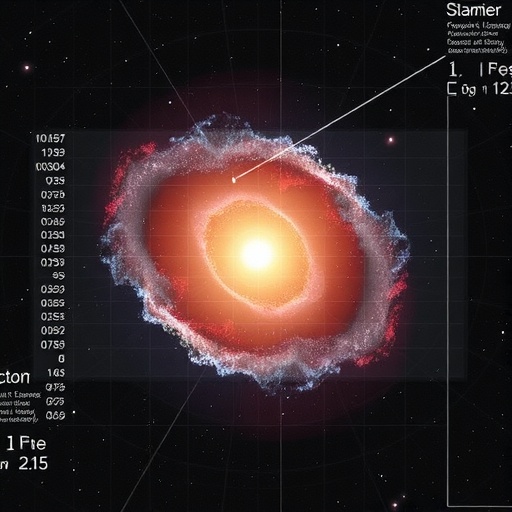
A groundbreaking study emerging from joint efforts by the Center for Astrobiology (CAB), CSIC-INTA, and the University of Oxford has unveiled an extraordinary wealth of small organic molecules hidden in the heart of the ultra-luminous infrared galaxy IRAS 07251–0248. Utilizing the immense power of the James Webb Space Telescope (JWST), researchers have opened a new chapter in astrochemical research, offering unprecedented insights into the formation and transformation of complex organic molecules under extreme cosmic conditions.
IRAS 07251–0248, shrouded by dense clouds of gas and dust, presents a significant challenge for traditional observational techniques focused on the electromagnetic spectrum visible to the human eye. However, by exploiting the unique capabilities of infrared observation, particularly in the 3–28 micron wavelength range, JWST can penetrate this obscuring material. This infrared prowess allows scientists to observe the central regions of the galaxy and obtain vital spectral data that reveal the types, quantities, and temperatures of various chemical species present in this tumultuous environment.
The collaborative research effort harnessed advanced spectroscopic techniques, integrating data from JWST’s NIRSpec and MIRI instruments. These instruments not only detect the radiative signatures of gas-phase molecules but also delineate features arising from ices and dust grains within the galactic nucleus. This level of detail is critical because it enables the identification of various small organic molecules, including prominent compounds such as benzene (C₆H₆), methane (CH₄), acetylene (C₂H₂), diacetylene (C₄H₂), and triacetylene (C₆H₂). Notably, the methyl radical (CH₃), detected for the first time outside the Milky Way, adds another intriguing dimension to our understanding of the cosmic chemical inventory.
Lead author Dr. Ismael García Bernete, who previously worked at Oxford University and now continues his research at CAB, expressed astonishment at the unexpected level of chemical complexity observed in these regions. The findings suggest that abundances of small organic molecules in the galaxy are strikingly higher than what current theoretical models had predicted. This revelation raises important questions regarding the sources of carbon and organic materials in these extreme environments, prompting further investigations into their formation processes.
Intriguingly, the implications of this research extend beyond mere curiosity; these small organic molecules serve as essential building blocks for more complex organic chemistry, which holds potential significance for the origins of life. Co-author Professor Dimitra Rigopoulou from the University of Oxford emphasizes the relevance of these findings to prebiotic chemistry. While small organic molecules are not found in living organisms, they may represent crucial precursors to the formation of amino acids and nucleotides, foundational elements for life as we know it.
The analysis conducted by the research team went beyond merely cataloging the chemical species present; it also explored the mechanisms responsible for their abundances. Using models of polycyclic aromatic hydrocarbons (PAHs) developed at the University of Oxford, the researchers concluded that the observed chemical processes could not be solely explained by high temperatures or turbulent gas flows. Instead, cosmic rays, which are prevalent in these energetic environments, likely play a pivotal role by fragmenting PAHs and carbon-rich dust, thereby liberating smaller organic molecules into the surrounding gas phase.
Additionally, the study revealed a compelling correlation between the abundance of hydrocarbons and levels of cosmic-ray ionization in similar galactic nuclei. This connection fortifies the hypothesis that obscured galactic centers operate as organic molecule factories, contributing crucially to the chemical evolution of galaxies. By establishing these links, the study provides a clear pathway for further exploration of the interactions between cosmic rays and organic chemistry in regions long hidden from view.
The impact of the research extends beyond the immediate findings associated with IRAS 07251–0248. This work signifies a major advancement in our ability to probe the chemical makeup of deeply obscured regions of space, especially those that were previously thought to be inaccessible to study. By illuminating these hidden corners of the universe, JWST showcases its potential to unlock new scientific horizons and expand our understanding of cosmic processes that lead to the formation of complex organic compounds.
In light of these developments, the research team anticipates that their findings will pave the way for future explorations into the chemical evolution of the cosmos. By combining the power of advanced telescopes such as JWST with innovative analytical techniques, scientists can expect to derive further insights into the building blocks of life, fostering a deeper understanding of our universe’s complex and dynamic nature.
The significance of this study resonates with broader scientific interests, as it challenges existing paradigms and invites revisions to our understandings of where and how complex organic chemistry occurs in the universe. It demonstrates that even in the most challenging environments, our quest for knowledge about the universe’s chemical diversity can yield fruitful results, highlighting the intertwined nature of carbon chemistry, cosmic rays, and the formation of galaxies over cosmic time.
Moreover, the collaborative nature of this research underscores the importance of interdisciplinary approaches to tackling complex astronomical questions. With contributions from various institutions, the work exemplifies how diverse expertise can come together to form a comprehensive understanding of complex phenomena in astrophysics and astrochemistry.
As the scientific community digests these findings, the expectation is that they will ignite further inquiry into the nature of organic molecule production in cosmic settings. Given the central importance of these molecules to both the origins of life and the evolution of galaxies, researchers are keen to replicate and extend these findings in other similar environments, thereby continuing to push the boundaries of what we know about the universe.
In conclusion, the remarkable discoveries regarding the chemical complexity of IRAS 07251–0248 illuminate the dynamic processes within galaxies that contribute to the universe’s rich tapestry of organic chemistry. As we continue to explore these cosmic regions using powerful instruments like the James Webb Space Telescope, our understanding of the fundamental processes that govern the chemistry of the universe will inevitably deepen, potentially revealing critical insights into the story of life’s origins.
Subject of Research: The richness of small organic molecules in IRAS 07251–0248
Article Title: JWST detection of abundant hydrocarbons in a buried nucleus with signs of grain and PAH processing
News Publication Date: 6-Feb-2026
Web References: http://dx.doi.org/10.1038/s41550-025-02750-0
References: Nature Astronomy
Image Credits: Data from Mikulski Archive for Space Telescopes, Space Telescope Science Institute, Association of Universities for Research in Astronomy, Inc., NASA
Keywords
Organic molecules, IRAS 07251-0248, James Webb Space Telescope, astrochemistry, cosmic rays, prebiotic chemistry, small organic molecules, galaxies, chemical evolution, polycyclic aromatic hydrocarbons.


