


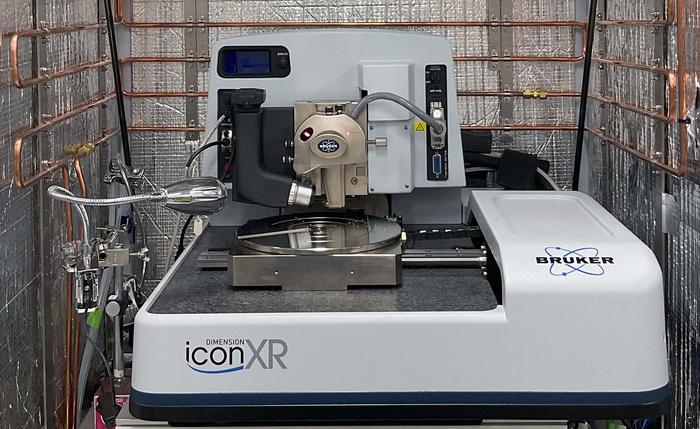
Ice in nature is surrounded by liquid most of the time, and therefore it is key to understand how ice and liquid interact. A Kobe University and Institute for Molecular Science study could now for the first time directly observe the precise shape of ice at the interface between ice and liquid – by using antifreeze and a refrigerated microscope.

Credit: ONISHI Hiroshi
Ice in nature is surrounded by liquid most of the time, and therefore it is key to understand how ice and liquid interact. A Kobe University and Institute for Molecular Science study could now for the first time directly observe the precise shape of ice at the interface between ice and liquid – by using antifreeze and a refrigerated microscope.
When we slide on ice, when snowflakes form, when we lick ice cream, the surface of the ice is always covered with liquid water, and understanding the interaction between the liquid water and the ice is vital to understanding the whole phenomenon. However, because ice and water quickly transform into each other, it has been impossible to directly observe the interface between the two.
To get closer to understanding how ice interacts with its surrounding liquid, researchers led by Kobe University’s ONISHI Hiroshi decided to try the next best thing. He says: “We came up with the idea of measuring ice immersed in antifreeze colder than 0°C. This way, the ice doesn’t melt and the interface doesn’t move, and it should be possible to make precise observations.” Even so, the researchers struggled to get good measurements of the ice. “Through various trial and error processes, we found that we had to cool the entire microscope system in a cooling box, and it took some ingenuity to ensure that the atomic force microscope, a precision measuring instrument, could operate stably at sub-zero temperatures,” explains the Kobe University researcher.
In The Journal of Chemical Physics, the group now published their results. They found that, while ice without surrounding liquid features so-called “frost pillars” about 20 nanometers tall, in antifreeze the ice is perfectly flat with occasional steps only one molecular layer high. “We think that the flat surface is formed through … partial dissolution and recrystallization of the ice surface in the 1-octanol liquid (the antifreeze),” the researchers write in the paper.
Onishi and his team also tried different liquids, all alcohols like 1-octanol. And even though all liquids they tried have similar properties, they observed that the ice surface looks different in each case, underscoring the importance of directly measuring the interface. In addition, they investigated the “hardness” of the ice surface under 1-octanol and found that the ice is much harder than previously estimated using less direct methods.
The researchers hope that their results will invite further study of the ice-liquid interface, but they have also set clear goals for their own future work saying: “We expect to increase the resolution of the microscope to single water molecules and use measurement methods other than atomic force microscopy. In this way, we hope to expand the range of possible applications of molecular-level measurements of the ice-antifreeze interface.”
This research was funded by the Ministry of Education, Culture, Sports, Science and Technology Japan (grants JPMXP1222MS0008 and JPMXP1223MS0001) and the Japan Society for the Promotion of Science (grants 21K18935 and 23H05448). It was conducted in collaboration with researchers from the Institute for Molecular Science, National Institutes of Natural Sciences.
Kobe University is a national university with roots dating back to the Kobe Commercial School founded in 1902. It is now one of Japan’s leading comprehensive research universities with nearly 16,000 students and nearly 1,700 faculty in 10 faculties and schools and 15 graduate schools. Combining the social and natural sciences to cultivate leaders with an interdisciplinary perspective, Kobe University creates knowledge and fosters innovation to address society’s challenges.
Journal
The Journal of Chemical Physics
Method of Research
Experimental study
Subject of Research
Not applicable
Article Title
The interface between ice and alcohols analyzed by atomic force microscopy
Article Publication Date
9-Jul-2024
Cite Scienmag News
Bethany Barker. (July 9, 2024). It takes a cool microscope and antifreeze to really look at ice. Scienmag. https://scienmag.com/it-takes-a-cool-microscope-and-antifreeze-to-really-look-at-ice/
Bethany Barker. "It takes a cool microscope and antifreeze to really look at ice." Scienmag, 9 July 2024, https://scienmag.com/it-takes-a-cool-microscope-and-antifreeze-to-really-look-at-ice/. Accessed 4 September 2026.
Bethany Barker. "It takes a cool microscope and antifreeze to really look at ice." Scienmag. July 9, 2024. https://scienmag.com/it-takes-a-cool-microscope-and-antifreeze-to-really-look-at-ice/

