


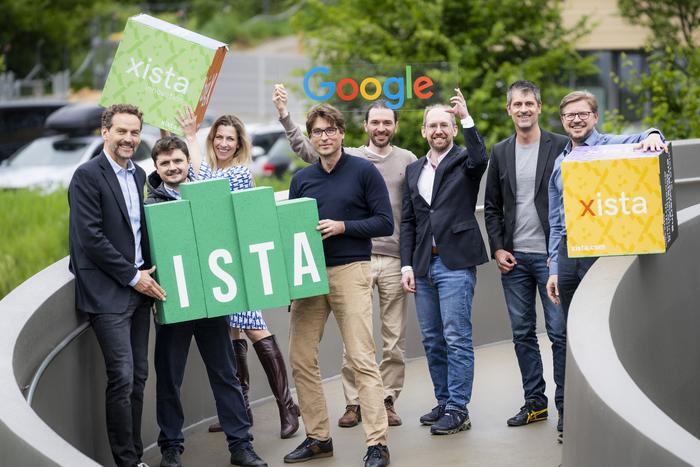
The Institute of Science and Technology Austria (ISTA), located in Klosterneuburg, and global technology leader Google have embarked on a groundbreaking scientific collaboration as part of a newly signed “Master Sponsored Research Agreement.” This multi-faceted partnership aims to propel forward fundamental research in areas spanning artificial intelligence (AI), advanced algorithms, and innovative neuro-imaging techniques with the potential to revolutionize medical research. The collaboration is uniquely anchored by Google’s physical presence in the xista science park, situated strategically opposite the ISTA campus, thereby solidifying a direct conduit between cutting-edge corporate research and the vibrant academic environment of ISTA, alongside dynamic entrepreneurial ventures within the xista ecosystem.
Over the last 15 years, ISTA has cultivated a reputation for fostering insightful connections between academic excellence and societal impact. Martin Hetzer, President of ISTA, emphasizes the significance of such engagement: “Our institute’s links to society and economy have been central from the outset. The addition of Google’s presence complements the rich innovation ecosystem flourishing on our campus, opening new avenues for collaboration across disciplines.” This synergy is further enhanced by xista, ISTA’s tech transfer division, whose Managing Director Markus Wanko highlights the value of integrating Google’s robust industrial expertise with ISTA’s nimble academic prowess, describing xista’s ecosystem as the ideal platform for scalable innovation.
At the core of this partnership lies a shared vision to promote agile, interdisciplinary research. Lizzie Dorfman, Product Lead for Science in Google Research, articulates this alignment by noting that ISTA’s culture of outside-the-box scientific inquiry, spanning natural sciences, mathematics, and computer science, perfectly complements Google’s strategic research ambitions. Past joint projects laid the foundation for this agreement, providing a proven track record of fruitful scientific exchange and innovation extension, which both institutions are now poised to expand.
The scope of this long-term agreement is deliberately broad and flexible, designed to nurture emerging ideas and swiftly adapt to evolving research landscapes. Current collaborations demonstrate a diverse range of advanced projects. Within the realm of AI, ISTA’s Prof. Dan Alistarh directs research targeting the efficiency and scalability of machine learning models. His team explores advanced model compression techniques, examining the ‘scaling laws’ that govern highly accurate sparse models. Concurrently, another project focuses on data compression strategies, aiming to minimize the sample complexity necessary to train high-quality AI systems, a crucial step toward more resource-efficient machine learning.
Complementing these efforts, Prof. Monika Henzinger’s group leverages deep expertise in algorithms and differential privacy, focusing on methods that enable the training of Large Language Models (LLMs) without compromising individual privacy. By developing privacy-preserving algorithms rooted in robust theoretical frameworks, her team addresses one of the most pressing challenges in AI: balancing powerful computational capabilities with stringent ethical requirements for data protection.
Another pioneering AI initiative is led by Prof. Francesco Locatello, whose work bridges vision-language models and environmental science. This interdisciplinary project seeks to harness advances in multimodal AI to automate the interpretation of complex climate data and probabilistic forecasts. By integrating sophisticated machine learning models capable of understanding visual and textual information, this research has the potential to transform how scientists monitor and predict environmental phenomena, contributing critical insights in the urgent context of climate change.
Materials science and biomedical research also stand to benefit significantly from this partnership. Prof. Johann Danzl and his research group have pioneered novel light microscopy techniques surpassing traditional electron microscopy in data richness. These methods enable detailed reconstruction of brain tissue, mapping neural connections with unprecedented accuracy. The resultant high-dimensional datasets pose computational challenges, which are currently addressed in collaboration with Google Research through advanced data analysis algorithms. This fusion of experimental innovation and computational power promises new frontiers for understanding neurological structures and diseases.
The wider ISTA ecosystem, representing a thriving hub of fundamental research and technology transfer, continues to grow. With 90 research groups across natural sciences, mathematics, and computer science, ISTA is aiming to expand its capacity to 150 groups by 2036, thus catalyzing a broader impact. The institute also actively engages the public through its VISTA Science Experiences initiative, fostering science education and literacy, thereby strengthening societal ties.
Central to translating research into tangible innovations is the xista science park, a specialized facility tailored for science-driven startups requiring modern laboratory infrastructure. This park, continuously expanded to accommodate burgeoning scientific ventures, now hosts Google’s liaison office, embedding the tech giant directly within the innovation environment. This proximity accelerates collaborative opportunities, providing startups access to Google’s technical resources and expertise, while offering Google a front-row seat to emerging scientific breakthroughs.
Financially underpinning this dynamic landscape is xista science ventures, a venture fund that has successfully supported and invested in 22 spin-offs from various scientific institutions, including ISTA. This investment framework ensures that promising fundamental research can transition efficiently into commercial applications, fostering a vibrant ecosystem where academic ideas evolve into impactful technologies that drive economic and societal advancement.
The partnership between ISTA and Google represents a model for synergistic collaboration between academia and industry, combining deep theoretical research with practical applications. The integration of cutting-edge AI, privacy-preserving technologies, and groundbreaking imaging methods exemplifies the diverse, interdisciplinary approach needed to tackle today’s complex scientific questions. As this alliance matures, it is poised to contribute transformative advancements across multiple disciplines, ultimately cultivating new knowledge, technologies, and societal benefits.
In summary, the collaboration established through the Master Sponsored Research Agreement cements a strategic alliance that intertwines academic rigor with industrial innovation. This initiative harnesses ISTA’s strong fundamental research capabilities and Google’s technological leadership to explore frontier scientific questions while fostering an innovation ecosystem that bridges basic research, technology transfer, and startup culture. The presence of Google within the xista science park signifies a tangible commitment to this vision, facilitating ongoing interaction that will drive scientific and technological breakthroughs well into the future.
News Publication Date: Not specified
Web References:
- https://ista.ac.at/en/research/alistarh-group/
- https://ista.ac.at/en/research/henzinger_monika-group/
- https://ista.ac.at/en/research/locatello-group/
- https://ista.ac.at/en/research/danzl-group/
- https://ista.ac.at/en/
- https://www.vistascience.at/en/
- http://www.xista.com
- https://xista-park.com/
- https://xista.vc/
Cite Scienmag News
Courtney Benton. (June 16, 2025). ISTA and Google Initiate Groundbreaking Research Collaboration. Scienmag. https://scienmag.com/ista-and-google-initiate-groundbreaking-research-collaboration/
Courtney Benton. "ISTA and Google Initiate Groundbreaking Research Collaboration." Scienmag, 16 June 2025, https://scienmag.com/ista-and-google-initiate-groundbreaking-research-collaboration/. Accessed 6 September 2026.
Courtney Benton. "ISTA and Google Initiate Groundbreaking Research Collaboration." Scienmag. June 16, 2025. https://scienmag.com/ista-and-google-initiate-groundbreaking-research-collaboration/


