


Magnesium compounds are a common ingredient of many remedies designed to help people wind down and escape the stresses of modern life.

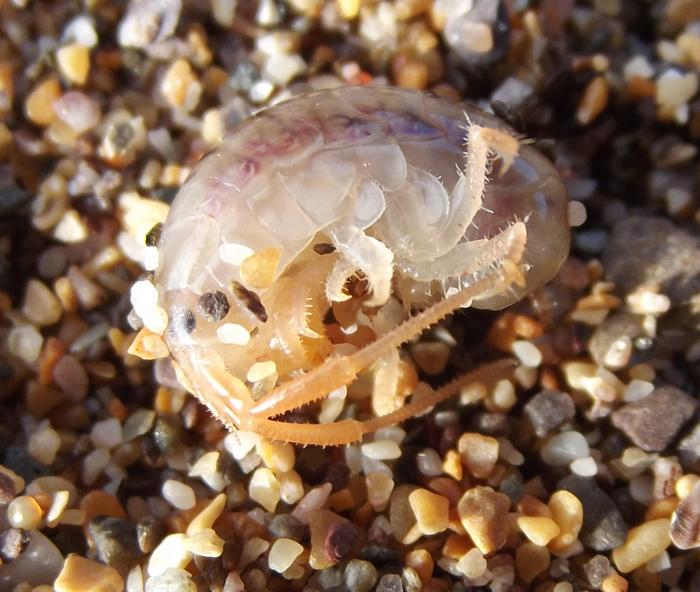
Credit: University of Plymouth
Magnesium compounds are a common ingredient of many remedies designed to help people wind down and escape the stresses of modern life.
However, a new study has shown it is not only humans that are using forms of the chemical as a way to help them survive challenging conditions.
In tests conducted on beaches in Cornwall, and in the laboratory at the University of Plymouth, scientists confirmed the findings of previous studies which showed large sandhoppers (Talitrus saltator) increase the levels of magnesium ions in their bodies as temperatures fall. This slows them down so they are less active than they would be during the warmer months.
However, the new study has shown for the first time that when they want to enter a period of deep sleep the creatures have the means through which to increase their magnesium levels even further – in some instances more than doubling them.
Essentially acting as a natural narcotic, the magnesium puts the sandhopper into a torpid state. This enforced rest means that the creatures stay hidden in burrows up to 30cm beneath the beach surface, without the need to come up for food or water, and to some extent buffered from the wintery conditions at the surface of the sand.
The study – which focused on the sandhopper population at Portwrinkle, in South East Cornwall – was carried out by Professor of Marine Zoology John Spicer and BSc (Hons) Marine Biology graduate Jack Bush.
Writing in the Journal of Experimental Marine Biology and Ecology, they say it sheds further light on why large sandhoppers seem to disappear from sandy beaches during cold winter weather.
Professor Spicer has spent decades studying the impact of temperature on marine and coastal species, including a number of studies on sandhoppers in Scotland.
He said: “It has been known for over a century that large sandhoppers, relatives of shrimp and crabs, can overwinter buried deep in the sand at the top of beaches away from the reach of the tide. What our study shows is that they may help themselves ‘go to sleep’ by allowing a natural narcotising agent, magnesium ions, to build up in their body fluids.
“Fluids containing magnesium, like Epsom salts, are routinely used by humans to relax but also when aquatic animals are being examined as part of scientific investigations. Our study shows nature has also found a way to do that without outside involvement.
“That said, as it’s a temperature dependent process it does raise questions over what will happen as our world warms. Will sandhoppers no longer sleep and just eat decomposing wrack all day long? Or will they change their sleeping habits by adapting the way they manage the magnesium in their body fluids?”
Journal
Journal of Experimental Marine Biology and Ecology
Method of Research
Experimental study
Subject of Research
Animals
Article Title
Elevated extracellular magnesium in overwintering sandhoppers Talitrus saltator: Disentangling the effects of torpor and temperature
Article Publication Date
13-Jun-2024
Cite Scienmag News
Drew Townsend. (June 14, 2024). Is magnesium the sleeping potion that enables sandhoppers to survive cold winters? Scienmag. https://scienmag.com/is-magnesium-the-sleeping-potion-that-enables-sandhoppers-to-survive-cold-winters/
Drew Townsend. "Is magnesium the sleeping potion that enables sandhoppers to survive cold winters?" Scienmag, 14 June 2024, https://scienmag.com/is-magnesium-the-sleeping-potion-that-enables-sandhoppers-to-survive-cold-winters/. Accessed 4 September 2026.
Drew Townsend. "Is magnesium the sleeping potion that enables sandhoppers to survive cold winters?" Scienmag. June 14, 2024. https://scienmag.com/is-magnesium-the-sleeping-potion-that-enables-sandhoppers-to-survive-cold-winters/

