


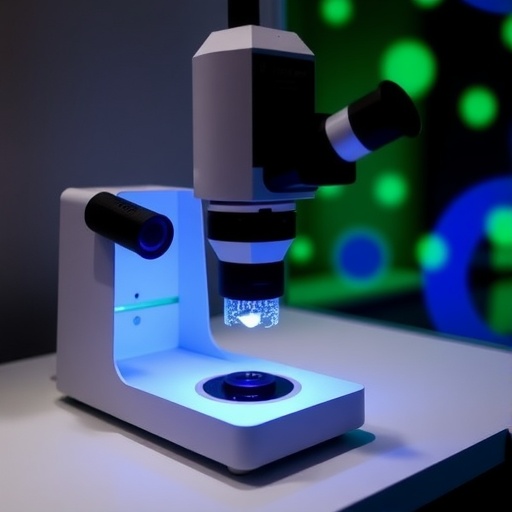
Trinity College Dublin has recently unveiled a groundbreaking technological advancement in biomedical research with the installation of Ireland’s first and only BioBrillouin microscope. This revolutionary instrument promises to profoundly transform the understanding of cellular mechanics and tissue physiology by enabling researchers to probe the mechanical properties of biological specimens in unprecedented detail. The arrival of this cutting-edge microscope at Trinity’s School of Engineering marks a significant milestone, not only for Ireland but for the global scientific community, as it opens up new avenues in the study of complex diseases such as inflammation and cancer, as well as developmental biology and biomedical materials research.
At the core of many physiological processes, and indeed pathological conditions, lies the mechanical behavior of cells and tissues. Mechanical cues regulate cellular function, influence tissue regeneration, and mediate disease progression. Traditionally, however, the study of such mechanics has been hampered by methodologies that often disrupt the very systems they aim to investigate. Techniques relying on physical contact, such as atomic force microscopy or micropipette aspiration, although powerful, are inherently invasive and limited in their ability to capture real-time dynamics within living systems. The BioBrillouin microscope circumvents these limitations by employing non-invasive optical methods that provide a comprehensive mechanical characterization without perturbing the sample.
The science behind Brillouin microscopy hinges on the interaction between photons and acoustic phonons within a material. When light passes through a medium, a fraction of it scatters due to the material’s intrinsic acoustic vibrations—phonons—resulting in an energy shift known as Brillouin scattering. This phenomenon yields rich data about the viscoelastic and compressibility properties of materials at a microscopic scale. By meticulously analyzing these subtle shifts in the frequency of scattered light, the BioBrillouin microscope maps the mechanical landscape of biological tissues with exquisite spatial resolution. Unlike other optical techniques, Brillouin microscopy uniquely captures both elastic and viscous components of tissue mechanics, providing more nuanced insight into cellular biomechanics.
Installed in the state-of-the-art Trinity Biomedical Sciences Institute and integrated within the Trinity Centre for Biomedical Engineering, the microscope currently operates under the supervision of Professor Michael Monaghan. The procurement and successful implementation of this system were made possible through generous funding from the European Research Council (ERC) and the Research Ireland initiative. Being the first commercial BioBrillouin microscope globally, the system benefits from robust technical collaboration with the manufacturer, CellSense Technologies GmbH, ensuring that Trinity’s researchers can explore the technology’s full potential while setting global benchmarks for its application.
Professor Monaghan, a prominent voice in this emerging field, contributed to an expert consensus article published recently in Nature Photonics, a leading journal in optical science. The paper consolidates interdisciplinary expertise and outlines the transformative promise of Brillouin microscopy in biological and material sciences. According to him, the microscope’s ability to non-invasively study live systems offers vital mechanobiological insights that are critical to elucidating complex disease mechanisms, including the genesis and progression of inflammation and cancer. Such insights could drive innovative diagnostic strategies and novel therapeutic interventions in biomedical research.
The application spectrum of Brillouin microscopy, however, extends far beyond biomedicine. The technology holds significant promise for expanding the frontiers of disciplines such as materials science, information and communications technology (ICT), energy storage, pharmaceuticals, and medical device development. In materials science, for instance, the microscope can probe the viscoelasticity and molecular interactions within polymers and composites under realistic conditions — an essential capability for the design of next-generation smart materials. Similarly, in ICT and energy sectors, understanding mechanical deformations at micro- and nano-scales can inform the durability and performance optimization of critical components.
Moreover, the non-contact, label-free nature of Brillouin microscopy is especially advantageous for longitudinal studies in dynamic biological systems. Researchers can monitor living cells and tissue samples over time to observe how mechanical properties evolve during processes such as differentiation, disease progression, or drug response, without the artifacts introduced by physical probing. This opens new horizons for developmental biology and pharmacology, where mechanical environment alterations are often subtle yet pivotal.
In tandem with the high technical sophistication, the introduction of BioBrillouin microscopy at Trinity is poised to attract a global community of scientists eager to leverage this unique capability. Already, international collaborations are taking shape, and visiting researchers have commenced utilizing the facility to advance their investigations. The collaborative environment, boosted by ERC and Research Ireland support, fosters cross-disciplinary innovations, bridging engineering, physics, biology, and medicine in unprecedented ways.
Importantly, the technology’s data-rich output is expected to synergize with emerging computational tools in machine learning and big data analytics. By integrating mechanical mapping with bioinformatics and molecular profiling, researchers can build comprehensive models of tissue behavior, disease etiology, and therapeutic effects. This confluence might accelerate the discovery pipeline from fundamental mechanobiology to clinical application, ensuring that discoveries generate meaningful health outcomes.
As the first commercial system of its kind, the Brillouin microscope at Trinity also serves as a platform for continuous technological refinement. Both hardware advancements and software enhancements are anticipated, refining sensitivity, resolution, and throughput—parameters crucial for integrating the microscope into routine research workflows. The close partnership between the academic researchers and the vendor exemplifies a model for successful technology transfer, translating cutting-edge innovation from conception to widespread academic and potentially clinical utility.
The scientific community’s embrace of this technology is a testament to its transformative potential. By enabling non-invasive, high-resolution mechanical characterization in live systems, BioBrillouin microscopy stands to reshape scientific paradigms concerning the interplay between mechanical forces and biological function. The prospect that researchers worldwide will travel to Trinity to access this instrument underscores the facility’s emerging status as a global hub for frontier mechanobiological research. This aligns perfectly with Trinity’s commitment to pioneering interdisciplinary science that tackles societally impactful challenges.
In summary, the arrival of the BioBrillouin microscope at Trinity College Dublin heralds a new era in mechanobiology and material science. This innovative technology unlocks the ability to visualize and quantify the mechanical properties of live biological systems and diverse materials without perturbation. Supported by major European funding, housed within a leading biomedical engineering environment, and equipped through global industry collaboration, this unique instrument is poised to accelerate discoveries in health, disease, and beyond. As researchers worldwide begin to unlock its capabilities, we can anticipate significant leaps forward that will expand scientific knowledge and drive technological progress across multiple disciplines.
News Publication Date: [Not specified in the original content]
Web References:
References:
- Expert consensus paper published in Nature Photonics by Prof. Michael Monaghan and international collaborators.
Cite Scienmag News
Nathaniel Bowman. (July 3, 2025). Ireland Launches First BioBrillouin Microscope for Real-Time, Non-Invasive Living Cell and Tissue Analysis. Scienmag. https://scienmag.com/ireland-launches-first-biobrillouin-microscope-for-real-time-non-invasive-living-cell-and-tissue-analysis/
Nathaniel Bowman. "Ireland Launches First BioBrillouin Microscope for Real-Time, Non-Invasive Living Cell and Tissue Analysis." Scienmag, 3 July 2025, https://scienmag.com/ireland-launches-first-biobrillouin-microscope-for-real-time-non-invasive-living-cell-and-tissue-analysis/. Accessed 4 September 2026.
Nathaniel Bowman. "Ireland Launches First BioBrillouin Microscope for Real-Time, Non-Invasive Living Cell and Tissue Analysis." Scienmag. July 3, 2025. https://scienmag.com/ireland-launches-first-biobrillouin-microscope-for-real-time-non-invasive-living-cell-and-tissue-analysis/


