


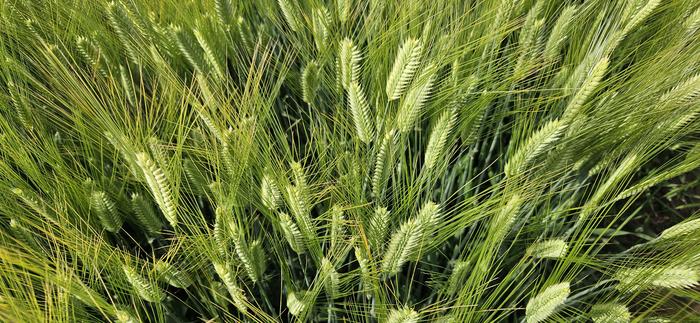
The inflorescence architecture of crop plants like barley is predominantly regulated by meristem activity and fate, which play a critical role in determining the number of floral structures for grain production. Spikelets are the basic reproductive unit of grass inflorescences. The identity and determinacy of many grass meristems are partially determined by a group of genes expressed specifically at organ boundaries, which can form local signalling centres that regulate adjacent meristem fate and activity.

Credit: IPK Leibniz Institute/ T. Schnurbusch
The inflorescence architecture of crop plants like barley is predominantly regulated by meristem activity and fate, which play a critical role in determining the number of floral structures for grain production. Spikelets are the basic reproductive unit of grass inflorescences. The identity and determinacy of many grass meristems are partially determined by a group of genes expressed specifically at organ boundaries, which can form local signalling centres that regulate adjacent meristem fate and activity.
These genes are critical for establishing and maintaining organs. Proteins regulate diverse cell identities, axillary meristem initiation, and proper development of neighbouring organs and tissues.
In this study, the research team characterised a barley spikelet developmental mutant, extra floret-a (flo.a). flo.a produced extra spikelets and fused glumes due to the defective establishment of organ boundaries, which separate meristems from developing organs, such as inflorescence meristem and developing spikelet primordia.
The gene HvALOG1 plays a crucial role in maintaining the inflorescence architecture of barley. On the one hand, the boundary-localized protein is associated with signals that confer proper development of the spikelet meristem (i.e. non-cell autonomously); on the other hand, it controls boundary formation between floral organs (autonomously). “We show that mutations in HvALOG1 lead to the production of extra spikelets and are linked to the fusion of floral organs derived from improper boundary formation”, says Guojing Jiang, first author of the study.
“Our study offers new insights into the function of ALOG family members in regulating meristem activity and inflorescence development in barley”, says Prof. Dr. Thorsten Schnurbusch. “These findings may contribute to our understanding of the molecular mechanisms underlying inflorescence development and may have implications for crop improvement.”
The identification of the wheat gene ALOG-1 and its function during spikelet development has been described in the co-published article by Gauley et al., who show that wheat ALOG-1 is not expressed in the spikelet meristem but produces extra spikelets in the mutant, which is consistent with the effect found in barley. “Our joint results reveal an important and conserved mechanism of ALOG1 in specifying spikelet meristem determinacy and maintaining the characteristic spike-type inflorescence of cereals in Triticeae grasses”, says Prof. Dr. Thorsten Schnurbusch.
Journal
Current Biology
Article Title
Non-cell Autonomous Signaling Associated with Barley ALOG1 Specifies Spikelet Meristem Determinacy
Article Publication Date
22-May-2024
Cite Scienmag News
Alan Morgan. (May 22, 2024). IPK research team uncovers mechanism for spikelet development in barley. Scienmag. https://scienmag.com/ipk-research-team-uncovers-mechanism-for-spikelet-development-in-barley/
Alan Morgan. "IPK research team uncovers mechanism for spikelet development in barley." Scienmag, 22 May 2024, https://scienmag.com/ipk-research-team-uncovers-mechanism-for-spikelet-development-in-barley/. Accessed 5 September 2026.
Alan Morgan. "IPK research team uncovers mechanism for spikelet development in barley." Scienmag. May 22, 2024. https://scienmag.com/ipk-research-team-uncovers-mechanism-for-spikelet-development-in-barley/

