


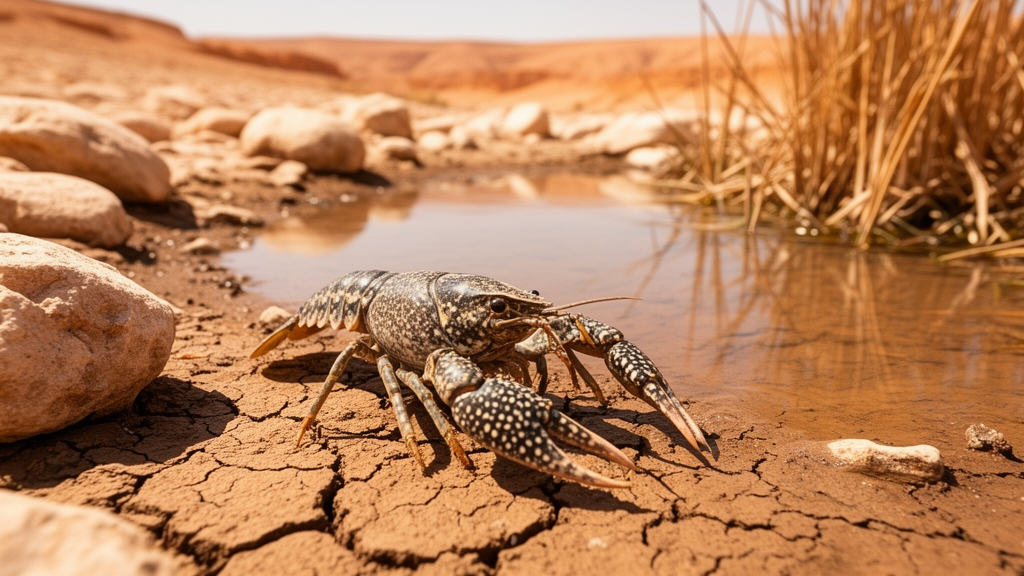
The marbled crayfish, a self-cloning invader that has colonized freshwater systems in more than 24 countries across North America, Europe, Africa and the Middle East, has now been caught in the act of rewriting the food webs of some of the world’s most fragile aquatic habitats. A new study published in the journal NeoBiota provides the first assessment of the trophic ecology of Procambarus virginalis in the semi-arid Middle East, revealing an animal of remarkable dietary flexibility that occupies an intermediate trophic position, survives on almost any food available, and turns on its own offspring when plant-based meals dominate the menu.
Unlike the perennial lakes and streams of Europe where the species has been studied before, the water bodies of the Levant are small, seasonal and shaped by pronounced wet and dry periods. Many of them lack fish entirely, because periodic desiccation prevents top predators from establishing. That absence of predation pressure, combined with native communities that evolved few defenses against efficient predators, makes these systems uniquely vulnerable to invasion. Crayfish, meanwhile, are among the most destructive invasive species in the world: generalist omnivores that can affect every trophic level, and ecosystem engineers whose burrowing and foraging modify sediment properties, increase bioturbation and alter water quality.
The research team, working under permits from the Israel Nature and Parks Authority, sampled three established marbled crayfish populations in Israel between October 2022 and September 2023. Ein Meshotetim is a contact spring in the Siah Stream on Mount Carmel near Haifa, feeding a small rock-carved inner pool that intermittently flows into an outside pool that is occasionally emptied. Tzaanan Pool, in the Guvrin Stream near Beit Guvrin in central-eastern Israel, is a seasonal pool with a maximum depth of 120 centimeters that naturally dries out every year for at least one to two months. Approximately one kilometer downstream lies Mekorot Pool, a shallow habitat fed by surplus groundwater discharged from a nearby drinking water facility. In total, the researchers collected 101 crayfish and 94 samples of potential food sources for stable isotope analysis, along with 432 crayfish from Tzaanan Pool for controlled diet experiments.
To reconstruct the invader’s diet, the scientists turned to stable isotope analysis, a technique that measures the ratios of carbon-13 to carbon-12 and nitrogen-15 to nitrogen-14 in animal tissues. Because these ratios reflect what an animal has assimilated over weeks to months, they provide an integrated view of diet that gut content analysis cannot match. Dried, homogenized samples were analyzed at Cornell University’s Stable Isotope Facility using continuous-flow combustion on a Carlo Erba NC2500 connected to a DeltaV isotope ratio mass spectrometer. Nitrogen isotope values increase predictably with trophic level, allowing the researchers to calculate the crayfish’s trophic position using small aquatic invertebrates as site-specific baselines, while carbon isotope values, corrected for lipid content in samples with carbon-to-nitrogen ratios above 3.5, trace the ultimate energy pathways supporting the animal.
The results confirmed that Procambarus virginalis functions as a flexible omnivore across all three habitats, occupying trophic positions between 2.3 and 2.9, with the highest values observed during summer. Bayesian mixing models, run with identical Markov chain Monte Carlo parameters across three chains of 300,000 iterations, revealed strikingly site-specific diets. At Ein Meshotetim, the crayfish diet was dominated by zooplankton, contributing a posterior median of 46.6 percent, and gastropods at 34.9 percent. At Tzaanan Pool, macrophytes and tadpoles were the main contributors, at 36.3 and 34.8 percent respectively. At Mekorot Pool, tadpoles dominated at 50.5 percent, with leaf litter contributing 27 percent. Notably, the marbled crayfish was the most nitrogen-15-enriched species at all three sites during summer, when four to fourteen faunal taxa were collected per site, underscoring its position near the top of these fishless food webs.
Seasonal patterns added another layer of complexity. Nitrogen isotope values in crayfish from Tzaanan Pool and Ein Meshotetim were significantly higher in summer than in autumn and winter, a pattern the authors attribute to increased consumption of animal prey, changes in the isotopic composition of basal resources driven by enhanced microbial processing and internal nitrogen recycling during dry periods, and physiological effects on individuals confined to burrows, where reduced feeding and reliance on internal reserves can elevate tissue nitrogen isotope values. Ontogenetic trends also diverged between sites: at resource-rich Tzaanan Pool, larger crayfish showed higher trophic positions, consistent with growing predatory capacity, while at resource-poor Ein Meshotetim the correlation was negative, suggesting larger individuals there cannot access protein-rich prey and feed mainly on periphyton and detritus.
The diet regime experiments, conducted with crayfish and their offspring from Tzaanan Pool, tested how three dietary regimes affected survival and growth. Juveniles of the smallest size class, reared in the absence of adults, exhibited survival rates above 75 percent across all diets, with no significant differences between treatments, indicating that young crayfish do not require animal-based food to survive. However, diet did significantly affect growth: juveniles fed a rich vegetarian diet of lettuce, carrots and kohlrabi reached an average length of 1.78 centimeters, significantly larger than the 1.52 centimeters achieved on a poor lettuce-only diet. Adults and sub-adults showed high survival under all tested diets, but with a dark twist: cannibalism occurred, and it was amplified when the animals were fed purely plant-based diets. Survival of the smallest juveniles in the presence of adults dropped below 30 percent in all three diets, with cannibalism directed primarily at juveniles aged zero to two months, while cannibalism among adults and sub-adults themselves remained very limited even at high densities.
The findings carry particular concern for amphibian conservation. Israel hosts the southernmost range limit of the critically endangered banded newt, whose populations begin their aquatic phase and reproduction shortly after seasonal pools refill. At the onset of the wet season, ecological succession is slow: crayfish that survived the dry summer rapidly become fully active, while other aquatic organisms are scarce and many are in early developmental stages. The resulting paucity of alternative prey may drive excessive predation pressure on newt eggs and tadpoles, potentially leading to extirpation of local populations. The absence of fish in these ephemeral systems, which releases the crayfish from top-down control, compounds the threat, although the dry season itself poses a major challenge that the species survives by taking refuge in underground burrows, where it can sustain egg incubation and early development under humid air conditions.
For management, the study suggests that temporary drainage, which has proven effective against other invasive crayfish in Swiss habitats, may work in the ephemeral Beit Guvrin Stream depending on timing and how far it extends the natural dry period. Other approaches, from trapping and hand removal to biocides and predatory fish introduction, have achieved suppression but not eradication, and each carries ecological risks. Intriguingly, regional climate change may already be reshaping the invasion: 2025 was one of the driest years on record in the Beit Guvrin area, with Tzaanan Pool drying out just weeks after refilling, and combined with manual collection of crayfish from their burrows, this raises the possibility that the population there may have been eradicated. Future monitoring will confirm whether this self-cloning invader has finally met its match in the drying streams of the semi-arid Middle East.
Subject of Research: Invasive species ecology
Article Title: Trophic ecology of the invasive marbled crayfish in ephemeral streams of semi-arid environments
Article References: Mor, R., Kolodny, O., & Guy-Haim, T. (2026). Trophic ecology of the invasive marbled crayfish in ephemeral streams of semi-arid environments. NeoBiota, 108, 121-143. https://doi.org/10.3897/neobiota.108.183096
Image Credits: AI Generated
DOI: 10.3897/neobiota.108.183096
Keywords: marbled crayfish, invasive species, stable isotope analysis, ephemeral streams, semi-arid ecosystems, trophic ecology, cannibalism, amphibian conservation, NeoBiota, Israel, Trophic, ecology
Cite Scienmag News
Gavin Prescott. (October 17, 2026). Invasive marbled crayfish thrives as flexible omnivore in drying Middle Eastern streams. Scienmag. https://scienmag.com/invasive-marbled-crayfish-thrives-as-flexible-omnivore-in-drying-middle-eastern-streams/
Gavin Prescott. "Invasive marbled crayfish thrives as flexible omnivore in drying Middle Eastern streams." Scienmag, 17 October 2026, https://scienmag.com/invasive-marbled-crayfish-thrives-as-flexible-omnivore-in-drying-middle-eastern-streams/. Accessed 17 October 2026.
Gavin Prescott. "Invasive marbled crayfish thrives as flexible omnivore in drying Middle Eastern streams." Scienmag. October 17, 2026. https://scienmag.com/invasive-marbled-crayfish-thrives-as-flexible-omnivore-in-drying-middle-eastern-streams/


