


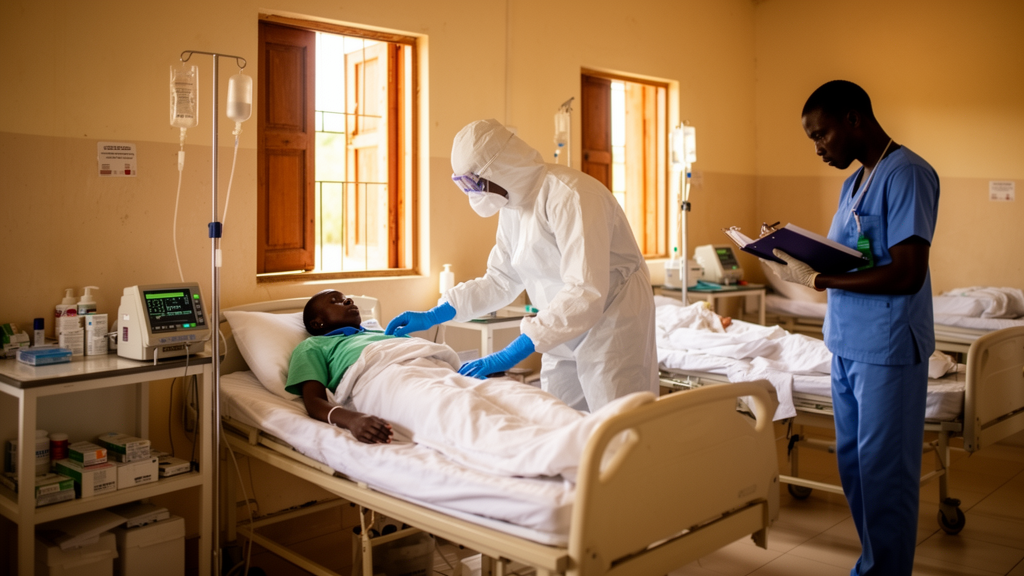
When the Ebola virus tore through West Africa between 2014 and 2016, Guinea was the country hit hardest, and the crisis exposed just how fragile its health system was. Before the outbreak, only a small fraction of the population had reliable access to healthcare, qualified staff were scarce, and the infrastructure needed to detect and contain dangerous pathogens barely existed. A decade later, a nationwide cross-sectional study published in Frontiers in Epidemiology offers the most complete picture yet of what has changed. Led by Dimaï Ouo Kpamy of Gamal Abdel Nasser University in Conakry, together with colleagues from Guinea’s National Health Security Agency, Johns Hopkins Bloomberg School of Public Health, and institutions in Mali, the research tracked how resources for managing epidemic-prone diseases evolved before, during, and after the Ebola catastrophe, and then identified which factors actually determine whether patients receive good care.
The findings are striking. At the national level, the overall resource score for epidemic management rose from a dismal 12 percent before the Ebola outbreak to 73 percent during the crisis, and it held at 77 percent in the post-Ebola period. Using a standard classification scale, that represents a transition from poor resource availability to an average level that has been sustained long after the emergency ended. The improvement was not uniform across all resource categories, however. Human resources climbed from 12 percent to 74 percent during the outbreak and reached 79 percent afterward. Material resources, including laboratories, personal protective equipment, and epidemic treatment centers, rose from 8 percent to 72 percent and then to 78 percent. Informational resources showed the greatest continuous improvement, increasing from 18 percent before Ebola to 79 percent during the crisis and 89 percent afterward, reflecting the deployment of electronic surveillance platforms such as DHIS2 and the standardization of case management protocols.
Temporal resources, which measure how quickly cases are detected and managed, followed a similar trajectory, rising from 15 percent to 67 percent during the outbreak and then to 87 percent. This reflects the adoption of the 7-1-7 approach, an international benchmark requiring that a public health event be detected within seven days, notified within 24 hours, and that major response actions begin within the following seven days. Guinea operationalized this through its network of epidemic treatment centers, decentralized Public Health Emergency Operations Centers, and strengthened national and regional diagnostic laboratories. Reducing response time is one of the most important determinants of whether an outbreak spirals out of control or is contained early, because every day of delay allows a pathogen to spread further through communities.
But one resource category tells a more troubling story. Financial resources surged from 9 percent to 71 percent during the Ebola crisis, then collapsed to just 50 percent in the post-Ebola period, according to the study’s data. This pattern, in which international funding floods in during emergencies and evaporates once outbreaks are brought under control, is a well-documented vulnerability in low- and middle-income countries. The authors warn that without predictable, flexible, and sustainable domestic financing, the progress Guinea has achieved in epidemic preparedness could gradually erode, compromising the country’s ability to respond to future threats such as COVID-19, Marburg virus disease, mpox, or Lassa fever, which remains endemic in the region.
To understand what actually drives quality of care, the researchers surveyed 400 epidemic response actors across all eight administrative regions of Guinea, achieving a participation rate of 93.5 percent. Respondents included prefectural health directors, disease control physicians, logisticians, laboratory managers, hospital directors, and members of epidemic response committees. The team collected data through structured questionnaires and individual interviews, then cross-validated everything against official documents including national preparedness plans, surveillance reports, training records, and epidemic treatment center registers. This triangulation was essential to minimize the recall bias inherent in asking people to reconstruct conditions from a decade earlier.
The quality of care itself was assessed using a composite score built from seven criteria: early diagnosis, timeliness of care, early patient isolation, regular coordination meetings, availability of dedicated case management staff, safety of patient care, and administration of treatments according to established protocols. A facility was rated as providing good-quality care only if it met at least six of these criteria, with protocol-compliant treatment as an essential requirement. Overall, 60.5 percent of health facilities were rated as providing good-quality care, while 39.5 percent fell short. That is a meaningful baseline, but the variation between facilities reveals exactly where the system’s strengths and weaknesses lie.
Using multivariable logistic regression, the researchers identified five factors independently associated with good-quality care after adjusting for other variables. The strongest was the availability of dedicated case management teams: facilities with specialized multidisciplinary teams were more than eight times as likely to provide good-quality care than those without them (adjusted odds ratio 8.51; 95 percent confidence interval 4.07 to 17.76; p less than 0.001). The presence of functional patient isolation facilities was the second strongest factor, more than quadrupling the odds of good care (aOR 4.76; 95 percent CI 1.72 to 13.17; p 0.003). A patient diagnostic mechanism more than tripled the odds (aOR 3.17; 95 percent CI 1.74 to 5.57; p less than 0.001), effective coordination of case management roughly tripled them (aOR 3.04; 95 percent CI 1.10 to 8.39; p 0.031), and the availability of treatment protocols more than doubled them (aOR 2.42; 95 percent CI 1.27 to 4.61; p 0.007). The team confirmed that multicollinearity was not a problem, with variance inflation factor values between 1.08 and 1.30, meaning each factor contributed independently to the observed variation in care quality.
These results carry significant technical weight because they show that quality of care during epidemics depends not only on clinical expertise but on the organization of health services and the availability of structural and operational resources. Early and accurate diagnosis is the cornerstone of epidemic management, enabling rapid case identification, appropriate clinical management, early implementation of infection prevention and control measures, and timely notification to surveillance systems. During outbreaks, delayed or inaccurate diagnosis facilitates ongoing transmission and increases mortality. Standardized treatment protocols reduce variation in medical practice and reinforce adherence to national and international guidelines, which is particularly important during emergencies when recommendations evolve rapidly as new evidence emerges. Isolation remains one of the most effective measures for interrupting transmission within healthcare facilities while ensuring appropriate clinical management of infected patients, and experience from Ebola, COVID-19, and mpox outbreaks has shown that specialized isolation units reduce healthcare-associated infections and protect healthcare workers.
Coordination deserves particular emphasis because epidemic response requires continuous collaboration among clinicians, surveillance teams, laboratories, logistics units, infection prevention and control specialists, risk communication teams, and decision-makers. Well-coordinated systems mobilize resources rapidly, improve information sharing, and ensure continuity of patient care. The World Health Organization and multiple studies from the Ebola and COVID-19 responses have identified coordination as a major determinant of response effectiveness and health system resilience. Guinea’s post-Ebola reforms, including the establishment of the National Health Security Agency, regional and prefectural epidemic alert and response teams, and decentralized emergency operations centers, were designed precisely to strengthen these coordination mechanisms across all levels of the health system.
The study’s implications extend beyond Guinea’s borders. The five factors identified as cornerstones of good-quality care should inform national epidemic preparedness strategies throughout West Africa and other regions facing recurrent infectious disease threats. Strengthening diagnostic capacity, maintaining specialized response teams, keeping isolation facilities operational, regularly updating evidence-based protocols, and improving coordination will not only improve care during future outbreaks but also reduce delays in case detection and limit pathogen transmission. The authors note that sustaining these gains will require continued investment, particularly in health system financing, and that the decline in financial resources observed in the post-Ebola period represents a major threat to the sustainability of the capacities developed. Without domestic commitment to long-term funding, the progress achieved since 2016 may gradually erode. The study also has limitations worth noting: the cross-sectional design cannot establish causal relationships, and retrospective data collection may have introduced recall bias, though the researchers mitigated this through careful respondent selection, standardized questionnaires, and systematic triangulation with official documents. Even so, the national coverage, the mixed-methods approach, and the rigorous multivariable analysis make this one of the most comprehensive assessments of post-Ebola health system strengthening conducted anywhere in the region, and a template for how other countries can evaluate their own epidemic readiness.
Subject of Research: A national cross-sectional study of health system resources and quality of care for epidemic-prone diseases in Guinea before, during, and after the 2014–2016 Ebola outbreak.
Article Title: Evolution of health system resources and factors associated with the quality of care for epidemic-prone diseases in Guinea: a national cross-sectional study
Article References: Kpamy, D. O., Cherif, F., Conde, S., Traore, F. A., Sidibe, S., Diarra, B., Winch, P. J., Toure, A., Keita, S., Doumbia, S., & Delamou, A. (2026). Evolution of health system resources and factors associated with the quality of care for epidemic-prone diseases in Guinea: a national cross-sectional study. Frontiers in Epidemiology, 6, Article 1818264. https://doi.org/10.3389/fepid.2026.1818264
Image Credits: AI Generated
DOI: 10.3389/fepid.2026.1818264
Keywords: Guinea, Ebola virus disease, epidemic preparedness, health systems, quality of care, case management, infection prevention and control, Frontiers in Epidemiology, Evolution, health, system, resources
Cite Scienmag News
Kristina Jarvis. (October 17, 2026). Guinea’s epidemic care has transformed since Ebola, but funding gains are slipping. Scienmag. https://scienmag.com/guineas-epidemic-care-has-transformed-since-ebola-but-funding-gains-are-slipping/
Kristina Jarvis. "Guinea’s epidemic care has transformed since Ebola, but funding gains are slipping." Scienmag, 17 October 2026, https://scienmag.com/guineas-epidemic-care-has-transformed-since-ebola-but-funding-gains-are-slipping/. Accessed 17 October 2026.
Kristina Jarvis. "Guinea’s epidemic care has transformed since Ebola, but funding gains are slipping." Scienmag. October 17, 2026. https://scienmag.com/guineas-epidemic-care-has-transformed-since-ebola-but-funding-gains-are-slipping/


