

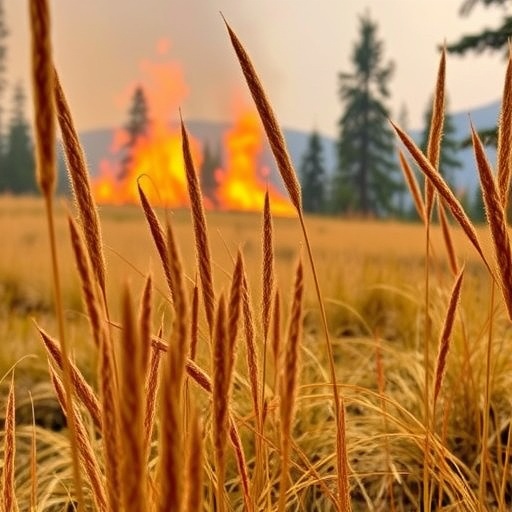
In the wake of wildfires, the visible devastation often garners immediate attention—the charred landscapes, the blackened tree trunks, and the ashen earth paint a stark picture of loss. However, recent research conducted by ecologists at the University of British Columbia reveals that the aftermath of such infernos extends well beyond the fading flames. Landscapes ravaged by wildfires remain highly susceptible to ecological transformations for years, particularly becoming vulnerable to invasions by aggressive, fast-growing grasses that exacerbate fire hazards and hinder native flora recovery.
This comprehensive study, one of the largest vegetation trajectory assessments ever undertaken post-wildfire, carefully tracked ecological dynamics two years following a massive wildfire in interior British Columbia. While some native plant species demonstrated resilience and gradual regrowth, the overall pace and robustness of recovery were notably slower and more fragile than ecological models had anticipated. The extended vulnerability highlights a critical window where intervention becomes paramount, as ecosystems struggle to regain their pre-fire balance.
A particularly alarming aspect of post-wildfire ecosystems is the proliferation of invasive grasses like cheatgrass (Bromus tectorum). These grasses possess phenological traits that grant them a competitive advantage in fire-prone environments: they germinate early in the spring, use seasonal moisture efficiently, and dry out by mid-summer, creating a highly flammable layer of fine fuels that behave like a tinder-dry runway for future fires. This dynamic mirrors patterns observed in the catastrophic 2023 Lahaina fire in Maui, underscoring the grave risks these grasses pose if unchecked in regions like British Columbia’s Interior.
Dr. Jennifer Grenz, lead author and restoration ecologist with the Lytton First Nation, elaborated on this phenomenon, noting that landscapes that might have appeared utterly desolate immediately post-fire are soon overrun by dense mats of cheatgrass. By the time visible signs of invasion appear, the opportunity for rapid, effective mitigation may have already passed, emphasizing the importance of early detection and intervention strategies to prevent long-term ecological degradation.
The study’s focal point was the 46,000-hectare McKay Creek wildfire near Lillooet, BC, an event that provided an unparalleled natural laboratory for observing post-fire vegetation trajectories. This research was enabled by years of pre-fire invasive species monitoring data, a rare dataset made possible through the collaborative efforts of the Lillooet Regional Invasive Species Society, the Provincial Invasive Plant Program, and local Indigenous communities. These baseline measurements allowed for a nuanced examination of assumptions surrounding invasions and vegetation recovery in fire-disturbed landscapes.
One of the pivotal findings of the research was the pronounced influence of elevation on recovery dynamics. Lower elevation zones, characterized by hotter and drier conditions, present ideal environments for drought-resistant invasive species to dominate. These zones are also subject to significant anthropogenic disturbance from hikers, ATV riders, hunters, and road maintenance crews, all of which contribute to continuous seed dispersal and facilitate invasive plant colonization. This convergence of abiotic stress and biotic disturbance tips the balance heavily in favor of non-native grasses, crowding out native species and accelerating fire risks.
Conversely, higher elevations offered a more congenial environment for native flora resurgence. Cooler temperatures and persisting soil moisture support the recovery of native shrubs and herbaceous plants, whose root systems often survive the initial fire, enabling gradual regeneration. While recovery at these altitudes is slow, the re-establishment of native plant communities fundamentally disrupts the expansion of invasive grasses, suggesting that elevation-related microclimatic factors play a vital role in shaping post-fire successional trajectories.
The study underscores a sobering reality in the era of mega-fires, where the ecological response post-disturbance can strongly influence the severity and frequency of subsequent wildfires. Landscape vulnerability arising from invasive grass proliferation creates a feedback loop of increased burn potential and reduced ecological resilience, necessitating proactive management strategies to break this cycle. Dr. Grenz stresses that understanding these spatial and temporal vegetation dynamics is essential for anticipating and mitigating future fire disasters.
Given the constrained resources often available for post-fire restoration, the researchers recommend three key management practices to mitigate invasion risk and promote native vegetation re-establishment. First, establishing vehicle and boot washing stations at fire access points could significantly reduce the introduction and spread of invasive seeds. Second, targeted seeding or planting of native vegetation along vulnerable roads and corridors can create biological barriers that impede invasive species spread. Third, applying herbicides early to small infestations can prevent the expansion of invasive grasses, preserving ecological integrity and reducing fire fuels.
The research team plans to maintain long-term monitoring of these post-fire landscapes, offering valuable data to inform land management policies and community resilience initiatives. Ongoing observation will elucidate the temporal scales of vegetation recovery and invasion, enhancing predictive models that land managers rely on for making informed decisions in fire-affected regions.
Virginia Oeggerli, a leading PhD student in Dr. Grenz’s laboratory and principal contributor to this study, encapsulates the essence of ecological recovery as a fundamental component of wildfire prevention. “When landscapes are dominated by invasive grasses after a fire, they become increasingly prone to reburning,” she explains. “Supporting the regeneration of native plants isn’t just restoration—it’s a critical preventative strategy against the escalation of fire risk.”
This research contributes critical insights into the complex plant–fire interactions shaping British Columbia’s interior landscapes, with implications far beyond regional boundaries. As climate change accelerates fire frequency and intensity globally, understanding these ecological processes and deploying strategic interventions will be paramount in safeguarding both natural ecosystems and human communities.
Subject of Research: Post-wildfire vegetation recovery and invasive plant management in interior British Columbia.
Article Title: Factors influencing early post-wildfire vegetation and implications for invasive plant management in the interior of British Columbia, Canada.
News Publication Date: March 5, 2026.
Web References: http://dx.doi.org/10.1186/s42408-026-00463-x
Image Credits: Jennifer Grenz
Keywords: Wildfires, Forest fires, Natural disasters, Invasive plants, Post-fire vegetation recovery, Cheatgrass, Fire ecology, Ecosystem restoration, British Columbia, Invasive species management


