


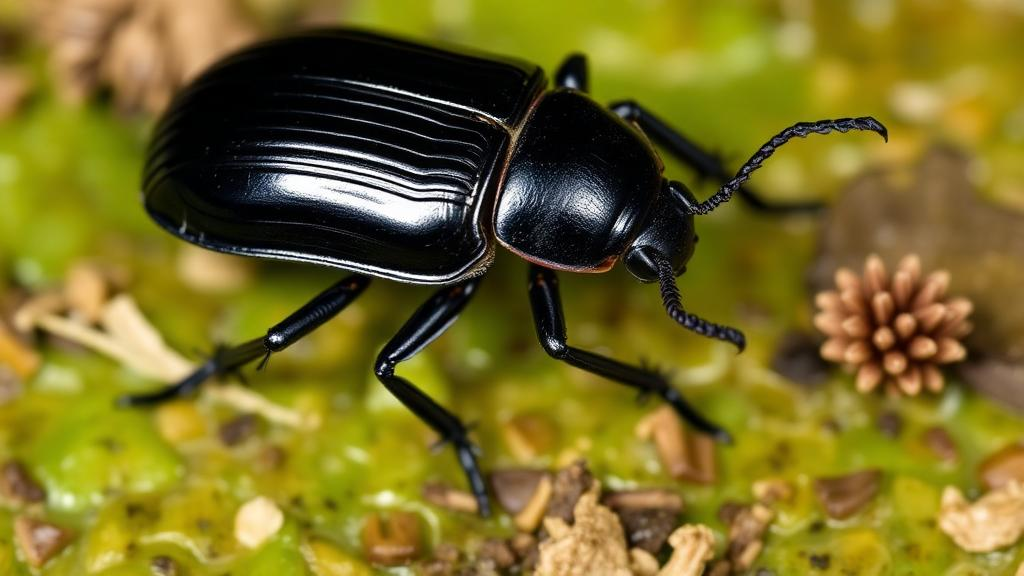
An invasive ambrosia beetle from East Asia has quietly established itself across southern Switzerland, and scientists have now confirmed that it has brought its fungal partner along with it. In a study published in Alpine Entomology, researchers report the widespread occurrence of the ambrosia beetle Anisandrus maiche in canton Ticino and the first European record of its mutualistic ambrosia fungus Ambrosiella cleistominuta. The finding matters because ambrosia beetles are among the most successful insect invaders in the world, and their fungal symbionts can sometimes turn out to be plant pathogens capable of killing trees.
The discovery came from two independent insect surveys in 2022. Trap catches from locations ranging from the Italian border near Chiasso to the central-upper valleys around Biasca revealed that A. maiche is not a marginal arrival but a well-established resident. In total, 715 specimens were trapped across 40 sites in canton Ticino and one site in canton Grisons, and every single one was female. That detail is significant: like many ambrosia beetles, A. maiche has an inbreeding mating system in which females mate with males inside their natal galleries before dispersing. A single mated female arriving in wood packaging material can therefore found an entire new population, which explains how such species establish themselves so readily after international transport.
Anisandrus maiche is native to northeast Asia, occurring in parts of China, Japan, the Korean peninsula and the Russian Far East. Its invasion history is a textbook example of gradual global spread. Established non-native populations were first detected in Pennsylvania in 2005 and subsequently in several other US states and in the Canadian provinces of Ontario and Quebec. In Europe, the beetle was found in western Russia and eastern Ukraine in 2007, roughly 14 years before it turned up in the Italian regions of Veneto and Lombardy in 2021 and 2022. The Swiss population appears contiguous with the Italian one, with the nearest known Italian occurrence only about 30 kilometres from the Swiss border, suggesting the species has been present in the region for many years without being noticed.
Part of the reason for the delayed detection is superficial resemblance. A. maiche looks strikingly similar to Xylosandrus germanus, another non-native invasive ambrosia beetle of East Asian origin that is already common in Europe. Specimens may have been caught in earlier surveys but misidentified. The researchers confirmed the identity of the Swiss beetles using both morphological characters and molecular diagnostics based on three genetic markers: the mitochondrial COI barcode region and the nuclear 28S ribosomal gene and CAD gene. The nuclear markers showed 100% identity with reference sequences of A. maiche, while the COI analysis revealed a remarkable pattern. Two distinct haplotypes, diverging by 5.9%, were found among the specimens, and four individuals showed heteroplasmy, a condition in which both haplotypes coexist within a single insect. A specimen from the Russian Far East shared the same pattern, providing a genetic link to the native range.
The trapping surveys used several different trap types and attractants, and the results offer practical lessons for surveillance. Simple bottle traps baited with 70% ethanol proved by far the most effective, capturing on average about 1.02 specimens per trap per day during the main flight period from June to August. Green and black multi-funnel traps baited with ethanol, alpha-pinene and an eight-component lure blend designed for longhorn beetles captured roughly 15 to 100 times fewer individuals, and unbaited Polytrap interception traps fell in between. Ethanol alone, it seems, is a superior attractant for species of Anisandrus, although the authors caution that ethanol concentration and release rate, trap colour and trap height may all influence catch rates and have not been studied systematically for this species.
Flight activity followed a clear seasonal pattern. Trap samples collected at intervals of two to four weeks from early April to early September showed that beetles flew mainly from June to mid-August, with no evidence of a second flight peak. Because the Polytraps operated continuously from March to October without missing any flights, the researchers conclude that A. maiche is probably univoltine in the study region, completing one generation per year. Most captures occurred at low elevations in the valleys, between roughly 195 and 386 metres above sea level, but a few individuals were trapped as high as 916 metres near Faido, indicating that mountain forests are also within reach of this invader.
The fungal work is where the study breaks new ground. The researchers installed live bottle traps without preservative to catch beetles alive, then allowed individual females to walk across agar plates so that fungal spores on their bodies would deposit on the surface. The beetles were then surface-sterilised, crushed and plated again to reveal fungi carried inside their bodies, including the mycangia, the specialized pockets in which ambrosia beetles transport their fungal mutualists. From seven live beetles, nine fungal cultures were recovered, belonging to four species. DNA barcoding of the nuclear internal transcribed spacer region confirmed that four cultures were Ambrosiella cleistominuta, the known mutualist of A. maiche, previously recorded only from the United States where it was described as a new species in 2017. Its presence in Europe, still in association with its beetle partner, represents the first record of the fungus on the continent and was almost certainly introduced together with its host.
Three other fungi were isolated from the beetles, and one of them raises a flag of caution. Fusarium lateritium is a globally distributed plant pathogen known to cause chlorotic leaf distortion on sweet potato, nut grey necrosis on hazelnut fruits and, most recently, shoot dieback of boxelder maple in Poland. The possibility that A. maiche could act as a vector of this pathogen cannot be excluded, although the authors suspect the association may be coincidental since it was found only sporadically. The other two species, the yeast-like Aureobasidium pullulans and the common environmental mould Cladosporium cladosporioides, are widespread saprophytes, though C. cladosporioides is also recognised as a fruit pathogen responsible for Cladosporium fruit rot on grapes.
So far, there is no indication of major damage in Switzerland. Only three infestations by A. maiche are known from Ticino: two at the botanic garden on Brissago Island in Lake Maggiore, involving a live Hakea shrub and a dead Chinese lacquer tree, and one in a five-millimetre chestnut twig at a forest edge near Tegna. Yet the beetle is known to be highly polyphagous. In its native range, host records span maples, alders, birches, hornbeams, hazels, ashes, walnuts, oaks and elms, and in Ukraine and North America it has been reported breeding in birch, poplar, oak, elm, red maple and many other trees. Observations from Ukraine suggest the species prefers to attack living but weakened trees over dead wood, which means trees stressed by drought, flooding or fire may be particularly vulnerable. In North America, A. maiche has become one of the two most abundant ambrosia beetles at some locations, and a similar rise in abundance in Europe could increase both damage to infested trees and competition with native ambrosia beetles.
The study also highlights a technical challenge for future research. The heteroplasmy observed in COI sequences, a known problem with insect DNA barcoding, complicates population genetic studies of the invasion and could confound analyses that rely on this marker alone. The authors recommend that future work on ambrosia beetle invasions examine additional genetic markers. As of late 2023, A. maiche is regulated as a quarantine pest in Switzerland and the European Union, although its classification is under review. Given the volume of international trade in wood packaging, firewood and live plants, and the species’ apparent abundance south of the Alps, the researchers consider it probably only a matter of time before the beetle becomes established north of the Alpine divide. Systematic surveys for damage, better knowledge of its host plants and fungal associates, and a clearer picture of the pathways that carried it to Europe are now needed to assess what impact this tiny beetle and its invisible fungal cargo may have on the forests of Central Europe.
Subject of Research: Distribution of the invasive ambrosia beetle Anisandrus maiche (Coleoptera, Scolytinae) in Switzerland and first record in Europe of its ambrosia fungus Ambrosiella cleistominuta
Article Title: Distribution of the invasive ambrosia beetle Anisandrus maiche ( Coleoptera , Scolytinae ) in Switzerland and first record in Europe of its ambrosia fungus Ambrosiella cleistominuta
Article References: Ribeiro-Correia, J. P., Prospero, S., Beenken, L., Biedermann, P. H. W., Blaser, S., Branco, M., Chittaro, Y., Frey, D., Hölling, D., Kaya, S. O., Knížek, M., Mittelstrass, J., Ruffner, B., Sanchez, A., & Brockerhoff, E. G. (2024). Distribution of the invasive ambrosia beetle Anisandrus maiche (Coleoptera, Scolytinae) in Switzerland and first record in Europe of its ambrosia fungus Ambrosiella cleistominuta. Alpine Entomology, 8, 35-49. https://doi.org/10.3897/alpento.8.117537
Image Credits: AI Generated
Keywords: Distribution, invasive, ambrosia, beetle, Anisandrus, maiche, Coleoptera, Scolytinae, Switzerland, first, record, Europe
Cite Scienmag News
Roger Howard. (October 17, 2026). Invasive ambrosia beetle spreads through Switzerland, bringing its fungus to Europe. Scienmag. https://scienmag.com/invasive-ambrosia-beetle-spreads-through-switzerland-bringing-its-fungus-to-europe/
Roger Howard. "Invasive ambrosia beetle spreads through Switzerland, bringing its fungus to Europe." Scienmag, 17 October 2026, https://scienmag.com/invasive-ambrosia-beetle-spreads-through-switzerland-bringing-its-fungus-to-europe/. Accessed 17 October 2026.
Roger Howard. "Invasive ambrosia beetle spreads through Switzerland, bringing its fungus to Europe." Scienmag. October 17, 2026. https://scienmag.com/invasive-ambrosia-beetle-spreads-through-switzerland-bringing-its-fungus-to-europe/


