


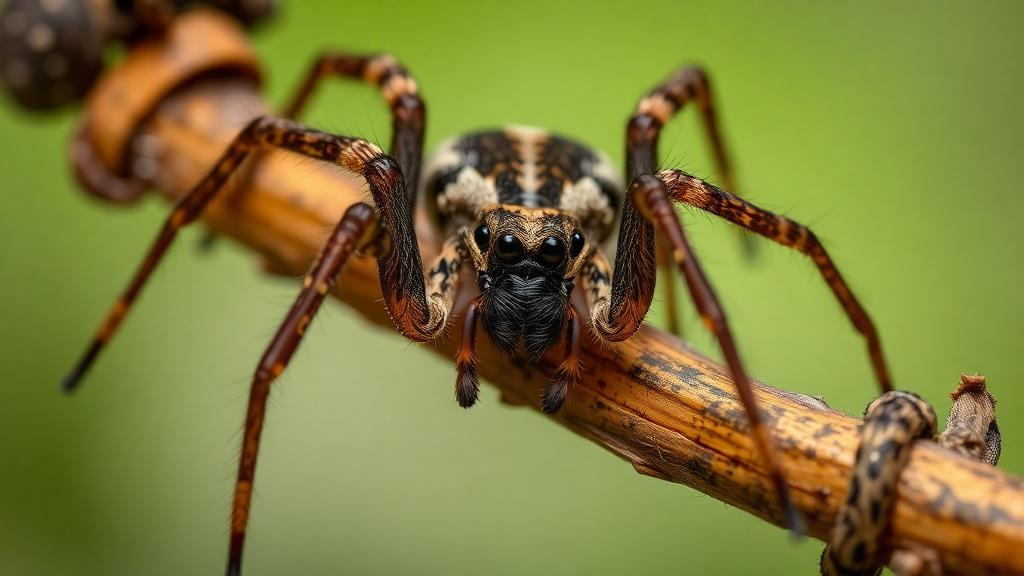
Deep in the leaf litter of African forests, and improbably also in the treetops above them, lives a group of small spiders that scientists have long struggled to classify. Known as zodariids, or ant-eating spiders, these animals belong to one of the larger spider families, yet the African representatives of the genus Asceua were, until now, represented by only two described species. A new revision published in African Invertebrates changes that picture dramatically, describing six new species and doubling the known Afrotropical fauna of the genus to eight. The work also uncovers a biological oddity that may explain why these spiders show distribution patterns unlike anything else in their family.
The revision, led by arachnologists at the Royal Museum for Central Africa in Tervuren, Belgium, examined specimens collected across the African continent, from South Africa’s Eastern Cape to the forests of Guinea in West Africa. Using stereomicroscopy, automontage photography, scanning electron microscopy and careful dissection of female genitalia, the team sorted through decades of museum material and fresh field collections. The result is a taxonomic overhaul that recognizes Asceua arborivaga from Guinea, Asceua foordi from South Africa, DR Congo and Guinea, Asceua incensa and Asceua luki from western DR Congo, Asceua palustris from DR Congo, and Asceua ventrofigurata from Tanzania, alongside the previously known Asceua radiosa from the Comoros and the widespread Asceua lejeunei.
What makes these spiders particularly intriguing is their lifestyle. The vast majority of zodariid species are ground dwellers, living in burrows or roaming the soil surface in search of their preferred prey: ants. Yet Asceua species appear regularly in canopy samples, collected by fogging treetops or beating vegetation several metres above the forest floor. They are, according to the revision, the only zodariids that belong convincingly to the canopy fauna. Strangely enough, the same species are also often found in the litter layer of forests and woodlands, sometimes in the very same locations where they were fogged from the trees above.
This peculiar mixed lifestyle may hold the key to one of the most puzzling aspects of the revision: the distributions of some species are enormous by zodariid standards. Asceua foordi has been found from KwaZulu-Natal in South Africa, through central DR Congo, to as far north as Guinea in West Africa. Asceua lejeunei spans the width of the African continent, from Ethiopia in the east to Ivory Coast in the west. Such ranges are extremely unusual in a family whose members typically have relatively small distributions, probably linked to their ground-dwelling habits and the absence of ballooning behaviour, the aerial dispersal technique that many other spiders use to travel on silk threads carried by the wind.
Zodariidae are among the few spider families for which no ballooning has ever been observed, the authors note. This is probably connected to their ground-dwelling behaviour. It is therefore not surprising that most species in the family have relatively small distributions. In this context, the distribution patterns of Asceua are strange. The authors suggest that the phenomenon is probably linked to the canopy-dwelling behaviour, which appears common in the genus but unique for this spider family. Spiders that live in trees may be more likely to balloon, since arboreal species are better positioned to launch silk threads into air currents. Although no ballooning has been documented for Asceua so far, the authors consider it would not be surprising if these spiders do indeed disperse through the air, a behaviour that would fit their arboreal lifestyle.
The genus Asceua itself has a remarkably large distribution, apparently the largest of any genus in the Zodariidae, stretching from South Africa and West Africa to Japan. Canopy-dwelling behaviour has already been documented for the Japanese species Asceua japonica, suggesting that the arboreal habit is widespread across the genus. Since at least some of the African species are canopy dwellers, the authors expect that more species will be discovered as more canopy studies are carried out in tropical forests.
Another puzzle is why these spiders are so often found in forest leaf litter on the ground, even when the same species also turns up in canopy samples. The authors propose a possible explanation: adults, which are rarely collected as juveniles, may migrate from the canopy to the soil, where it is easier to find a mate. For a spider with poor eyesight that does not construct a web, the ground layer may offer better odds of encounter at mating time. If confirmed, this behaviour would be an example of the importance of whereabouts at mating time, a factor that could shape both the ecology and the distribution of these animals.
The revision also documents remarkable patterns of sympatry, with multiple species sharing the same localities. Asceua luki and Asceua incensa occur together in western DR Congo, and even three species, Asceua arborivaga, Asceua lejeunei and Asceua foordi, have been found together on Mount Nimba in Guinea, although apparently at different altitudes. Such coexistence of closely related species in the same forests raises questions about how they partition resources and habitats, and suggests that the African Asceua fauna is richer and more ecologically diverse than previously imagined.
Among the more striking observations in the revision is the ant-like appearance of the males. Many zodariids are known to prey on ants, and observations on the biology of Asceua have revealed that these spiders prefer ants as prey. In this context it makes perfect sense that they mimic ants. The large palps of Asceua males play the role of an ant’s head, an effect that is permanent and therefore not entirely similar to the Asiatic corinnid Pranburia mahannopi, in which the ant-like habitus is obtained only when hair brushes on the frontal femora are kept together. The blurred photograph of a live male Asceua foordi in the revision shows the resemblance particularly clearly, with the palps bearing great similarity to an ant’s head.
The technical work behind the revision involved meticulous examination of spider genitalia, the primary characters used to distinguish spider species. Males were identified by details of the palpal organ, including the number and shape of tibial apophyses, the configuration of the cymbial fold, and the form of the embolus and median apophysis. Females were distinguished by the structure of the epigyne, including the presence and shape of a scape, the number of copulatory duct coils visible in transparency, and the form of the spermathecae. The authors also provide a key to the Afrotropical species, allowing future researchers to identify specimens. The six new species descriptions are accompanied by photographs, drawings and scanning electron micrographs that document the diagnostic characters in detail.
The revision of Afrotropical Asceua represents a significant advance in understanding the diversity and biogeography of a spider genus that has long puzzled arachnologists. By doubling the known African species and highlighting the canopy-dwelling behaviour that may explain their unusual distributions, the work opens new avenues for research into the ecology and evolution of these ant-eating spiders. As more canopy studies are carried out in African forests, scientists expect that the true diversity of Asceua will prove even greater than the eight species now recognized, and that the puzzling distributions of these treetop ant hunters will gradually come into focus.
Subject of Research: Taxonomy and biogeography of Afrotropical ant-eating spiders
Article Title: A revision of Afrotropical Asceua ( Araneae , Zodariidae ), ant-eating spiders with puzzling distributions
Article References: Jocqué, R., & Henrard, A. (2024). A revision of Afrotropical Asceua (Araneae, Zodariidae), ant-eating spiders with puzzling distributions. African Invertebrates, 65(2), 161-198. https://doi.org/10.3897/afrinvertebr.65.138029
Image Credits: AI Generated
DOI: 10.3897/afrinvertebr.65.138029
Keywords: spiders, taxonomy, Zodariidae, Africa, canopy ecology, new species, revision, Afrotropical, Asceua, Araneae, ant-eating, puzzling
Cite Scienmag News
Gavin Prescott. (October 17, 2026). Ant-Eating Spiders That Live in Treetops Puzzle Scientists With Huge African Distributions. Scienmag. https://scienmag.com/ant-eating-spiders-that-live-in-treetops-puzzle-scientists-with-huge-african-distributions/
Gavin Prescott. "Ant-Eating Spiders That Live in Treetops Puzzle Scientists With Huge African Distributions." Scienmag, 17 October 2026, https://scienmag.com/ant-eating-spiders-that-live-in-treetops-puzzle-scientists-with-huge-african-distributions/. Accessed 17 October 2026.
Gavin Prescott. "Ant-Eating Spiders That Live in Treetops Puzzle Scientists With Huge African Distributions." Scienmag. October 17, 2026. https://scienmag.com/ant-eating-spiders-that-live-in-treetops-puzzle-scientists-with-huge-african-distributions/


