


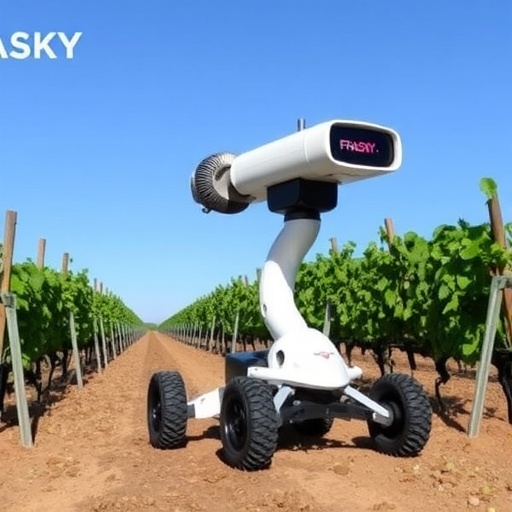
A groundbreaking advancement in agricultural robotics has emerged from the laboratories of the Italian Institute of Technology (IIT), setting new standards for autonomous precision farming through the creation of Frasky, a highly sophisticated robotic system designed specifically for vineyard applications. This innovative machine exhibits the capacity to navigate complex agricultural environments independently and perform delicate tasks such as grape cluster monitoring, manipulation, and targeted application of treatments, marking a significant leap forward in integrating cutting-edge technology with traditional viticulture practices.
Frasky was conceived and developed by researchers at the Soft Robotics for Human Cooperation and Rehabilitation Lab under the leadership of Manuel G. Catalano. The project itself is a collaborative achievement stemming from the JOiiNT LAB initiative, a joint laboratory that fosters synergy between academic research and industry players concentrated in Italy’s Bergamo region. This consortium includes several key partners such as Consorzio Intellimech, Confindustria Bergamo, the University of Bergamo, and the Kilometro Rosso Innovation District, collectively dedicated to pioneering solutions that tackle modern agricultural challenges.
The robot’s design embodies the fusion of robust mechanical engineering and advanced artificial intelligence. Equipped with a multi-degree-of-freedom robotic arm and a dexterous hand, Frasky can interact with the environment around it with precision and gentleness. The integration of an embedded camera system within the arm allows it to generate high-fidelity 3D maps, detect various obstacles, and identify key objects such as grape clusters. This sensory capability is coupled with a commercial, four-wheeled mobile platform optimized for outdoor terrains, giving the robot the agility required to traverse the uneven and often unpredictable vineyard landscape.
At the heart of Frasky’s operation lies an intricately designed software architecture, which segments its functional capabilities into three principal modules: navigation, perception, and manipulation. The navigation module facilitates autonomous spatial orientation, enabling the robot to chart optimal paths through rows of vines while dynamically avoiding obstacles. The perception module is responsible for real-time environmental comprehension, employing sophisticated computer vision algorithms to discern the intricate details of grape clusters amidst foliage. This data serves not only to enhance navigation but also informs the manipulation module, which directs the robotic arm with the required delicacy to interact with fragile plant structures safely.
Frasky’s modular software and hardware framework enables flexible adaptation, allowing the system to integrate additional tools tailored to diverse farming requirements. For example, the robotic hand’s adaptability includes a nozzle designed specifically for the selective application of treatments, such as pesticides or nutrients, directly onto grape bunches. This targeted delivery method significantly reduces chemical usage and environmental impact compared to traditional blanket-spraying techniques, promoting sustainability in viticulture.
The development team emphasized the crucial role of human-machine interaction by implementing an intuitive graphical user interface. Through this platform, operators can seamlessly send commands and monitor the robot’s activities in real time, enhancing control and facilitating prompt decision-making during field operations. This capability ensures that Frasky acts as a collaborative assistant to viticulturists, enhancing rather than replacing human expertise.
The impetus behind creating Frasky addresses two pressing issues in modern agriculture: the growing labor shortage and the urgent call for environmentally sustainable practices. Manual vineyard work is notably labor-intensive and physically demanding, often involving repetitive tasks that can now be alleviated through intelligent automation. Moreover, the precision targeting of treatments decreases chemical runoff and human exposure to potentially harmful substances, safeguarding both ecological health and worker safety.
Operating in vineyards presents a unique set of technical challenges. Agricultural terrains are inherently uneven and subject to seasonal variation, with foliage density fluctuating throughout the year. These environmental dynamics reduce visibility and restrict movement pathways, necessitating a highly adaptable navigation system capable of real-time environmental mapping and obstacle avoidance. Additionally, the manipulation of grape clusters requires a robot to exhibit a high level of dexterity and gentle handling, as the fruit is delicate and susceptible to damage.
The validation phase for Frasky included rigorous laboratory testing within an artificial vineyard setting before entering real-world trials. Field demonstrations took place in “Le Corne,” a vineyard located in Grumello del Monte in the Bergamo region. These tests showcased Frasky’s ability to autonomously traverse complex vineyard layouts, build detailed spatial maps, and perform selective treatment applications effectively, confirming its practical viability.
Looking forward, the development team envisions enhancing Frasky’s capabilities to accommodate a wider range of agricultural contexts and increasingly complex tasks. According to Francesca Negrello, IIT researcher and JOiiNT LAB Technology Manager, future improvements will focus on augmenting the robot’s perception and manipulation faculties to support activities beyond monitoring and treatment application. This evolution aims to position Frasky as an indispensable partner to viticulturists, capable of sustained collaboration in demanding production environments.
The collaborative nature of the JOiiNT LAB initiative highlights the critical interplay between research and industry in driving technological innovation. Fabio Previdi, a professor at the University of Bergamo, emphasizes the profound educational benefits that arise from such partnerships. By integrating students into these projects, the initiative cultivates interdisciplinary expertise and prepares the next generation of engineers and technologists to tackle the evolving challenges of digital transformation within agriculture.
Furthermore, Stefano Ierace, Director of Consorzio Intellimech, underscores the broad impact of technologies like Frasky beyond mere manufacturing applications. These advancements contribute to regional economic growth, enhance workforce training quality, and support sustainable agricultural practices, thereby benefiting the entire production chain and surrounding communities.
Frasky’s emergence at the intersection of robotics, artificial intelligence, and agriculture represents a pioneering step toward smarter, more sustainable farming. By addressing labor constraints, minimizing environmental footprints, and enhancing operational precision, this innovative robot heralds a new era of agricultural productivity and resilience, showcasing the transformative potential of technology in shaping the future of viticulture.
News Publication Date:
18 September 2025
Web References:
https://www.joiintlab.com/
Cite Scienmag News
Denise Maddox. (September 18, 2025). Introducing Frasky: The Innovative New Robot Revolutionizing Vineyard Management. Scienmag. https://scienmag.com/introducing-frasky-the-innovative-new-robot-revolutionizing-vineyard-management/
Denise Maddox. "Introducing Frasky: The Innovative New Robot Revolutionizing Vineyard Management." Scienmag, 18 September 2025, https://scienmag.com/introducing-frasky-the-innovative-new-robot-revolutionizing-vineyard-management/. Accessed 3 September 2026.
Denise Maddox. "Introducing Frasky: The Innovative New Robot Revolutionizing Vineyard Management." Scienmag. September 18, 2025. https://scienmag.com/introducing-frasky-the-innovative-new-robot-revolutionizing-vineyard-management/


