


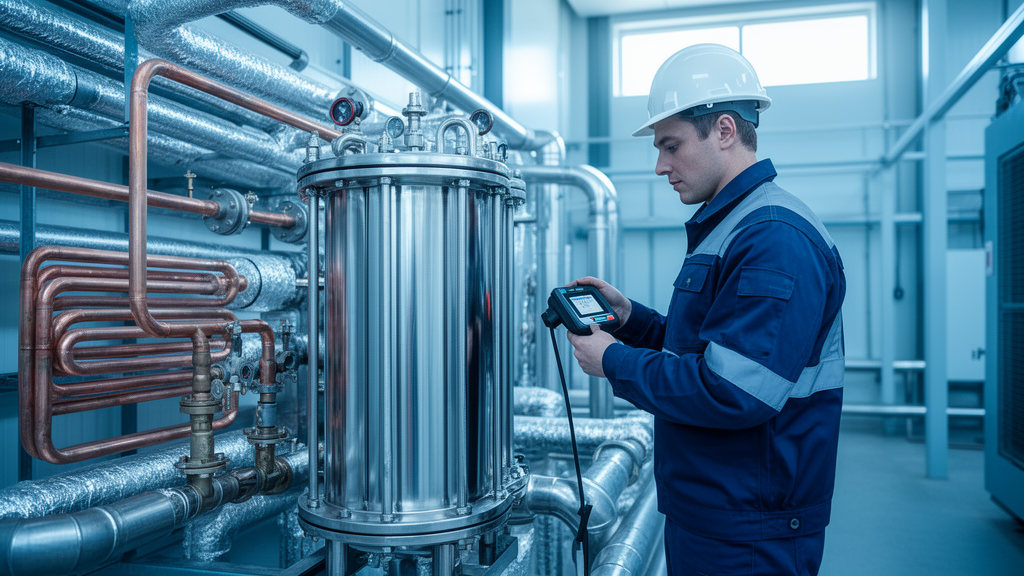
A small device hidden inside refrigeration systems could reshape how the world cools its food, vaccines, and buildings — but only if engineers know exactly when to use it. A new systematic review published in Frontiers in Thermal Engineering has synthesized evidence from 22 studies conducted between 2020 and 2025 to determine precisely when internal heat exchangers (IHXs) genuinely improve the second-law performance of natural-refrigerant vapor-compression cycles, and when they merely shuffle thermodynamic losses from one component to another. The findings challenge the widespread assumption that adding an IHX is universally beneficial, offering instead a condition-based roadmap for sustainable refrigeration design.
Natural refrigerants — ammonia (R717), hydrocarbons such as propane (R290) and isobutane (R600a), and carbon dioxide (R744) — have gained enormous attention as replacements for synthetic refrigerants with high global warming potential. They offer negligible ozone depletion potential, low environmental impact, and favorable thermodynamic properties. But their performance characteristics differ dramatically. Ammonia delivers high refrigeration capacity per unit mass with excellent heat transfer. Hydrocarbons provide favorable saturation properties and moderate operating pressures, while mixtures can even produce temperature glide that improves heat-exchanger matching. Carbon dioxide offers compact system designs thanks to its high volumetric capacity, but its low critical temperature frequently forces transcritical operation, making performance highly dependent on gas-cooler conditions and high-side pressure.
The internal heat exchanger itself is deceptively simple. It transfers heat between the high-pressure liquid line leaving the condenser or gas cooler and the low-pressure vapor line leaving the evaporator. The resulting liquid-line subcooling lowers the enthalpy of refrigerant entering the expansion device, increasing the specific refrigeration effect. Simultaneously, the suction-line superheating helps prevent liquid refrigerant from reaching the compressor — but it also raises compressor-inlet temperature and specific volume. These competing effects mean the IHX can either improve or degrade performance depending on the refrigerant, operating conditions, and cycle configuration.
From an exergy perspective, the stakes are higher still. Unlike energy-based indicators such as the coefficient of performance (COP), exergy analysis identifies the magnitude and location of thermodynamic irreversibilities within individual components. An IHX may reduce throttling irreversibility while simultaneously increasing compressor irreversibility or introducing losses through finite-temperature heat transfer and pressure drop. Consequently, a higher COP does not necessarily imply improved second-law performance — a critical distinction the review emphasizes throughout.
The review, led by Cedrick Bryll C. Sison and Jaime P. Honra of Mapúa University in Manila, followed the PRISMA framework with structured database searches in Scopus and Web of Science, supplemented by manual searches and citation tracking. From 325 initially identified records, 84 duplicates were removed, leaving 241 unique records for title and abstract screening. After applying inclusion and exclusion criteria, 94 articles proceeded to full-text eligibility assessment, and 26 met the criteria for methodological quality appraisal using a six-question engineering checklist. Ultimately, 22 studies were retained for thematic synthesis, spanning 10 countries with China contributing the most publications, followed by Spain, Turkey, and India.
The most consistent exergy improvements emerged in hydrocarbon-based systems. Single- and multi-evaporator configurations using propane, isobutane, and their mixtures reported increases of 10%–20% in COP and 1%–8% in exergy efficiency at moderate evaporating temperatures. Experimental work on R290/R600a mixtures confirmed these gains across different compressor speeds, while theoretical studies showed that zeotropic mixtures benefit from temperature glide that improves heat-exchanger matching. In these systems, the reduction in expansion-related irreversibility typically outweighs the additional compressor work introduced by suction superheating, yielding genuine net second-law benefits.
In ammonia-based and carbon dioxide-based systems, the picture becomes conditional. Cascade cycles pairing R290/R170 and R717/R170 exhibited gains most pronounced at −50 °C evaporating temperature, diminishing at −60 °C as compressor irreversibilities increasingly dominated. Transcritical carbon dioxide and ejector-assisted cycles achieved up to 22.5% lower gas-cooler exergy loss and approximately 4%–9% higher COP — but only when discharge pressures were optimized around 4.25–8.75 MPa and IHX effectiveness was sufficiently high. Outside these favorable windows, additional suction superheat increased compressor work enough to offset reductions elsewhere, sometimes reducing both COP and exergy efficiency.
Based on exergy performance, the review recommends hydrocarbon single-stage and ejector-enhanced cycles with an IHX as the most effective configurations, multi-stage or intercooled transcritical carbon dioxide cycles with an IHX under optimized pressure and intercooling conditions, and selective IHX application in cascade systems rather than universal deployment on both stages. The authors stress that improvements in COP do not always coincide with improvements in exergy performance — several studies reported cases where COP increased while exergy efficiency remained unchanged or even decreased, typically because IHX-induced superheating shifted irreversibilities toward the compressor.
The review identifies priority research needs including experimental validation of IHX integration in ammonia and carbon dioxide-based cycles across wider operating envelopes, standardized benchmark cases to compare IHX performance across refrigerant families, and integrated exergy-environmental assessment to guide sustainable refrigeration system design. The authors also note that ambient conditions modulate these effects by setting condensing or gas-cooler outlet temperatures, implying climate-dependent IHX performance that must be evaluated across the full service envelope rather than at a single design point.
As the world phases down high-GWP synthetic refrigerants under international agreements, the condition-based patterns identified here offer engineers a thermodynamically rigorous foundation for deciding when internal heat exchangers deliver genuine second-law gains and when they merely redistribute losses. The message is clear: the IHX is not a universal upgrade but a precision tool whose value depends on refrigerant properties, cycle architecture, and operating conditions — and the evidence now exists to use it wisely.
Subject of Research: Systematic review of exergy performance in natural refrigerant cycles with internal heat exchangers
Article Title: Systematic review of exergy performance in natural refrigerant cycles with internal heat exchangers
Article References: Sison, C. B. C., & Honra, J. P. (2026). Systematic review of exergy performance in natural refrigerant cycles with internal heat exchangers. Frontiers in Thermal Engineering, 6, Article 1896370. https://doi.org/10.3389/fther.2026.1896370
Image Credits: AI Generated
DOI: 10.3389/fther.2026.1896370
Keywords: Systematic, review, exergy, performance, natural, refrigerant, cycles, internal, heat, exchangers, scientific research
Cite Scienmag News
Denise Maddox. (October 16, 2026). Internal heat exchangers boost natural refrigerant efficiency only under the right conditions, review finds. Scienmag. https://scienmag.com/internal-heat-exchangers-boost-natural-refrigerant-efficiency-only-under-the-right-conditions-review-finds/
Denise Maddox. "Internal heat exchangers boost natural refrigerant efficiency only under the right conditions, review finds." Scienmag, 16 October 2026, https://scienmag.com/internal-heat-exchangers-boost-natural-refrigerant-efficiency-only-under-the-right-conditions-review-finds/. Accessed 16 October 2026.
Denise Maddox. "Internal heat exchangers boost natural refrigerant efficiency only under the right conditions, review finds." Scienmag. October 16, 2026. https://scienmag.com/internal-heat-exchangers-boost-natural-refrigerant-efficiency-only-under-the-right-conditions-review-finds/


