

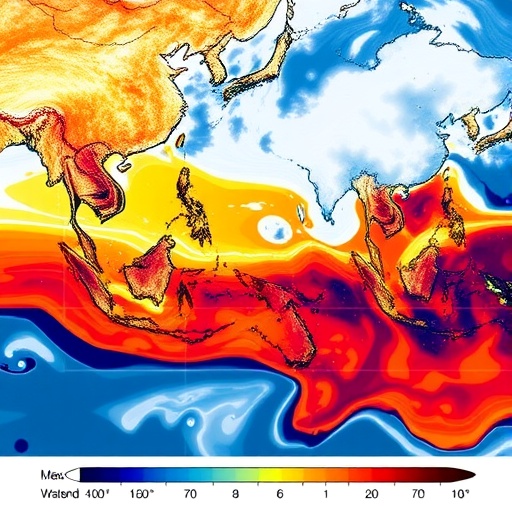
In a groundbreaking study set to redefine our understanding of prehistoric climate dynamics, researchers Shi, Yan, Zhang, and colleagues have unveiled transformative insights into the modulation of the Holocene Asian-Australian summer monsoon by inter-hemispheric temperature gradients. Published in Nature Communications in 2025, this work intricately deciphers how temperature contrasts between the Northern and Southern Hemispheres during the Holocene epoch have orchestrated the patterns and intensities of monsoon systems that have historically governed Asia and Australia’s climate, ecosystems, and civilizations.
The Asian-Australian summer monsoon is pivotal for billions of people, influencing agricultural productivity, water resources, and weather patterns across one of the most densely populated regions on Earth. Understanding the ancient drivers of this monsoon system helps scientists anticipate future trends in the context of accelerating global climate change. The study delves deep into paleoclimate proxies, intricate climate models, and isotopic analyses to reveal the subtle yet profound role of inter-hemispheric thermal gradients—temperature differentials between the Northern and Southern Hemispheres—in modulating monsoon strength and spatial reach.
At the core of the research lies a detailed reconstruction of temperature patterns spanning the Holocene, approximately the last 11,700 years after the last major ice age. By utilizing sediment core data, speleothem isotope ratios, and high-resolution paleotemperature proxies, the team meticulously charted the fluctuations in hemispheric temperatures and juxtaposed these against monsoonal intensity records. Their compelling findings confirm that shifts in temperature gradients do not merely accompany monsoon variability but actively govern the behavior of monsoon circulations.
A key revelation from the study is the identification of a feedback mechanism where warmer Northern Hemisphere phases coincide with more vigorous and expansive monsoon activity, while a relative cooling in the Northern Hemisphere corresponds with monsoon weakening and southward shifts. This interplay underscores the critical importance of thermal asymmetry in shaping not only local but regional climatic outcomes. The temperature differential essentially acts as a thermal engine driving atmospheric circulation changes that manifest as monsoonal pulses.
To unravel these complex interactions, Shi and colleagues employed advanced coupled climate models enhanced by paleoclimate data assimilation techniques. They simulated plausible Holocene scenarios integrating orbital forcing, greenhouse gas concentrations, and ocean-atmosphere coupling. The nuanced outputs affirm that the interplay between solar insolation patterns and inter-hemispheric temperature contrasts orchestrated monsoonal variability on centennial to millennial scales, shaping ecological and human adaptations.
Moreover, the study highlights the influence of sea surface temperature anomalies in the Indian Ocean and Western Pacific as intermediaries in the thermal coupling between hemispheres. These oceanic hotspots act as conduits for transmitting differential heating signals that modulate monsoon intensity, reflecting the dynamic complexity of ocean-atmosphere interplay. Their role as climate modulators is crucial in understanding how regional temperature shifts translate into far-reaching atmospheric circulations impacting monsoon behavior.
One of the most striking implications of this research lies in contextualizing anthropogenic climate impacts. Modern human-induced warming skews inter-hemispheric temperature gradients in unprecedented ways, threatening to disrupt the monsoon regimes that societies have historically depended upon. By retracing natural variability against anthropogenic signals, the study offers a critical baseline for assessing potential future monsoon destabilization under various emission scenarios.
The robustness of the findings is amplified by the multidisciplinary approach adopted. Integration of geochemical proxies, such as stable isotopes of oxygen and carbon from speleothems and marine sediments, with climatic simulation models provides a comprehensive framework to decipher monsoon dynamics from both empirical and theoretical perspectives. This blend of data-centric and model-driven methodologies sets a new standard in paleoclimatology research.
Additionally, the temporal resolution achieved in the study permits fine-scale examination of abrupt climate shifts, including events such as the Holocene Thermal Maximum and the subsequent mid-Holocene cooling period. This granularity exposes the sensitivity of the Asian-Australian monsoon to rapid hemispheric temperature transitions, highlighting potential thresholds and tipping points that can precipitate drastic climate rearrangements.
Aside from climatological insights, the research carries profound ecological and anthropological ramifications. Fluctuations in monsoon behavior influenced ecosystem productivity, vegetation patterns, and freshwater resources, which in turn affected early agricultural practices and settlement distributions in Asia and Australia. Recognizing the role of hemispheric temperature gradients enhances our understanding of how prehistoric human societies coped with climatic stresses and adapted their livelihoods accordingly.
This study also provides a vital perspective on inter-hemispheric teleconnections—climatic linkages that transcend hemispheric boundaries. Showing how temperature imbalances across the equator regulate monsoonal wind systems on such large scales enriches the discourse on global climate system coherence and connectivity. These insights refine predictive abilities about how future hemispheric warming asymmetries might shape monsoon ecosystems and hydrological cycles.
Importantly, the research underscores the necessity of incorporating inter-hemispheric temperature dynamics into future climate models. Conventional modeling efforts have often emphasized local or hemispheric drivers in isolation. This integrative approach illustrates that a truly global perspective is essential to capture the profound sensitivity of monsoonal regimes to cross-equatorial temperature contrasts and associated atmospheric circulation changes.
As global climate interventions, mitigation pathways, and adaptation plans form under various policy frameworks, the implications of this study cannot be overstated. Reliable anticipation of monsoon variability directly feeds into water security, food production sustainability, and disaster preparedness strategies, particularly for vulnerable populations reliant on predictable monsoon rains. This newfound understanding equips policymakers and climate scientists with more refined tools to forecast and manage climate risks.
In conclusion, Shi, Yan, Zhang, and their team have significantly advanced the frontiers of climate science by elucidating the fundamental role of inter-hemispheric temperature gradients in modulating the Holocene Asian-Australian summer monsoon. Their work bridges paleoclimatology, oceanography, atmospheric science, and human geography, delivering critical knowledge to navigate an era of unprecedented climatic transformations. The study’s synthesis of high-resolution proxy data and sophisticated modeling forms a template for future explorations into the intricacies of Earth’s climate system and its monumental impacts on life.
Subject of Research: Modulation of the Holocene Asian-Australian summer monsoon by inter-hemispheric temperature gradients.
Article Title: Modulation of inter-hemispheric temperature gradients on the Holocene Asian-Australian summer monsoon.
Article References:
Shi, G., Yan, H., Zhang, W. et al. Modulation of inter-hemispheric temperature gradients on the Holocene Asian-Australian summer monsoon. Nat Commun (2025). https://doi.org/10.1038/s41467-025-67951-7
Image Credits: AI Generated


