

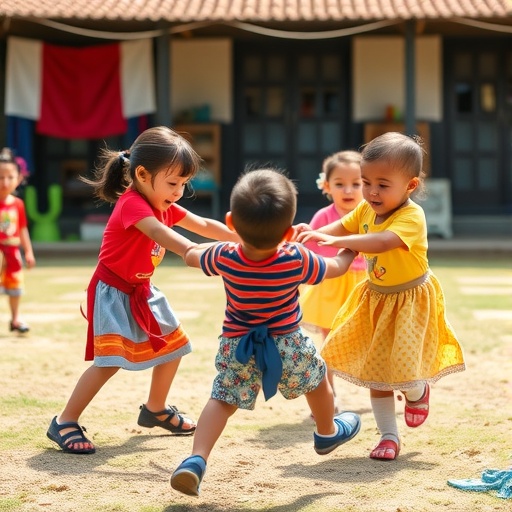
In recent years, the importance of integrating traditional games into early childhood education has gained significant attention as researchers emphasize innovative strategies to enhance learning experiences. The study undertaken by Saearani, M.F.T., Sampurno, M.B.T., and Chan, A.H. explores a creative movement model that incorporates traditional games, shedding light on its potential benefits in early learning. By combining educational goals with active play, this research holds promise for fostering not just academic skills but also physical and social development among young children.
The creative movement model proposed in this study aims to bridge the gap between structured education and spontaneous play. Traditional games serve as a vehicle to engage children in physical activities while encouraging collaboration and communication among peers. This dual focus on movement and social interaction is crucial for holistic development in early childhood education, addressing both cognitive and emotional learning domains. The innovative approach helps educators leverage the familiarity and cultural significance of traditional games to promote engagement and motivation among young learners.
Delving deeper into the mechanics of this model, researchers conducted usability evaluations that provided insight into how effectively these traditional games could be integrated into structured educational settings. The study utilized feedback from educators, parents, and children, revealing an overwhelmingly positive reception to the introduction of this model in classrooms. Participants noted that the incorporation of movement not only made learning more enjoyable but also contributed meaningfully to grasping educational concepts in a dynamic context.
Moreover, the study identified specific traditional games that aligned well with educational objectives, allowing for a seamless blend of play and learning. Games that emphasized cooperation and strategy were particularly highlighted, as they fostered skills such as critical thinking and problem-solving while promoting physical engagement. This alignment not only facilitated skill acquisition but also nurtured a sense of belonging and cultural identity among children, making the learning experience richer and more relatable.
The impact of this model extends beyond individual classrooms. By revitalizing interest in traditional games, the research also advocates for a broader cultural appreciation and preservation. As educators adopt this movement model, they simultaneously emphasize the value of cultural heritage and traditional practices. This element is crucial, considering the growing homogenization of play experiences due to technological advancements and globalization. By focusing on localized games, this approach invigorates children’s cultural understanding while enhancing their educational journey.
Implementation of the creative movement model didn’t come without challenges. During the usability evaluation phase, some educators expressed concerns regarding the need for professional development in effectively facilitating these activities. The study acknowledges this gap and recommends tailored training sessions that equip educators with the necessary skills to lead creative movement activities confidently. This additional investment in professional development is vital to ensure that the model’s implementation is not only well-received but also sustainable over the long term.
Furthermore, addressing varied educational settings became a focal point of discussion. The versatility of the creative movement model allows it to be adapted to different cultural contexts and age groups. Through ongoing research, future adaptations might consider regional variations in traditional games, ensuring that the model remains relevant and effective across diverse populations. This adaptability is critical for broader acceptance and application in various educational frameworks globally.
As the study progresses, researchers anticipate longitudinal benefits emerging from consistent implementation of the creative movement model. With a foundation rooted in both tradition and modern educational strategies, the potential for long-term academic success, improved social skills, and physical health among children becomes increasingly apparent. Preliminary outcomes suggest that children exposed to these dynamic learning environments show enhanced engagement and retention of knowledge compared to more passive learning approaches.
Equally significant is the implication of this model for parental involvement. By familiarizing families with the traditional games integrated into the educational curriculum, parents can actively participate in their children’s learning outside the classroom. This partnership not only solidifies learning but also strengthens familial bonds, contributing positively to children’s emotional and social development. Consequently, the role of family becomes an integral component of educational success, paving the way for experiential learning to extend beyond the classroom.
The ultimate goal of this research aligns with contemporary paradigms in education that prioritize learner-centered approaches. Rather than viewing education as a one-size-fits-all model, the integration of traditional games invites flexibility and creativity in curriculum design. This shift towards engagement allows children to explore subjects through play, enabling them to discover their interests and strengths organically. Such an approach is likely to foster lifelong learners who value creativity and collaboration.
As the 2026 publication date approaches, anticipation builds within the academic community regarding the impact of Saearani and colleagues’ findings. The merging of traditional games with a contemporary educational framework is expected to influence educators, policymakers, and curriculum designers alike. This research not only provides a robust argument for adopting creative methodologies but also highlights the necessity of integrating cultural elements in educational settings to resemble the diverse world children inhabit.
In conclusion, the innovative research by Saearani et al. provides a critical look at how integrating traditional games into early childhood education can enrich learning experiences. The evaluation of the creative movement model shows promising results that underscore the value of play in education. By fostering engagement, promoting cultural identity, and enhancing social skills, this model sets a precedent for future educational strategies that prioritize active learning through creativity. The implications of this study extend beyond immediate educational environments, advocating for a shift in how we engage young learners in meaningful, culturally relevant ways.
Subject of Research: The integration of traditional games in early childhood education through a creative movement model.
Article Title: Development and usability evaluation of a creative movement model integrating traditional games for early childhood education.
Article References:
Saearani, M.F.T., Sampurno, M.B.T., Chan, A.H. et al. Development and usability evaluation of a creative movement model integrating traditional games for early childhood education. Discov Educ (2026). https://doi.org/10.1007/s44217-025-01098-x
Image Credits: AI Generated
DOI:
Keywords: Early childhood education, traditional games, creative movement model, holistic development, cultural integration.


