


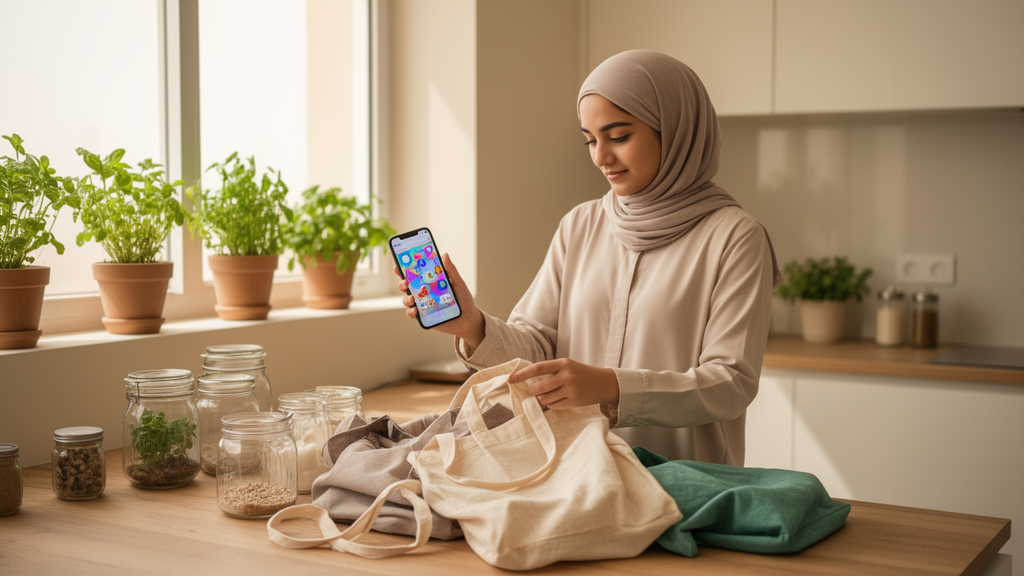
A six-month experiment in Qatar suggests that Instagram, often dismissed as a frivolous scroll of lifestyle content, can be engineered into a genuine educational environment capable of nudging people toward more sustainable lives. Researchers at Hamad Bin Khalifa University and Qatar’s Ministry of Education and Higher Education built a purpose-designed Instagram account called WeSustainQtr, delivered a structured sustainability curriculum through it, and then measured what happened to the knowledge, attitudes, and self-reported habits of its followers. Their findings, published in Frontiers in Education, offer one of the most detailed looks yet at whether social media can do more than spread awareness — whether it can actually help close the stubborn gap between what people believe about the environment and what they do about it.
The study arrives at a moment when the limits of conventional sustainability education have become increasingly apparent. Since the 17 Sustainable Development Goals were launched at the Rio Summit in 2015, governments have poured resources into embedding sustainability across school and university curricula, yet no nation has fully achieved those objectives. Many awareness campaigns, the researchers note, succeed at informing people but fail at converting information into sustained behavioral change. Meanwhile, young adults — Millennials and Generation Z — spend enormous portions of their lives on social platforms, making those platforms an obvious but underexplored venue for education. In the Gulf region specifically, where social media use is pervasive, rigorous studies of how these tools shape sustainable consumption have remained scarce.
The research team, led by Maryam Al-Hail and Mariem Fekih Zguir with Muammer Koç, adopted a Design-Based Research methodology, iterating through cycles of design, implementation, evaluation, and refinement. Their intervention was grounded in a multi-theoretical framework drawing on the Theory of Planned Behavior, which explains how attitudes, subjective norms, and perceived control shape intentions; Social Learning Theory, which holds that people acquire habits by observing peers and influencers; Norm Activation Theory, Bloom’s Digital Taxonomy, Narrative Engagement Theory, digital nudging, and Self-Regulation Theory. The theoretical scaffolding was not decorative: each theory mapped onto a concrete design feature of the Instagram account, from quizzes that activated social norms to visual stories that made abstract environmental concepts emotionally resonant.
Cultural adaptation was central to the design. The curriculum wove Islamic principles into sustainability messaging — khalifah (stewardship of the Earth), wasatiyyah (moderation and balance), and the avoidance of israf (wastefulness) — alongside the United Nations SDGs. Content was bilingual in Arabic and English and timed around culturally significant occasions such as Ramadan and Eid. Before launch, a pilot phase with ten stakeholders, including sustainability educators, graduate students, and digital content developers, prompted simplification of terminology, a minimalist visual style, and stronger storytelling. The researchers were transparent about their positionality: as insiders embedded in Qatari academic and governmental institutions, they acknowledged that their involvement could shape the instruments and interpretations, and they took steps such as third-author review of survey materials and stakeholder feedback to mitigate that influence.
The intervention itself ran for six consecutive months. Each week introduced a new sustainability theme — food waste, plastic pollution, textile waste, paper consumption, energy conservation, water conservation, and responsible purchasing — delivered through a coordinated mix of educational posts, reels, infographics, carousel posts, archived stories, quizzes, polls, discussion prompts, weekly challenges, and gamified elements. A baseline survey of 420 respondents conducted before any educational content was released doubled as a needs assessment, revealing misconceptions such as the widespread belief that recycling is the primary solution to environmental problems. That finding shaped the curriculum, which emphasized waste prevention and source reduction rather than recycling alone.
The baseline data also revealed a striking paradox about the audience. Most respondents spent at least two hours per day on Instagram, and Qatari respondents were especially heavy users, with 21 percent logging three to four hours daily and 10 percent exceeding six hours. Yet despite this saturation, sustainability content occupied only a minor slice of their feeds: while 69.4 percent followed at least one environmental account, most followed only a handful. The appetite was there — roughly 87 percent said they wanted to see more sustainability content, and 66.8 percent already followed sustainability influencers — suggesting an underserved demand that a well-designed account could meet.
After the six-month intervention, a post-survey distributed to the account’s 3,949 followers drew 415 responses, exceeding the statistically required minimum sample of 335. The engagement patterns went well beyond passive viewing: 68.48 percent followed the account, 58.79 percent liked posts, 30.30 percent commented, 26.58 percent tagged others, 26.06 percent participated in quizzes, and 23.64 percent created and shared their own sustainability content. Water conservation content drew the highest engagement at 56.36 percent, followed by food waste reduction and plastic waste reduction — a signal, the authors suggest, that people respond most strongly to practical, action-oriented material applicable to everyday life. University students showed particularly sustained participation, with about 60 percent reporting involvement in daily quizzes and weekly challenges, the highest proportion among the groups compared.
The self-reported behavioral outcomes were the study’s most striking results. Avoiding single-use plastics was the most commonly adopted new habit at 51.75 percent, followed by turning off lights and unplugging devices at 50.35 percent and proper recycling at 41.26 percent. Substantial minorities reported planning meals to reduce food waste (30.07 percent), using water-saving fixtures (31.47 percent), buying only what was necessary (31.47 percent), and repairing or donating clothing rather than discarding it (26.57 percent). Crucially, the changes rippled outward: 27.97 percent shared sustainable practices with others, 18.88 percent promoted sustainability on social media, and participants reported encouraging family and friends to adopt simple actions like switching off lights — a diffusion pattern consistent with Social Learning Theory, in which observable, low-effort behaviors spread most readily through social networks.
The researchers are careful about what these numbers can and cannot show. Because the surveys were anonymous to respect privacy norms in Qatar’s culturally sensitive context, pre- and post-responses could not be matched at the individual level, so the findings represent group-level trends rather than proof of individual behavioral change. An exploratory comparison of comparable behavioral domains, quantified with Cohen’s h effect sizes, found a small-to-moderate difference for recycling (0.44), a moderate negative value for food-waste reduction — likely because that behavior was already common at baseline, leaving less room for new adoption — and small positive differences for responsible purchasing and sharing sustainability practices. The authors also flag social desirability bias as a known limitation of self-reported pro-environmental behavior, noting that online engagement metrics should never be treated as direct evidence of offline change.
Even with those caveats, the study makes a compelling case that social media can function as far more than a broadcast channel for environmental messaging. By combining curriculum design, participatory learning, gamification, digital nudging, and culturally grounded storytelling, the WeSustainQtr intervention transformed a platform built for scrolling into one that supported perceived learning, engagement, and reported habit adoption. The team proposes a Holistic Integrated Framework for Digital Sustainable Learning extending these insights beyond Instagram, and recommends that universities integrate similar approaches into formal curricula, that policymakers partner with trusted local influencers — whom respondents rated as currently underperforming on sustainability despite their recognized potential — and that future research use longitudinal designs tracking the same individuals over time. The broader lesson may resonate far beyond Qatar: the intention-behavior gap in sustainability is not closed by awareness alone, but by education designed for the digital spaces where people already live.
Subject of Research: Using a culturally tailored Instagram intervention to promote sustainable consumption behaviors and sustainability education in Qatar
Article Title: From following to caring and acting: analyzing social media's role in shaping mindsets and transforming habits for sustainable living
Article References: Al-Hail, M., Fekih Zguir, M., & Koç, M. (2026). From following to caring and acting: analyzing social media's role in shaping mindsets and transforming habits for sustainable living. Frontiers in Education, 11, Article 1947733. https://doi.org/10.3389/feduc.2026.1947733
Image Credits: AI Generated
DOI: 10.3389/feduc.2026.1947733
Keywords: social media, Instagram, sustainability education, sustainable consumption, behavioral change, Qatar, higher education, gamification, digital nudging, Theory of Planned Behavior, Social Learning Theory, SDGs
Cite Scienmag News
Sloane Callahan. (October 19, 2026). Instagram as a Classroom: How a Six-Month Social Media Experiment Shifted Sustainability Habits in Qatar. Scienmag. https://scienmag.com/instagram-as-a-classroom-how-a-six-month-social-media-experiment-shifted-sustainability-habits-in-qatar/
Sloane Callahan. "Instagram as a Classroom: How a Six-Month Social Media Experiment Shifted Sustainability Habits in Qatar." Scienmag, 19 October 2026, https://scienmag.com/instagram-as-a-classroom-how-a-six-month-social-media-experiment-shifted-sustainability-habits-in-qatar/. Accessed 19 October 2026.
Sloane Callahan. "Instagram as a Classroom: How a Six-Month Social Media Experiment Shifted Sustainability Habits in Qatar." Scienmag. October 19, 2026. https://scienmag.com/instagram-as-a-classroom-how-a-six-month-social-media-experiment-shifted-sustainability-habits-in-qatar/


