


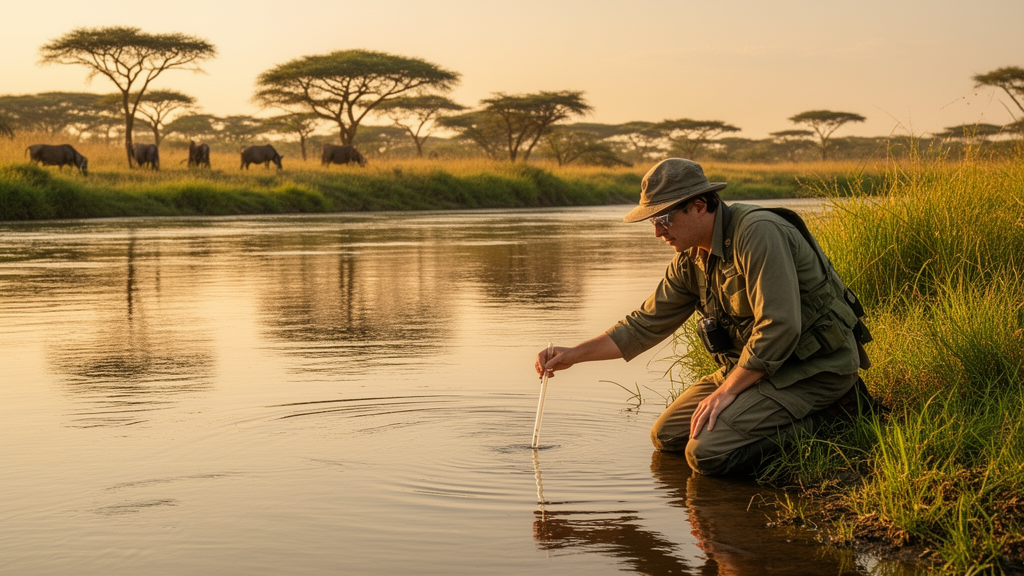
Sub-Saharan Africa holds some of the most extraordinary biodiversity on Earth, from the cichlid radiations of the African Great Lakes to the world’s second-largest rainforest in the Congo Basin. Yet a new systematic review published in Frontiers in Conservation Science reveals that the region’s use of one of modern conservation’s most powerful tools, environmental DNA (eDNA), is strikingly uneven, heavily skewed toward aquatic systems, and constrained by gaps that leave much of the continent’s life effectively invisible to genetic monitoring.
Environmental DNA works by capturing the genetic material organisms constantly shed into their surroundings through skin, mucus, faeces, gametes, and decaying tissue. Researchers can filter water or collect soil, amplify the recovered DNA with primers targeting specific gene regions, and sequence the result to identify which species were present, all without capturing, handling, or even seeing a single animal. The approach is faster, cheaper, less destructive, and often more sensitive than traditional surveys such as gillnetting, electrofishing, or pitfall trapping, and it can detect rare and elusive species that conventional methods routinely miss.
To understand how this technology has been applied across the region, a team of Tanzanian researchers led by Joshua James Ibrahim of the Nelson Mandela African Institution of Science and Technology conducted a systematic review following PRISMA 2020 guidelines. They searched Scopus and Google Scholar for peer-reviewed English-language studies published between January 2018 and April 2026 that used eDNA or DNA metabarcoding to assess aquatic or terrestrial biodiversity in sub-Saharan African countries. Only twenty-five studies met the criteria, a remarkably small evidence base for a region of more than forty countries containing roughly thirty-four global biodiversity hotspots.
The geographic and taxonomic patterns in those studies are stark. Southern Africa dominated with twelve studies, or forty-eight percent of the total, driven largely by South Africa’s six studies. East Africa contributed seven, West Africa five, and Central Africa just two, both from the Democratic Republic of Congo and focused on pathogens. Notably, the Congo Basin, one of the planet’s most important rainforests, has no published eDNA biodiversity studies at all as of April 2026. Aquatic ecosystems accounted for eighty-eight percent of the research, fish were the target taxon in forty-eight percent of studies, and not a single study was dedicated to arthropods, the insects, spiders, and other invertebrates that make up the majority of the region’s undescribed animal species.
Methodologically, the field has settled into a narrow groove. Twelve percent of studies used the mitochondrial 12S rRNA marker, typically with fish-tuned primers such as MiFish or Teleo, and seventy-two percent relied on Illumina sequencing platforms. Water was the sampling medium in ninety-two percent of studies, with median field replication of three samples per site. Only sixteen percent of studies included seasonal replication, a serious omission for organisms whose communities shift dramatically across wet and dry seasons. This technical conformity around fish-targeted vertebrate markers has, in practice, narrowed the taxonomic reach of the region’s entire eDNA research program.
The single most cited limitation, reported in sixty-eight percent of studies, was incomplete reference databases, the curated libraries of DNA barcodes needed to match environmental sequences to named species. The consequences are quantifiable. In Tanzania’s Rufiji catchment, researchers found that twenty-nine of the ninety-one fish species estimated to occur there had no 12S reference sequence at all, meaning they were undetectable by eDNA regardless of how carefully the water was sampled. In South Africa, twenty-three percent of freshwater fish species lack COI barcodes and forty-one percent lack 12S barcodes. For arthropods the situation is worse: barcode coverage in public databases falls below five percent for many agriculturally critical groups such as parasitoid wasps, wild bees, and dung beetles.
Where reference libraries exist, the technology performs impressively. Studies detected sixty-six fish species in the Rufiji River, recovered twenty-seven elasmobranch species including twelve new records in Mauritania’s Banc d’Arguin National Park, and identified the invasive Nile perch in Nigerian waters. One Tanzanian study found that a single water sample could capture roughly forty percent of the species observed across fifty samples, suggesting that modest, well-replicated sampling can recover much of a detectable community. Comparisons with traditional methods show that eDNA and conventional surveys each detect species the other misses, so researchers increasingly view eDNA as a complement to, rather than a replacement for, nets and traps.
Logistics and capacity pose their own challenges. Field teams contended with security concerns, tidal mangrove channels, cold-chain failures, and filtration clogging, with one team averaging only 202 millilitres filtered per sample. Contamination risks surfaced in thirty-two percent of studies, in some cases requiring species to be excluded when they dominated extraction blanks. Perhaps most tellingly, seventy-six percent of the reviewed studies included non-African co-authors, and only twenty percent were led by Africa-based first authors, with several studies possible only through international funding. This capacity gap feeds a circular dependency: without local taxonomists, African reference barcodes cannot be produced; without barcodes, eDNA cannot assign species; and without detection success, funding for taxonomy remains scarce.
The review’s authors argue the way forward is clear. Reference database development should be prioritised for overlooked taxa, particularly agricultural pests and pollinators, with proposed initiatives modelled on existing global barcoding efforts. Emerging low-cost, portable sequencers such as Oxford Nanopore’s MinION, demonstrated in Nigeria for roughly one thousand dollars in capital cost compared with hundreds of thousands for Illumina systems, could democratise sequencing capacity and enable same-day pest detection in farm settings. Standardized multi-marker protocols, rigorous replication and controls, mandatory open-data deposit, and sustained Africa-led training and infrastructure investment round out the recommendations.
The findings arrive at a critical moment. Sub-Saharan Africa has lost about half its wetlands since 1900, and freshwater vertebrate populations declined by eighty-three percent between 1970 and 2016, the steepest drop of any continent. With fewer than five percent of African insect species formally described, the region cannot afford to leave entire ecosystems and taxonomic groups outside the reach of modern monitoring. The twenty-five studies synthesized here prove that eDNA works across African rivers, lakes, estuaries, and soils; the open question, the authors conclude, is whether funders and governments will invest in closing the reference gap and shifting the technology from its aquatic stronghold to the terrestrial and arthropod diversity on which the region’s food security depends.
Subject of Research: Applications and limitations of environmental DNA metabarcoding for biodiversity monitoring in sub-Saharan Africa
Article Title: Environmental DNA (eDNA) applications for biodiversity monitoring across countries in the Sub-Saharan African region: a systematic review
Article References: Ibrahim, J. J., Baino, A., Ndakidemi, B., Mbega, E., & Mkindi, A. (2026). Environmental DNA (eDNA) applications for biodiversity monitoring across countries in the Sub-Saharan African region: a systematic review. Frontiers in Conservation Science, 7, Article 1941471. https://doi.org/10.3389/fcosc.2026.1941471
Image Credits: AI Generated
DOI: 10.3389/fcosc.2026.1941471
Keywords: environmental DNA, eDNA, DNA metabarcoding, biodiversity monitoring, Sub-Saharan Africa, reference databases, conservation, freshwater fish, arthropods, terrestrial biodiversity, capacity building, Illumina sequencing
Cite Scienmag News
Margaret Porter. (October 19, 2026). Environmental DNA Reveals a Skewed Picture of Sub-Saharan Africa’s Biodiversity. Scienmag. https://scienmag.com/environmental-dna-reveals-a-skewed-picture-of-sub-saharan-africas-biodiversity/
Margaret Porter. "Environmental DNA Reveals a Skewed Picture of Sub-Saharan Africa’s Biodiversity." Scienmag, 19 October 2026, https://scienmag.com/environmental-dna-reveals-a-skewed-picture-of-sub-saharan-africas-biodiversity/. Accessed 19 October 2026.
Margaret Porter. "Environmental DNA Reveals a Skewed Picture of Sub-Saharan Africa’s Biodiversity." Scienmag. October 19, 2026. https://scienmag.com/environmental-dna-reveals-a-skewed-picture-of-sub-saharan-africas-biodiversity/


