


In recent years, cancer immunotherapy, exemplified by PD-1 and its ligand PD-L1 blockade, has made remarkable advances. But while immunotherapy drugs offer new treatment possibilities, only about 20% to 40% of patients respond to these treatments. The majority either don’t respond or develop drug resistance. Researchers are now looking for ways to enhance the scope of tumor immunotherapy in order to benefit a wider range of patients.

Credit: Insilico Medicine
In recent years, cancer immunotherapy, exemplified by PD-1 and its ligand PD-L1 blockade, has made remarkable advances. But while immunotherapy drugs offer new treatment possibilities, only about 20% to 40% of patients respond to these treatments. The majority either don’t respond or develop drug resistance. Researchers are now looking for ways to enhance the scope of tumor immunotherapy in order to benefit a wider range of patients.
One such avenue is through the protein tyrosine phosphatase non-receptor type 2 (PTPN2) and its close superfamily member, PTPN1, identified in previous research as crucial modulators involved in the regulation of immune cells signaling pathways that promote tumorigenesis by attenuating tumor-directed immunity. While promising, the development of PTPN2/PTPN1 inhibitors has faced challenges as a result of unfavorable pharmacokinetics due to the highly cationic active site and the relatively shallow nature of the protein surface.
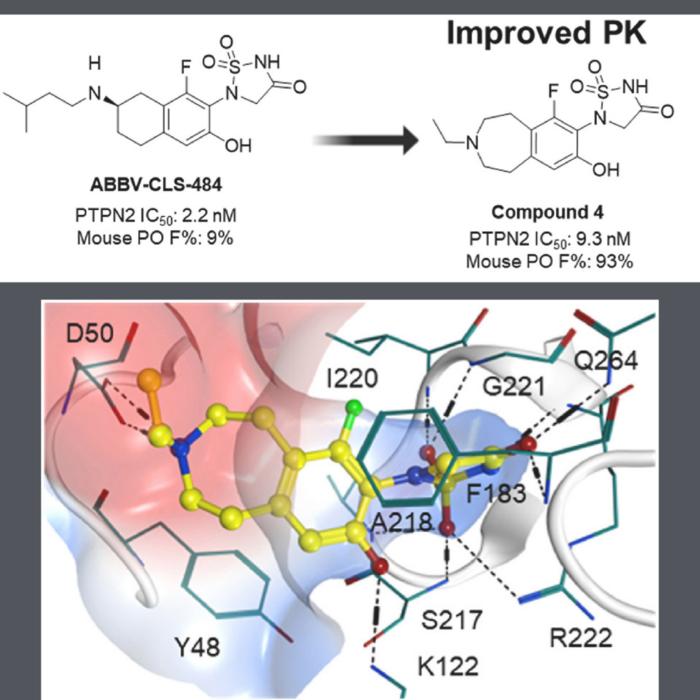
In a significant milestone, researchers at Abbvie discovered the dual PTPN2/N1 inhibitor ABBV-CLS-484 through structure-based drug design and optimization of drug-like properties. Now, clinical stage artificial intelligence (AI)-driven drug discovery company Insilico Medicine (“Insilico”) has initiated a program with a fast-follow strategy to design a novel PTPN2/N1 inhibitor with drug-likeness properties and in vivo oral absorption, supported by the Company’s generative AI drug design engine Chemistry42. The research was published in the European Journal of Medicinal Chemistry on April 5.
Scientists inputted the structure of the known PTPN2/N1 inhibitor as a reference compound to Chemistry42 as a starting point and generated a series of novel PTPN2/N1 inhibitors based on ligand-based drug design strategy. They further optimized and synthesized the most promising molecules and obtained candidates with desirable ADME properties. Insilico’s compound demonstrated enhanced oral absorption, systemic exposure, and equivalent biological activities compared to the reference compound in in vitro studies. Furthermore, Insilico’s compound demonstrated the same efficacious dose as the reference compound in murine model.
“One of the most significant advances in the research was validating the fast follow ability of Chemistry42, the molecular generation and design engine of Pharma.AI, which allows users to rapidly improve existing molecules with more desirable properties,” said Xiao Ding, PhD, vice president and head of medicinal chemistry of Insilico Medicine. “In this paper, we reported a novel PTPN2/PTPN1 inhibitor demonstrating nanomolar inhibitory potency, good in vivo oral bioavailability, and robust in vivo antitumor efficacy. Further investigation is currently ongoing.”
Insilico Medicine is a pioneer in using generative AI for drug discovery and development. The Company first described the concept of using generative AI for the design of novel molecules in a peer-reviewed journal in 2016. Then, Insilico developed and validated multiple approaches and features for its generative adversarial network (GAN)-based AI platform and integrated those algorithms into the commercially available Pharma.AI platform, which includes generative biology, chemistry, and medicine and has been used to produce a robust pipeline of promising therapeutic assets in multiple disease areas, including fibrosis, cancer, immunology and aging-related disease, a number of which have been licensed. Since 2021, Insilico has nominated 18 preclinical candidates in its comprehensive portfolio of over 30 assets and has advanced six pipelines to the clinical stage. In March 2024, the Company published a paper in Nature Biotechnology that discloses the raw experimental data and the preclinical and clinical evaluation of its lead drug – a potentially first-in-class TNIK inhibitor for the treatment of idiopathic pulmonary fibrosis discovered and designed using generative AI currently in Phase II trials with patients.
About Insilico Medicine
Insilico Medicine, a global clinical-stage biotechnology company powered by generative AI, connects biology, chemistry, and clinical trial analysis using next-generation AI systems. The company has developed AI platforms that utilize deep generative models, reinforcement learning, transformers, and other modern machine learning techniques for novel target discovery and generating novel molecular structures with desired properties. Insilico Medicine is developing breakthrough solutions to discover and develop innovative drugs for cancer, fibrosis, immunity, central nervous system diseases, infectious diseases, autoimmune diseases, and aging-related diseases. www.insilico.com
Journal
European Journal of Medicinal Chemistry
Article Title
Synthesis and structure-activity optimization of azepane-containing derivatives as PTPN2/PTPN1 inhibitors
Article Publication Date
5-Apr-2024
Cite Scienmag News
Nathaniel Bowman. (April 11, 2024). Insilico Medicine develops novel PTPN2/N1 inhibitor for cancer immunotherapy using generative AI. Scienmag. https://scienmag.com/insilico-medicine-develops-novel-ptpn2-n1-inhibitor-for-cancer-immunotherapy-using-generative-ai/
Nathaniel Bowman. "Insilico Medicine develops novel PTPN2/N1 inhibitor for cancer immunotherapy using generative AI." Scienmag, 11 April 2024, https://scienmag.com/insilico-medicine-develops-novel-ptpn2-n1-inhibitor-for-cancer-immunotherapy-using-generative-ai/. Accessed 4 September 2026.
Nathaniel Bowman. "Insilico Medicine develops novel PTPN2/N1 inhibitor for cancer immunotherapy using generative AI." Scienmag. April 11, 2024. https://scienmag.com/insilico-medicine-develops-novel-ptpn2-n1-inhibitor-for-cancer-immunotherapy-using-generative-ai/

