


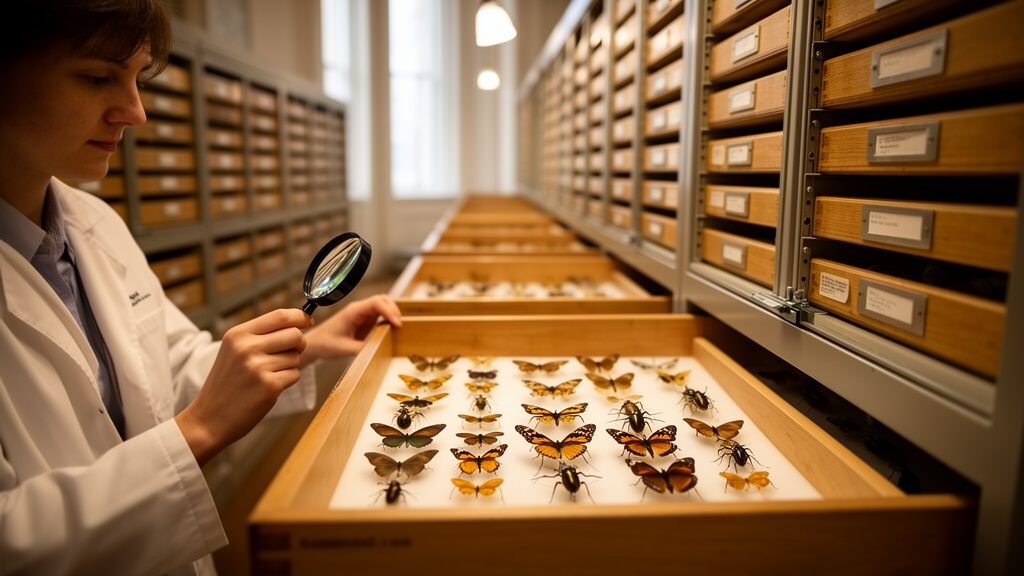
At the KwaZulu-Natal Museum in Pietermaritzburg, South Africa, some of the most effective science communication tools are not touchscreens or virtual reality installations but simple wooden drawers filled with pinned insects. These entomology outreach drawers, described in a recent article in the journal Natural History Collections and Museomics, have become the centrepiece of a public engagement programme that reached more than 3,500 people across 15 events in a single financial year. The drawers travel to schools, universities, shopping malls, festivals and career expos, carrying with them a slice of one of the largest and most representative collections of Afrotropical flies in the Southern Hemisphere.
The museum itself is no small operation. Opened in 1904, it is one of four national museums in South Africa and welcomes over 80,000 visitors annually, including more than 400 school visits. Its Entomology Department, established when Dr B. R. Stuckenberg was appointed in 1953, houses approximately 250,000 specimens, with a strong emphasis on Diptera, the order of flies that has defined the department’s research identity for decades. But research specimens locked away in a scientific collection do little to inspire the public unless someone deliberately carries them out into the world, which is precisely what the outreach programme sets out to do.
The drawers fall into two distinct categories, and the distinction matters. Some are purpose-built educational displays, complete with artistic backdrops produced by the museum’s Exhibitions Department and carefully curated information about the specimens they contain. Others are something quite different: drawers of pinned but mostly unlabelled specimens that would otherwise have been discarded, because without collecting information they cannot enter the scientific collection. Showing these data-less specimens alongside the polished displays gives audiences an honest picture of what a research collection actually looks like behind the scenes, stripped of backdrops and interpretive text.
Running such a programme is not without its difficulties. The staff who carry out most of the outreach are typically drawn from the Marketing and Education Departments, and they have not always been trained in what to say about the entomology drawers. The museum takes on interns who need work experience to complete their degrees or diplomas, creating a regular turnover of personnel. The Entomology Department itself has only three staff members, far too few to attend every event, so when an entomologist does join an outreach team, the occasion doubles as an impromptu training session, with colleagues and interns asking questions and learning about the display drawers on the spot.
Language adds another layer of complexity. South Africa has 11 official languages, and in the region around Pietermaritzburg the two most commonly spoken are English and isiZulu. A large proportion of the school children who attend outreach events speak isiZulu as their home language, with English as a second language. Having both English and isiZulu speakers on the outreach team is therefore essential, particularly for younger children who cannot yet communicate in English. The museum acknowledges that its current drawers carry no isiZulu text, but plans to include isiZulu labels in the new drawers it produces.
The public response to a drawer full of dead insects is famously unpredictable. Feedback ranges from an emphatic declaration of disgust at bugs to genuine wonder at what is on display. School groups span the full spectrum, from blank stares of children who have been dragged along against their will to eager questioners with a real interest in natural science. Career expo days tend to attract the most positive audiences, since these are school children contemplating careers in the natural sciences or university students scouting job opportunities after graduation. Among the general public, two questions come up more than any others: are the specimens real, and are they dead.
Experience has taught the entomology team what makes a drawer work. Themed drawers, such as insects found in compost heaps or in rivers, reliably draw a good response, as do drawers that explain a single concept, like camouflage or the comparison between moths and butterflies. Smaller specimens benefit from being displayed together in larger numbers, otherwise it becomes difficult to illustrate anything meaningful about them. Practical considerations matter too: Perspex lids have replaced glass, which can break in transit, and lids that close tightly or drawers taped shut guard against eager young hands trying to open them mid-event. Keeping the associated information simple, the team has found, means a single drawer can reach audiences of all ages without needing to be redesigned for each one.
Replenishing the drawers poses its own scientific dilemma. Specimens wear out and get damaged over time, but new insect material is nowadays collected for research rather than for education, so suitable replacements are not always easy to come by. When building a new drawer, curators must decide whether it will follow a theme or simply represent the insect orders, and how many specimens to include. The museum is also exploring the production of an information leaflet to train interns and staff who participate in outreach events, aiming to make every team member confident enough to talk about the specimens even when no entomologist is present.
There is a cultural dimension to the future plans as well. A number of superstitions surround certain insects in isiZulu culture, one example being the belief that a praying mantid in your home represents the ancestors visiting. By incorporating these insects and the stories attached to them into future outreach drawers, the museum hopes to connect with more people on their own cultural terms, turning entomology from a foreign discipline into something rooted in local knowledge. Meanwhile, the museum’s active social media presence on Instagram under the handle @kznmuseum keeps promoting both the events and the institution itself to audiences who never set foot in the building.
Judged by raw numbers, the programme is working. Fifteen outreach events in the past financial year, with the entomology drawers in tow, engaged over 3,500 people, a figure that counts only those who interacted directly with the stand rather than the total attendance at the events. For a department of three staff members relying on borrowed hands and a handful of wooden boxes, that is a remarkable return on investment, and a demonstration that sometimes the most viral science communication tool is a drawer of real insects, opened carefully, explained patiently, and carried to wherever the public happens to be.
Subject of Research: Entomology outreach at the KwaZulu-Natal Museum
Article Title: Entomology outreach drawers – the good, the bad and the beneficial
Article References: Williams, K. A. (2025). Entomology outreach drawers – the good, the bad and the beneficial. Natural History Collections and Museomics, 2, 1-6. https://doi.org/10.3897/nhcm.2.152797
Image Credits: AI Generated
Keywords: entomology, museum outreach, KwaZulu-Natal Museum, science communication, insect collections, isiZulu, Diptera, public engagement, South Africa, natural history, outreach, drawers
Cite Scienmag News
Gavin Prescott. (October 19, 2026). Inside the Insect Drawers That Bring Museum Science to Thousands. Scienmag. https://scienmag.com/inside-the-insect-drawers-that-bring-museum-science-to-thousands/
Gavin Prescott. "Inside the Insect Drawers That Bring Museum Science to Thousands." Scienmag, 19 October 2026, https://scienmag.com/inside-the-insect-drawers-that-bring-museum-science-to-thousands/. Accessed 19 October 2026.
Gavin Prescott. "Inside the Insect Drawers That Bring Museum Science to Thousands." Scienmag. October 19, 2026. https://scienmag.com/inside-the-insect-drawers-that-bring-museum-science-to-thousands/


