


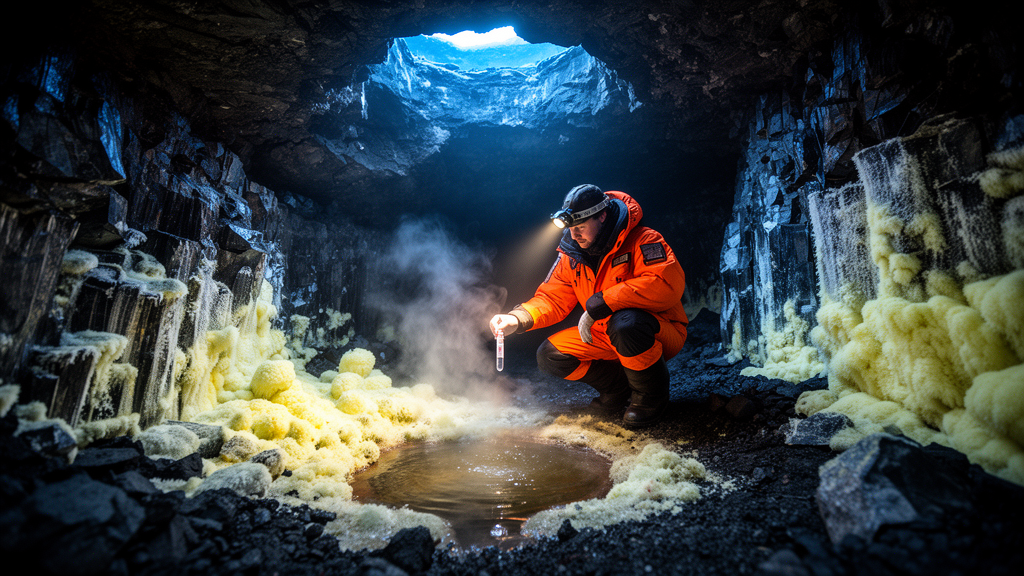
Deep beneath the ice of Job Glacier on Mount Meager in southwestern British Columbia, volcanic gases seep through a network of fumarole-carved ice caves, feeding a microbial ecosystem that scientists say has no known equivalent in North America. A new study published in Frontiers in Geochemistry describes the first detailed biogeochemical survey of this extraordinary environment, known as Q̓welq̓welústen in the language of the Líĺwat First Nation, a name meaning “cooked face place” or “cooked fire place.” The research, led by Jared Clance, Jacob Shaffer, and Jill Mikucki of the University of Tennessee together with colleagues at the Jet Propulsion Laboratory and Simon Fraser University, reveals a thriving community of chemosynthetic microbes sustained by sulfur-rich volcanic exhalations, and identifies the site as a compelling analog for icy ocean worlds such as Saturn’s moon Enceladus.
Mount Meager is an active, glacier-clad stratovolcano complex in the Garibaldi Volcanic Belt, part of the northern Cascade Volcanic Arc. Its last major explosive eruption occurred roughly 2,360 years ago, but the mountain remains restless, producing frequent landslides and venting volcanic gases through fumaroles on its glaciated slopes. The volcano is classified as a Very High threat volcano in Canada. Where fumarolic heat melts its way through glacial ice, void spaces form beneath the surface, creating glaciovolcanic cave systems. Only about six such cave areas have been described on Earth, and Mount Meager’s is unique among them in steadily releasing sulfur-rich gases rather than the carbon dioxide-dominated emissions documented at Mount Rainier, Mount St. Helens, and Mount Erebus.
In September 2022, a three-day field expedition brought expert cave explorers equipped with specialized self-contained breathing apparatus into the Job Glacier cave system. The hazards were considerable: darkness, technical glaciated terrain, icefall, and dangerously toxic concentrations of volcanic gases. LiDAR mapping and tacheometric surveying revealed a single interconnected system of subglacial passages with two entrances and a depth range of 59 meters, containing two distinct fumarolic areas, heated bedrock, a subglacial stream, and pools of standing water. Fumarole temperatures measured by thermal camera ranged from 28 to over 90 degrees Celsius, while the surrounding ice walls hovered between minus 3 and plus 2 degrees, a striking thermal contrast at the rock-ice boundary.
Gas measurements taken at the source were dramatic. Near the fumaroles, hydrogen sulfide exceeded 200 parts per million, sulfur dioxide exceeded 100 parts per million, carbon dioxide reached approximately 5,200 parts per million, and carbon monoxide measured about 230 parts per million. Methane was undetected. The sulfur isotope composition of the hydrogen sulfide, with a δ34S value near zero per mil, points to a deep magmatic origin for the sulfide, consistent with gases exsolving from magma at depth. Spectral analyses of yellow crystal-like deposits within the cave identified native elemental sulfur, along with ferric oxyhydroxides and alteration minerals such as goethite and illite, all hallmarks of active hydrothermal systems.
The geochemistry of cave sediments and waters told a complementary story. Sediments and water inside the cave were acidic, with pH values ranging from 3.6 to 6.0, and rich in sulfate, which ranged from 5.3 to 185.2 milligrams per liter, likely produced by the oxidation of fumarolic hydrogen sulfide. Most other major ions were below detection. Snow at the cave entrance was more acidic and sulfate-bearing than snow collected 50 meters away, which had a near-neutral pH of 7.6 and no detectable sulfate, clear evidence that fumarole exhalations are chemically transforming the surrounding snowpack. Water inside the cave appears to originate from snowmelt, as indicated by the strongly negative hydrogen and oxygen isotope values typical of meteoric precipitation.
Life was abundant and active throughout the system. Direct microscopic counts revealed between roughly 34,000 and 6.35 million cells per gram of sediment, and adenosine triphosphate measurements, a proxy for metabolic activity, were detectable in every snowmelt and water sample. The highest ATP concentration of the entire study, about 12,739 picomolar, came from a geothermally heated stream inside the cave, suggesting that flowing water provides particularly favorable conditions for metabolically active cells. The surrounding snowpack hosted spectacular blooms of pigmented snow algae, with chlorophyll a concentrations up to two orders of magnitude higher than those reported for snowpack at Mount Baker, a nearby glaciated volcano without comparable fumarolic influence at the sampling sites.
The microbial community composition set Mount Meager apart from other glacial environments. Green algae of the phylum Chlorophyta, including the genera Chlamydomonas and Chloromonas, dominated the snowpack eukaryotes, consistent with other Pacific Northwest glaciers. But the bacteria were another matter entirely. Firmicutes were the most abundant bacterial phylum across all samples, reaching 98.7 percent of reads at one fumarole-adjacent site, whereas other glacier and snowpack studies typically report abundant Sphingobacteria, Betaproteobacteria, and Alphaproteobacteria. Sulfur-cycling taxa were prominent: Acidithiobacillaceae made up 36.1 percent of reads at one cave site, and putatively thermophilic archaea of the Thermoplasmatales group A10, previously found in hot springs and acid mine drainage, were detected in the warmer cave sediments but not in the snowpack.
Shotgun metagenomic sequencing of sediment from the lower cave painted a picture of extraordinary metabolic versatility. The assembled metagenome contained complete gene pathways for three autotrophic carbon fixation strategies, the Calvin-Benson-Bassham cycle, the Wood-Ljungdahl pathway, and the Arnon-Buchanan pathway, along with complete dissimilatory sulfate reduction and sulfur oxidation via the Sox system. Notably, genes for photosystems were absent, confirming that the community relies on chemosynthesis rather than photosynthesis in the sunless depths. The researchers suggest that niche partitioning around energy availability shapes which carbon fixation pathway each organism employs, since the Wood-Ljungdahl and Arnon-Buchanan pathways require far less energy per mole of carbon fixed than the Calvin cycle. Individual genome bins revealed further specializations, including potential sulfur disproportionation, anaerobic carbon monoxide oxidation, and nitrate reduction.
Carbon isotope values added independent evidence of in-situ microbial activity. Organic matter in the sediments carried δ13C values between minus 29.0 and minus 26.1 per mil, typical of biological biomass on Earth, and dissolved organic carbon in snowmelt was even more depleted, down to minus 37 per mil, which the authors attribute to local microbial carbon transformations rather than imported soil organic matter. Together with the cell counts, ATP measurements, and functional genes, the isotope data support the conclusion that both heterotrophic and autotrophic metabolisms are actively cycling carbon in the cave sediments, driven ultimately by the chemical energy supplied by volcanic gases.
Beyond its value for understanding Earth’s cryosphere, the Mount Meager cave system offers a rare terrestrial analog for astrobiology. On Enceladus and possibly Europa, cryovolcanic plumes transport material from subsurface oceans through the icy shell and deposit it on the surface, where it could carry biomarkers or even cells from below. While cryovolcanism does not occur on Earth, glaciovolcanic fumaroles perform an analogous function, venting reduced gases and subsurface materials through ice to a photic, oxidizing surface environment. Cassini’s detection of molecular hydrogen and methane in the Enceladus plume provided evidence of seafloor hydrothermal activity, and thorough characterization of terrestrial systems like Mount Meager can help scientists develop and test the mission concepts, instruments, and operational strategies needed for future life-detection missions to the icy ocean worlds of the outer solar system.
Subject of Research: Biogeochemistry and microbiology of the sulfidic glaciovolcanic cave system on Mount Meager, British Columbia
Article Title: Biogeochemistry of the rare sulfidic glaciovolcanic cave system on Mount Meager, British Columbia, Canada
Article References: Clance, J. J., Shaffer, J. M. C., Cable, M. L., Stenner, C., Williams-Jones, G., Szynkiewicz, A., Paton, M., Graham, K., Vinnes, O., & Mikucki, J. A. (2024). Biogeochemistry of the rare sulfidic glaciovolcanic cave system on Mount Meager, British Columbia, Canada. Frontiers in Geochemistry, 2, Article 1410338. https://doi.org/10.3389/fgeoc.2024.1410338
Image Credits: AI Generated
DOI: 10.3389/fgeoc.2024.1410338
Keywords: glaciovolcanism, Mount Meager, glacier caves, fumaroles, hydrogen sulfide, chemosynthesis, microbiology, biogeochemistry, snow algae, astrobiology, Enceladus, ocean worlds
Cite Scienmag News
Morgan Morrow. (October 17, 2026). Inside Canada’s Sulfidic Ice Cave: A Volcanic Microbial World That Mirrors Enceladus. Scienmag. https://scienmag.com/inside-canadas-sulfidic-ice-cave-a-volcanic-microbial-world-that-mirrors-enceladus/
Morgan Morrow. "Inside Canada’s Sulfidic Ice Cave: A Volcanic Microbial World That Mirrors Enceladus." Scienmag, 17 October 2026, https://scienmag.com/inside-canadas-sulfidic-ice-cave-a-volcanic-microbial-world-that-mirrors-enceladus/. Accessed 17 October 2026.
Morgan Morrow. "Inside Canada’s Sulfidic Ice Cave: A Volcanic Microbial World That Mirrors Enceladus." Scienmag. October 17, 2026. https://scienmag.com/inside-canadas-sulfidic-ice-cave-a-volcanic-microbial-world-that-mirrors-enceladus/


